
 Worksheets
7E : Mixtures and Separation
Total questions: 60
Worksheet time: 44mins
Which of the following are mixtures? (choose 2)
carbon dioxide
soil
diamond
air
Which of the following are pure substances? (choose 2)
chocolate flavoured milk
purified water
vitamin C
soil
Mayonnaise is a mixture containing tiny oil droplets spread throughout vinegar. These two components are:
both gases
soild and liquid
solid and gas
both liquids
Why is mud is a mixture?
Because the soil particles in it are spread throughout water particles and no new substances have been formed.
Because the soil particles in it are mixed together
Because mud can be easily mixed with a wooden stick
Because the soil particles in it are clumped together
Is vinegar a mixture?
Yes because it is made of two substances- water and acetic acid
No because it is made of one substance
No because it is only made of liquid particles
No because it is only made of sour particles
What is a mixture?
It is a combination of two or more substances that keep their identities
It is a combination of two or more substances that reacts to become a compound

This is an example of a
Solution
Mixture
This is a type of mixture where one substance dissolves into another
Solution
Suspension
Compound
Colloid

This tool is used for separating solids from liquids or large particles from fine particles
Hands
Sieve
Boiling water
Evaporation


This picture represents which of the following?
element
compound
mixture
Lemonade, coke, and salt water are all examples of _________.
Solutions
Mixtures
Pure Substances
Factors of solubility
A combination of substances that dissolve into one another--they are evenly mixed so that individual parts cannot be seen or separated.
solutions
mixtures
observations
________ is the ability to dissolve in water.
Conductivity
Magnetism
Solubility
Reflectivity
A solution is made when one substance _________ in another.
settles at the bottom
moves
dissolves
is suspended
Which one of the following solids is insoluble (can't dissolve) in water?
sugar
sand
instant coffee
salt
In a saltwater solution, the salt is the __________.
solvent
molecule
part
solute
In a saltwater solution, the water is the _________
solvent
mixture
combination
solute

Is oil and water a mixture or a solution?
Mixture
Solution
In a mixture, the properties of a substance ______________
do not change
change forms
turn into a liquid
become solid
Mixtures are _________
easily separated
impossible to separate
always solutions
only liquids
When a substance dissolves, that means its particles _________.
spread out evenly
disappear
turn into water
True or false: cold water causes sugar to dissolve more easily than warm water
True
False

Water is the univeral ____.
solute
solvent
solution
solute + solvent =
solution
equation
Solutes dissolve quicker if you stir them.
true
false
Define the term soluble.
Can dissolve in water
Cannot dissolve in water
Partially dissolves in water
Define the term insoluble.
Can dissolve in water.
Cannot dissolve in water.
Partially dissolves in water.
What happens when salty water is boiled?
The salt becomes a new compound and water evaporates as it has a low boiling point
The water evaporates and the salt remains in the beaker as it has a high melting point
The water becomes a new compound and evaporates while salt remains in the beaker
The water will disappear and the salt remains in the beaker as it is a solid
Which of the following is a correct statement about distillation
The components of the mixture have different densities
The components of the mixture have different melting points
The components of the mixture have different boiling points
The components of the mixture form a heterogeneous mixture
What is the correct order for obtaining salt from a mixture of sand and salt?
Dissolving in water - filtration – evaporation
Evaporation - filtration - dissolving in water
Filtration - dissolving in water - evaporation
Dissolving in water – evaporation - filtration
The process used to separate heterogeneous mixtures of solids and liquids is called
filtration
crystallization
distillation
chromatography

Name the separation technique shown in the diagram
Filtration
Chromatography
Centrifugation
Distillation
Which are methods of separating dissolved particles from the liquid they are dissolved in?
Filtration, separation funnel, crystallization
Filtration, distillation, crystallization
Evaporation, filtration, crystallization
Evaporation, distillation, crystallization
What separation method is used to separate substances by their boiling point?
Filtration
Evaporation
Crystallization
Distillation
Which one of the following techniques would best be used to separate soil and water?
crystallization
distillation
Filtration
Chromatography
The process of separating small, insoluble solids from a liquid using a filter
filtration
evaporation
sieving
desalination
The sand that is left on the filter paper is known as
filtrate
semi-permeable
residue
sieving
The process of changing a liquid to a gas is called
evaporation
filtration
sieving
decanting
Insoluble solids like sand and flour can be separated from water by
decanting
sieving
filtration
evaporation
For paper chromatography to work,
the dyes must have different boiling points.
the dyes must have different solubilities in the solvent.
the starting line on the chromatogram must be drawn using pen.
The starting line must be below the level of the solvent.
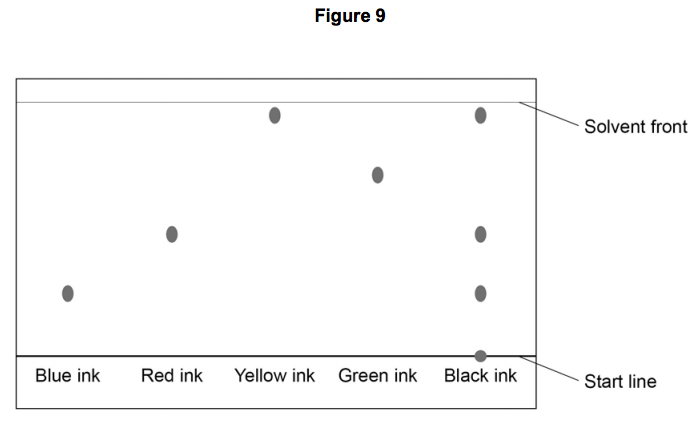
Which ink is most soluble?
Blue
Red
Yellow
Green
Which ink is a mixture?
Blue
Red
Yellow
Black
Referring to the chromatogram, black ink contains
Blue, red and yellow ink only
Blue, red, yellow and green ink
Blue and yellow ink
Black ink only

What is the separation technique in the picture?
Filtration
Crystallization
Using Funnel
Chromatography

What is the separating technique in the picture?
Evaporation
Sublimation
Chromatography
Filtration

What is the separation technique in the picture?
Evaporation
Centifugation
Decantation
Crystallization

We can separate salt from water using filtration?
True
False
When no more solute dissolves the solution is _________
supersaturated
unsaturated
saturated
supercalifragilisticexpialidocious

