wayground logo

Free Printable Worksheets

NEW

Font size

S
M
L
XL
Worksheets

Unit 6 Assessment and Vocabulary Review

Total questions: 55

Worksheet time: 1hrs 22mins

Name
Class
Date
1.
What is the water cycle?
a)
the 3 forms of water
b)
the movement of water on, above, or below the surface of the Earth
c)
when water melts
d)
when clouds form
2.
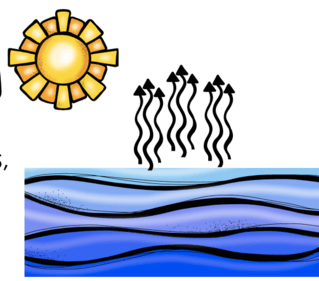
What part of the water cycle does this picture show?
a)
condensation
b)
precipitation
c)
evaporation
3.
Which of these is an example of precipitation?
a)
snow
b)
air
c)
clouds
d)
vapor
4.
Which best explains why runoff is important?
a)
It returns water to other locations on Earth
b)
It increases the chance of flooding
c)
It makes evaporation occur faster
d)
It increases condensation
5.
What is it called when plants give off water vapor as a waste product?
a)
condensation
b)
evaporation
c)
sublimation
d)
transpiration
6.
When water _________, dew forms.
a)
Melts
b)
Evaporates
c)
Condenses
d)
Precipitates
7.
What part of the water cycle does this picture show?
a)
condensation
b)
precipitation
c)
evaporation
8.
What could happen when a drop of water falls back to earth?
a)
it goes underground then into oceans,lakes, or rivers
b)
it goes into your mouth
c)
it goes underground
d)
it goes to the beach
9.
This is the layer where most commercial jet airliners fly.
a)
Troposphere
b)
Stratosphere
c)
Mesosphere
d)
Thermosphere
10.

What happens to the density (thickness)/air pressure of the air as you leave Earth?

a)

air gets thicker

b)

air gets thinner

c)

air stays the same

d)

air disappears

11.
This is the layer where meteors, or shooting stars, burn up.
a)
Troposphere
b)
Stratosphere
c)
Mesosphere
d)
Thermosphere
12.
Where you will find the ozone layer.
a)
stratosphere
b)
thermosphere
c)
exosphere
d)
mesosphere
13.
Where weather occurs.
a)
stratosphere
b)
thermosphere
c)
troposphere
d)
mesosphere
14.
Where we live.
a)
stratosphere
b)
thermosphere
c)
troposphere
d)
mesosphere
15.
The hottest layer.
a)
troposphere
b)
thermosphere
c)
exosphere
d)
mesosphere
16.

Which order is correct from the earth to space?

a)

thermosphere

troposphere

exosphere

mesosphere

stratosphere

b)

thermosphere

troposphere

stratosphere

exosphere

mesosphere

c)

exosphere

thermosphere

mesosphere

stratosphere

troposphere

d)

troposphere

thermosphere

troposphere

stratosphere

exosphere

mesosphere

17.
What does the earth's atmosphere do?
a)
help to regulate the temperature on Earth
b)
Help UV rays to reach the Earth's surface
c)
Creates meteors in the sky
d)
Keep ocean waters cold
18.
As you go higher in the troposphere, the temperature _______________.
a)
decreases
b)
increases
c)
stays the same
d)
gets very hot
19.
What is the function of the ozone layer?
a)
to allow UV rays to get to Earth
b)
to block UV rays from getting to Earth
c)
To keep oxygen in
d)
to allow meteors to get to Earth
20.
Where I find clouds.
a)
thermosphere
b)
stratosphere
c)
troposphere
d)
ionosphere
21.
Which layer is the outermost layer?
a)
troposphere
b)
thermosphere
c)
exosphere
d)
mesosphere
22.
Which gas in our atmosphere is most abundant?
a)
Argon
b)
Oxygen
c)
Nitrogen
d)
Carbon Dioxide
23.
Temperature in the stratosphere warms as altitude increases.
a)
True
b)
False
24.
Temperature decreases as altitude increases in the Thermosphere.
a)
True
b)
False
25.
What percentage of our atmosphere is made up of other gases such as argon, water vapor, and carbon dioxide?
a)
1%
b)
21%
c)
78%
d)
90%
26.
What is the percentage of oxygen in Earth's atmosphere?
a)
1%
b)
21%
c)
78%
d)
90%
27.
What is the percentage of nitrogen in Earth's atmosphere?
a)
1%
b)
21%
c)
78%
d)
90%
28.
Which layer of the atmosphere contains the greatest amount of water vapor?
a)
Thermosphere
b)
Troposphere
c)
Mesosphere
d)
Stratosphere
29.
What decreases as you go up in the atmosphere?
a)
Altitude
b)
Atmosphere
c)
Meteors
d)
Air Pressure
30.
Where is the temperature the highest?
a)
1
b)
2
c)
3
d)
4
31.
Where is the air pressure the greatest?
a)
1
b)
2
c)
3
d)
4
32.
Where is the altitude the greatest?
a)
1
b)
2
c)
3
d)
4
33.
The layers of the atmosphere are classified according to changes in _________.
a)
altitude
b)
density
c)
composition
d)
temperature
34.
What are the 2 most abundant gases in Earth's atmosphere?
a)
carbon dioxide and oxygen
b)
carbon dioxide and nitrogen
c)
nitrogen and oxygen
d)
nitrogen and hydrogen 
35.
James plans to climb to the top of Mount Everest.  Which of the following statements about his climb will be the most accurate?
a)
Air pressure will rise and the temperature on a thermometer will increase.
b)
Air pressure will fall and the temperature on a thermometer will decrease.
c)
Air pressure will rise and the temperature on a thermometer will decrease.
d)
Air pressure and thermometer will not change.
36.
Which of the following is NOT a reason why the atmosphere is important?
a)
It is made of many layers.
b)
It provides gases living things need.
c)
It provides warm temperatures.
d)
It protects us from UV rays and meteors.
37.
Which of the following is the correct order of the atmosphere layers from Earth to space?
a)
troposphere, stratosphere, mesosphere, thermosphere, exosphere
b)
troposphere, mesosphere, thermosphere, exosphere, stratosphere
c)
thermosphere, stratosphere, mesosphere, troposphere, exosphere
d)
troposphere, stratosphere, mesosphere, exosphere, thermosphere
38.
What are the two most common greenhouse gases?
a)
Water Vapor (H2O) and Methane (CH4)
b)
Carbon Dioxide COand Methane (CH4)
c)
Water Vapor (H2O) and Carbon Dioxide CO2
d)
Water Vapor (H2O) and Nitrous oxide (N2O)
39.

What are the three fossil fuels?

a)

oxygen, nitrogen, and helium

b)

carbon dioxide, methane, nitrous oxide

c)

water, wind, and solar

d)

oil, coal, and natural gas

40.

Which is an alternative, green source of energy?

a)

solar power

b)

oil

c)

coal

d)

natural gas

41.

How do we release the energy that is stored in fossil fuels?

a)

pumping them.

b)

stacking them.

c)

burning them.

d)

looking at them.

42.

What is released when fossil fuels are burned?

a)

oxygen

b)

greenhouse gases

c)

air

d)

water

43.

What is one thing that greenhouse gases do?

a)

Release heat into space.

b)

Cause plants to die immediately.

c)

Trap heat in the Earth´s atmosphere.

d)

Make people healthy.

44.

What effect will rising global temperature most likley have on evaporation of the water in earth's oceans?

a)

It would cause less evaporation.

b)

It would cause more evaporation

c)

It will stop the water cycle

d)

It will decrease the size of the ice caps.

45.

A mixture of smoke and fog is called:

a)

Haze

b)

Rain

c)

Smog

d)

Pollution

46.

A greenhouse gas released by termites

a)

Co2

b)

Methane

c)

NItrogen

d)

Water Vapor

47.

The leading human activity for CO2 emissions is

a)

Agriculture

b)

Landfills

c)

Rice production

d)

burning fossil fuels

48.

Ozone has a chemical formula of

a)

CO

b)

CO2

c)

CO3

d)

O3

49.

Good ozone is found in the

a)

Troposphere

b)

stratosphere

c)

Mesosphere

d)

Asthenosphere

50.
What is global warming?
a)
the steady rise of earth's daily temperature
b)
the rapid rise of Earth's average temperature
c)
the steady rise of the United States' daily temperature
d)
the rapid rise of the United States' average temperature
51.

What would happen to Earth without greenhouse gases?

a)

Earth would get really hot

b)

Earth would freeze

c)

Earth would stay the same

52.
Changes in temperature are expected to be greatest
a)
near the equator
b)
near the poles
53.
What is the greenhouse effect?
a)
warming of the earth due to gases in our atmosphere.
b)
cooling of the earth due to gases in our atmosphere
54.

A student researches changes in the concentrations of greenhouse gases in the atmosphere over the past 2,000 years.

*Forests help absorb CO2

*Burning and deforestation add CO2 to the atmosphere.

*Agriculture and fossil fuel use result in CH4 production.

*The average lifetime of N2) in the atmosphere is 121 years and of CH4 is 12.4 years.

*The industrial era began around the year 1750.

Which argument about the primary cause for the atmospheric changes is best supported by the evidence?

a)

The changes are caused by deforestation because it removes trees that absorb CO2.

b)

the changes are mostly caused by Earth's current position in the solar system which is different than it was 2,000 years ago.

c)

The changes are caused by the long periods of time needed for N2O and CH4 to break down in the atmosphere.

d)

The changes are mostly caused by industrial activities since those activities began at a similar time as the major changes in greenhouse gas concentrations.

55.

This diagram shows the phases of the water cycle.


Which phase of the water cycle is affected MOST directly by heat from the sun?

a)

Phase 1

b)

Phase 4

c)

Phase 3

d)

Phase 2