
 Worksheets
Periodic Table Test
Total questions: 60
Worksheet time: 44mins
Name
Class
Date
1.
Each column in the periodic table is called a
a)
period
b)
group
c)
cluster
d)
unit
2.

What are the first two elements on the periodic table?
a)
hydrogen and helium
b)
hydrogen and lithium
c)
hydrogen and carbon
d)
nitrogen and helium
3.
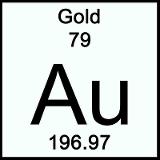
Which number is the atomic mass?
a)
79
b)
196.97
4.
The simplest substance is..?
a)
Carbon
b)
An element
c)
Water
d)
A simple compound
5.
A proton is....
a)
A negatively charged subatomic particle
b)
A positively charged subatomic particle
c)
A neutrally charged subatomic particle
d)
The only subatomic particle located in the nucleus
6.
A neutron has a charge of
a)
+2
b)
No charge
c)
-1
d)
+1
7.
Which element is not a metal?
a)
H
b)
Re
c)
Al
d)
B
8.
Which group of the periodic table is composed of inert (not reactive) gases?
a)
alkali metals
b)
alkaline earth metals
c)
halogens
d)
noble gases
9.
A ___________ is an arrangement of elements in columns
a)
columns
b)
rows
c)
periodic table
d)
electron shell
10.
The atomic number tells you what?
a)
number of electrons
b)
number of protons
c)
number of neutrons
d)
both electrons and protons in an atom.
11.

How many electrons does a Copper atom have?
a)
63
b)
29
c)
92
d)
34
12.
Particles in an atom that are neutral and have no charge are
a)
negatrons
b)
electrons
c)
neutrons
d)
protons
13.
What is the atomic mass equal to?
a)
the number of protons
b)
the number of protons and neutrons
c)
the number of neutrons
d)
the number of protons and electrons
14.

The atomic number of this pictured element is
a)
28
b)
58.6934
c)
Ni
d)
Nickel
15.

Which part is known as the atomic mass?
a)
Cu
b)
29
c)
63.546
d)
copper
16.
What scientist is known as the "Father of the Modern Periodic Table"?
a)
Johann Dobereiner
b)
John Newlands
c)
Demitri Mendeleev
d)
Henry Mosely
17.
Something that takes up space and has mass.
a)
volume
b)
matter
c)
mass
d)
density
18.
A state of matter that has a definite volume and shape.
a)
solid
b)
liquid
c)
gas
d)
matter
19.
What are the three states of matter?
a)
solid, volume, mass
b)
density, volume, mass
c)
solid, liquid, gas
d)
density, gas, volume
20.
Which 2 kinds of particles make up the nucleus of an atom?
a)
electrons and neutrons
b)
electrons and nuclei
c)
protons and neutrons
d)
protons and kryptons
21.
A pure substance that cannot be broken down into any other substance by chemical or physical means. There are about 100 of us shown in the Periodic Table
a)
compound
b)
mixture
c)
molecule
d)
element
22.

This picture is an example of a ____________.
a)
solid
b)
liquid
c)
gas
d)
all of the above
23.

What is this?
a)
Pure Substance
b)
Atom
24.

Which is this?
a)
Element
b)
Nucleus
25.
Atomic Number
a)
The number of protons in the nucleus of an atom is equal to the atomic number. Elements on the periodic table are arranged in order of atomic number.
b)
The sum of the protons and neutrons in an atom. Protons + Neutrons = Mass Number
26.
Atomic Mass Unit (AMU)
a)
The Si or metric unit used to express the masses of particles in atoms. Each proton and neutron has a mass of 1 amu.
b)
The number of protons in the nucleus of an atom is equal to the atomic number. Elements on the periodic table are arranged in order of atomic number.
27.
Neutron
a)
The Si or metric unit used to express the masses of particles in atoms.
b)
Particles found in the nucleus of an atom that have no charge but have mass.
28.
Electron
a)
Negatively charged particles found in the electron clouds of atoms. Electrons have a charge of -1.
b)
Particles found in the nucleus of an atom that have no charge but have mass.
29.
Element
a)
Pure substance that can’t be separated into simpler substances by physical or chemical changes.
b)
Negatively charged particles found in the electron clouds of atoms.
c)
The number of protons in the nucleus of an atom that is equal to the atomic number
30.
Pure Substance
a)
A substance made up of only one kind of particle. (atom or compound)
b)
The smallest particle into which an element can be divided and still be the same substance.
31.
Atom
a)
The tiny, dense, positively charged center of an atom. Contains most of the atom’s mass and protons and neutrons are located there.
b)
The smallest particle into which an element can be divided and still be the same substance.
32.
Periodic Table
a)
A table of the elements that organizes them according to a regular, repeating pattern.
b)
The properties of elements in a row follow a repeating pattern as you move across the period.
33.
Mass Number
a)
The sum of the protons and neutrons in an atom
b)
When arranged by increasing atomic mass, similar physical and chemical properties can be observed every eight elements.
34.
Period
a)
Horizontal rows of elements (left to right) on the periodic table
b)
Elements in the same group have similar physical and chemical properties.
35.

What is this?
a)
Atom
b)
Nucleus
36.

What is this?
a)
Periodic Table
b)
Proton
37.

What does the number in the upper left represent?
a)
Atomic Number
b)
Electron
38.

The number at the bottom is called the...
a)
Group
b)
Mass Number (Atomic Mass)
39.
Matter is anything that has...
a)
solid, liquid, or gas
b)
mass and volume
c)
plasma
d)
molecules
40.
Which are solids?
a)
glue, milk, and juice
b)
air, helium, and steam
c)
a rubber ball, smoke, and soda
d)
a computer, a tree, and a chair
41.
What is the Periodic Table? It is an _____________________ system for elements.
a)
organizational
b)
structural
42.
By 1860 about 60 elements were known and a method was needed for organization.
In 1869, Russian chemist _________________________proposed arranging elements by ____________________and properties.
In 1869, Russian chemist _________________________proposed arranging elements by ____________________and properties.
a)
Dimitri Mendeleev, atomic weights
b)
Issac Newton, heavier elements
43.
The periodic table has a special name for its columns, too. When a column goes from top to bottom, it's called a _________________.
a)
element
b)
group
44.
The genius of the periodic table is that it is organized like a big grid. The ___________are placed in specific places because of the way they look and act.
a)
elements
b)
atoms
45.

What is the atomic number of Hydrogen?
a)
1
b)
1.0079
46.

What is the atomic number of Nitrogen?
a)
14.007
b)
7
47.

What is the atomic mass of this element?
a)
55.845
b)
26
48.

What is the atomic mass of this element?
a)
17
b)
35.5
49.

What do you think this element is?
a)
magnesium
b)
copper
50.

What do you think this element is?
a)
Silver
b)
Gold
51.
What is the atomic number?
a)
the number of protons
b)
the number of protons and neutrons
c)
the number of neutrons
d)
the number of protons and electrons
52.
What is the mass number?
a)
the number of protons
b)
the number of protons and neutrons
c)
the number of neutrons
d)
the number of protons and electrons
53.

What is the atomic number of this nucleus?
a)
1
b)
3
c)
4
d)
7
54.
A phase change from liquid to gas
a)
condensation
b)
evaporation
c)
sublimation
d)
deposition
55.

The following illustration is in what state of matter?
a)
Solid
b)
Liquid
c)
Gas
d)
Plasma
56.
Ice melting, water freezing, water evaporating and steam condensing are all examples of what type of change?
a)
Chemical
b)
Plasma
c)
Physical
d)
Atomic
57.

What state of matter is this?
a)
solid
b)
liquid
c)
gas
58.

What state of matter is this?
a)
solid
b)
liquid
c)
gas
59.

What state of matter is this?
a)
solid
b)
liquid
c)
gas
60.

What state of matter is this?
a)
solid
b)
liquid
c)
gas
100 %

