wayground logo

Free Printable Worksheets

Font size

S
M
L
XL
Worksheets

Ocean commotion updated(HHS)

Total questions: 32

Worksheet time: 17mins

Name
Class
Date
1.
Tides are caused mainly by what?
a)
Moon’s gravitational pull
b)
Sun’s gravitational pull
c)
Earth’s gravitational pull
2.
What is a difference between spring and neap tides?
a)
Spring tides are the highest high tides and lowest low tides
b)
Spring tides occur when moon in 3rd or 1st quarter phases
c)
Neap tides are the highest high tides and lowest low tides
d)
Neap tides occur when the moon and sun are in a straight line with the Earth
3.
What type of tide would this arrangement of earth-moon-sun create?
a)
full moon tide
b)
new moon tide
c)
neap tide
d)
spring tide
4.
What type of tides would this arrangement of earth-moon-sun create?
a)
neap tide
b)
spring tide
c)
new moon tide
d)
full moon tide
5.
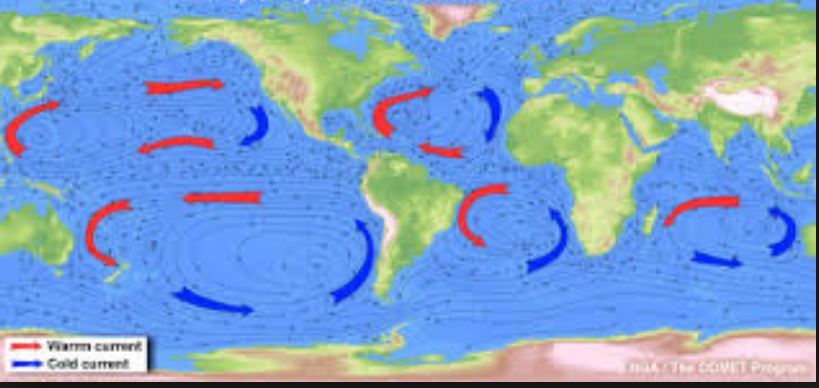
Analyze the image. What could explain why certain parts of the ocean have warmer temperatures?
a)
 heating of the Earth's surface id more concentrated at the equator
b)
Convection causes heat to circulate heat toward the equator
c)
hurricanes
d)
specific heat of water causes heat to be lost faster at the North and South poles
6.
Deep currents are caused by differences in the  _______________ ocean water.
a)
 eutrophication of
b)
sun's effect on
c)
density of
d)
 salinity  of 
7.
In the northern hemisphere, the Coriolis effect causes currents to do which of the following?
a)
curve counterclockwise
b)
curve clockwise
c)
reverse direction
d)
sink
8.
________ is a climate event that occurs when surface waters in the eastern Pacific are colder than normal.
a)
La Nina
b)
El Nino
c)
Coriolis Effect
d)
trade winds
9.

What are two factors that affect the density differences in the ocean.

a)

salinity and temperature

b)

Density and Pressure

c)

Pressure and Temperature

d)

Salinity and El Nino

10.
What are two factors that affect the density differences in the ocean.
a)
salinity and temperature
b)
salinity and Pressure
c)
Pressure and Temperature
d)
Salinity and El Nino
11.

How do warm-water currents affect the coastal areas along which they flow?

a)

Cooler weather at the coast

b)

Warmer weather at the coast

c)

Cause snow to fall year round

d)

Cause higher tides

12.
If there was an oil spill which of these would NOT happen
a)
economic  problems with tourist season due to fewer tourists
b)
distruption of the ocean food web
c)
higher prices for seafood harvested from that sea
d)
Increased algal growth that dies and reduces oxygen levels
13.

Costal sediment must be carefully protected to prevent it entering rivers because

a)

turbidity may be eaten by marine organisms

b)

turbidity may make the channel shallow and animals will suffer

c)

sediment (high turbidity) will cloud the water and block sunlight which feeds plants

d)

sediment interferes with the ozone's protection of sea life

14.

Limestone forms from calcium carbonate (shells). If there is more carbon dioxide in the Atmosphere, what will happen to ocean formed limestone

a)

Limestone will form more quickly

b)

limestone will form more slowly

c)

Limestone will form on Land instead of Ocean

d)

There will be no limestone what so ever forming

15.
how do pollutions like nitrogen and phosphorus enter the ocean from miles away?
a)
They are dissolved in our drinking water and enter they Bay by wastewater 
b)
They leak from cargo ships
c)
they are dumped by dump trucks
d)
they are carried to the bay by runnoff, streams and groundwater to the Bay from Lawns and roads.
16.
Nutrients are returned from the sea floor to the surface by
a)
convection
b)
subduction
c)
upwelling
d)
surface currents
17.
which layer on the graph does temperature  change gradually
(layers on graph are surface, thermocline and deep in order from top down)
a)
surface
b)
thermocline
c)
deep zone
18.

what would an increase in sea ice cause in ocean water (liquid)

a)

global warming

b)

loss of Carbon dioxide to the atmosphere

c)

increase in salinity of ocean water

d)

loss of oxygen in ocean water

19.
What is the temperature at which freshwater is most dense (graph)
a)
4 C
b)
0 C
c)
9 C
d)
7 C
20.
why is the temperature at the surface of the ocean more variable (changing) than on the floor?
a)
the surface is where energy is exchanged with atmosphere
b)
the ocean floor absorbs all the energy at the sea floor
c)
salt also varies at the surface
d)
water is less dense at the surface
21.
If glaciers melt what happens to the oceans
a)
sea level rises
b)
salinity rises
c)
atmospheric CO2 rises
d)
Oxygen in ocean rises
22.
According to the image, which of the below will have a cooler climate due to the currents on it's coast?
a)
N and S African west coast
b)
USA east Coast
c)
Asia East coast
d)
South American East Coast
23.

Hurricanes form over warm ocean water. Where should more hurricanes form

a)

Near the equator (5 degrees latitude)

b)

Near the middle latitudes (30-60)

c)

Closer to the N and S poles (90 degrees latitude)

24.
What is the technology that helped us discover what the ocean floor looks like before we could dive down?
a)
dolphin calls
b)
sonar
c)
radar
d)
microwaves
25.
Which natural event temporarily slows or reverses surface ocean currents near the  equator of the Pacific Ocean, causing a disruption of normal weather patterns?
a)
El Nino
b)
Volcanoes
c)
Monsoons
d)
Tornadoes
26.
Air and water are known scientifically on Earth as the
a)
Atmosphere and Hydrospher
b)
Air blanket and Ocean
c)
Atmosphere and Geosphere
d)
Biosphere and Hydrosphere
27.
What part of the ocean floor is at y
a)
Continetnal slope
b)
continental rise
c)
continental shelf
d)
abyssal plain
28.
What part of the ocean floor is at z
a)
Continetnal slope
b)
continental rise
c)
continental shelf
d)
abyssal plain
29.

Where is the most dense water in the ocean?

a)

Near the bottom (sea floor)

b)

Near the top (surface water)

c)

In the middle (thermocline)

d)

at the equator (0 degrees latitude)

30.

An increase in carbon dioxide in the atmosphere due to burning of fossil fuels will have what secondary affect on Ocean life?

a)

All life will die

b)

Animals with shells may suffer shell damage/ thinning due to CO2 making the water more acidic

c)

Animals with shells may suffer thickening of the shells due to CO2 making water more alkalin

d)

a decrease in oxygen due to phytoplankton unable to respire

31.

the deepest feature in the ocean floor, created by plates moving together is

a)

The abyssal plain

b)

sea mount

c)

deep sea trench

d)

mid ocean ridge

32.

The features created by magma on the ocean floor include which 2?

a)

Volcanic Arc

b)

Deep sea trench

c)

Mid ocean ridge

d)

abyssal plain