wayground logo

Free Printable Worksheets

Font size

S
M
L
XL
Worksheets

UNIT #3 PLATE TECTONICS

Total questions: 147

Worksheet time: 2hrs 9mins
Name
Class
Date
1.
The type of plate boundary where two plates come together is a .....
a)
Convergent Boundary
b)
Divergent Boundary
c)
Transform Boundary
d)
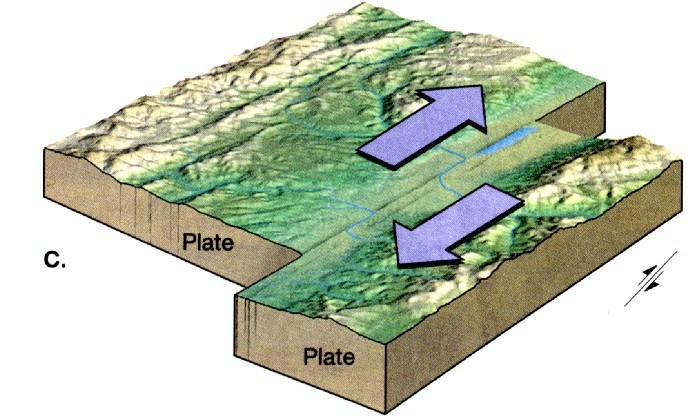
Plate Boundary
2.
Which of the following causes Earth's tectonic plates to move?
a)
Energy from the Sun
b)
Magnetic Pole Reversal
c)
Convection currents in the mantle
d)
Faults in Mountain Ranges
3.
What type of plate boundary is this?
a)
Plate
b)
Divergent
c)
Convergent
d)
Transform
4.
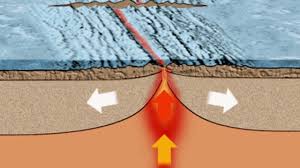
What type of event will occur at this boundary?
a)
Earthquake
b)
Volcano Eruption
c)
Tornado
d)
Mountain Building
5.
A divergent boundary occurs when plates ....
a)
Pull apart
b)
Come together
c)
Slide past each other
d)
subducting
6.
Which of the following is the name of the ancient supercontinent formed 28 Million Years ago.
a)
Pangea
b)
Gondwanda
c)
Laurasia
d)
Neverland
7.
Which of the following is NOT evidence to support the theory of plate tectonics?
a)
Fossils
b)
Mountains
c)
Glaciers
d)
Sand Erosion
8.
What type of plate boundary is this?
a)
Transform
b)
Convergent
c)
Divergent
d)
Plate
9.
The theory that says Earth's continents once made up an ancient supercontinent, and have been drifting apart ever since, is called the theory of...
a)
Pangea
b)
Plate Tectonics
c)
Natural Selection
d)
Gravity
10.
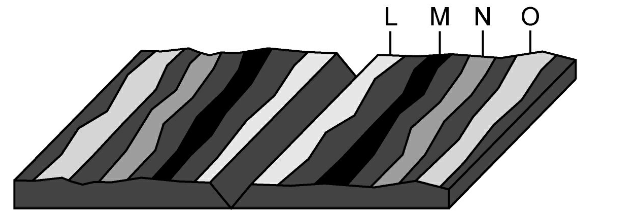
Where would the oldest rock be found?
a)
L
b)
M
c)
N
d)
O
11.
How is it possible for new crust to be formed without increasing the surface area of the Earth?
a)
Crust is destroyed at the same time it is created
b)
New crust is underwater where it sinks
c)
New crust breaks more easily than old crust
12.
Mountains are created when....
a)
Two continental plates collide
b)
Two oceanic plates pull apart
c)
An Oceanic plate subducts under a Continental Plate
d)
Two continental plates pull apart
13.
This layer of Earth is solid Iron and Nickel
a)
Outer Core
b)
Mantle
c)
Inner Core
d)
Crust
14.
The Great Rift Valley in Africa and the Mid-Ocean Ridge were all created by this boundary
a)
Divergent
b)
Convergent
c)
Reform
d)
Transform
15.
This layer of Earth is the thickest part
a)
crust
b)
outer core
c)
mantle
d)
inner core
16.
What are the two types of crust
a)
continental and oceanic
b)
ocean and upper
c)
lower and upper
d)
pizza and subway
17.
Which layer has convection currents?
a)
Inner Core
b)
Outer Core
c)
Mantle
d)
Crust
18.
subduction zones in the ocean can create which features?
a)
islands
b)
volcanoes
c)
earthquakes
d)
all of the above
19.
Earthquakes and volcanoes are most likely found in which locations?
a)
At plate boundaries
b)
in oceans
c)
in the middle of continents
d)
in the middle of plates
20.
When one plate sides under neath another, it _________ and the magma _________.
a)
hardens, sinks
b)
melts, sinks
c)
hardens, rises
d)
melts, rises
21.
The Himalayas in Asia are an example of what type of plate boundary?
a)
divergent
b)
continent-to-continent convergent
c)
ocean-to-continent convergent
d)
transform
22.
When an oceanic plate and a continental plate collide, which one will subduct?
a)
oceanic
b)
continental
c)
neither
23.
What is this image...
a)
Revolving boundary
b)
San Andreas (Transform)
c)
Convergent
24.
Two tectonic plates collide at a _______ plate boundary.
a)
convergent
b)
divergent
c)
transform
25.
Most volcanoes and earthquakes occur...
a)
along the coast
b)
along tectonic plate boundaries
c)
in the Arctic
d)
in the ocean
26.
This landform can occur at a divergent plate boundary.
a)
ocean trench
b)
mid-ocean ridge
c)
tall mountains
d)
transform fault
27.
What type of boundary is the SAN ANDREAS FAULT on?
a)
Covergent
b)
Transformers
c)
Divergent
d)
Transform
28.
Scientists think that convection currents that move the plates flow in Earth's
a)
Continental crust
b)
Oceanic crust
c)
Asthenosphere
d)
Lithosphere
29.
The mantle of Earth is made partly of magma. When magma rises and sinks, this is called ______________. 
a)
a conduction current
b)
a hot spot
c)
a volcanic eruption
d)
a convection current
30.
As you travel from the inner core to the crust, how would temperature, pressure and density of the material change?
a)
They would all increase
b)
They would all decrease.
c)
They would stay the same.  
d)
Temperature would decrease, but pressure and density would increase. 
31.
What would happen to the convection currents if the heat from the inner core disappeared? 
a)
They would stop. 
b)
They would change directions. 
c)
It would not change. 
d)
They would speed up. 
32.
Where does the heat come from that drives this convection current in the mantle? 
a)
The sun
b)
The crust
c)
the mantle
d)
the core
33.
The area around the pacific plate where boundaries form is called...
a)
death ring
b)
fire zone
c)
ring of fire
d)
zone of fire
34.
During sea floor spreading, molten material rises up from the mantle...
a)
along the continents
b)
at the mid ocean ridges
c)
deep ocean trenches
d)
at north and south poles
35.
Which ocean is expanding due to a mid-ocean ridge (divergent boundary)?
a)
Indian
b)
Dead Sea
c)
Atlantic
d)
Artic
36.
This layer of Earth is the thickest part
a)
crust
b)
outer core
c)
mantle
d)
inner core
37.
Which layer of the Earth is liquid iron?
a)
Crust
b)
Mantle
c)
Outer Core
d)
Inner Core
38.
The outside layer of the earth is called ______________________.
a)
core
b)
crust
c)
mantle
d)
outer core
39.
The huge pieces of the earth's crust are called ____________________________. 
a)
crust
b)
plates
c)
directions
d)
seismos
40.
Stress that squeezes together
a)
Compression
b)
Tension
c)
Shearing
41.
What is a break in the Earth's crust?
a)
Fault
b)
Focus
c)
Fold
d)
Mineral
42.
Rock layers undergo stress when they are stretched apart at divergent boundaries. This stress is called:
a)
tightening
b)
tension
43.
Ocean-to-ocean and subduction are two types of which boundary?
a)
divergent
b)
transform
c)
convergent
44.
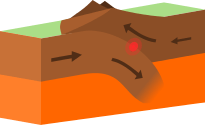
Which kind of plate boundary is this?
a)
divergent boundary
b)
transform boundary
c)
convergent boundary (ocean to continent)
d)
convergent boundary (continent to continent)
45.
Which kind of plate boundary is this?
a)
divergent boundary
b)
transform boundary
c)
convergent boundary (ocean to continent)
d)
convergent boundary (ocean to ocean)
46.
Which kind of plate boundary is this?
a)
divergent boundary
b)
transform boundary
c)
convergent boundary (ocean to continent)
d)
convergent boundary (continent to continent)
47.
According to the diagram, hot liquid rock inside the Earth is called?
a)
lava
b)
volcano
c)
eruption
d)
magma
48.
Remains of the reptilian creature, Mesosaurus, found on West Africa and South America is which type of evidence supporting continental drift?
a)
climate
b)
rock formation
c)
shape
d)
fossil
49.
Rock evidence shows that Australia once had polar, arctic conditions. This is an example of what type of evidence supporting continental drift?
a)
climate
b)
rock
c)
fossil
d)
shape
50.
What type of boundary creates new seafloor?
a)
convergent ocean ocean
b)
convergent ocean continental
c)
convergent continental continental
d)
divergent
51.
The Andes mountains and volcanoes are made by the South American Plate and Pacific Plate colliding, this is known as
a)
convergent ocean ocean
b)
transform
c)
convergent continental continental
d)
convergent ocean continental
52.
The Andes mountains and volcanoes are made by the South American Plate and Pacific Plate colliding, this is known as
a)
convergent ocean ocean
b)
transform
c)
convergent continental continental
d)
convergent ocean continental
53.
Which has thicker crust
a)
ocean
b)
continental
54.
Which crust is more dense?
a)
ocean
b)
continental
55.
Where do volcanoes occur?
a)
divergent boundaries
b)
convergent boundaries
c)
ring of fire
d)
all of the above
56.
What is a hot spot?
a)
A place that gets hit the most by the sun's rays
b)
When a mantle plume rises and breaks through the crust
c)
Every place with a volcano
d)
A place with temperatures above 90 degrees F
57.
What do hot spots create?
a)
earthquakes
b)
tsunamis
c)
island chains
d)
seafloor
58.
Which of the following is volcanism?
a)
Stromboli volcano erupting every 30 seconds
b)
Underwater volcano creating new seafloor
c)
Mount Vesuvius erupting on Pompeii
d)
all of the above
59.
T/F Magma rises because it is less dense than rocks
a)
TRUE
b)
FALSE
60.
What two things determine which type of magma & volcano is created
a)
viscosity & temperature
b)
viscosity & gas content
c)
gas content & temperature
d)
location & temperature
61.
Which volcano has a broad base and gentle sloping sides?
a)
stratovolcano
b)
shield
c)
cinder cone
62.
Which volcano is an island builder?
a)
stratovolcano
b)
shield
c)
cinder cone
63.
Which volcano created the Hawaiian Islands?
a)
stratovolcano
b)
shield
c)
cinder cone
64.
Which volcano is Mount St. Helens or Mount Vesuvius? 
a)
stratovolcano
b)
shield
c)
cinder cone
65.
What part of the volcano stores the melted rock?
a)
magma vacuole
b)
magma chamber
c)
magma crevice
d)
magma hole
66.
Which part of the volcano does the lava usually spew out of?
a)
mantle
b)
crater
c)
main vent
d)
side vent
67.
What also erupts from the volcano besides lava?
a)
gases and ash
b)
just ash
c)
just gas
d)
huge rock pieces
68.
Which of the following causes Earth's tectonic plates to move?
a)
Energy from the Sun
b)
Magnetic Pole Reversal
c)
Convection currents in the mantle
d)
Faults in Mountain Ranges
69.
What type of event will occur at this boundary?
a)
Earthquake
b)
Volcano Eruption
c)
Tornado
d)
Mountain Building
70.
What type of plate boundary is this?
a)
Plate
b)
Divergent
c)
Convergent
d)
Transform
71.
A divergent boundary occurs when plates ....
a)
Pull apart
b)
Come together
c)
Slide past each other
d)
subducting
72.

Which of the following is the name of the ancient supercontinent formed 280 Million Years ago.

a)

Pangea

b)

Gondwanda

c)

Laurasia

d)

Neverland

73.
Which of the following is NOT evidence to support the theory of plate tectonics?
a)
Fossils
b)
Mountains
c)
Glaciers
d)
Sand Erosion
74.
What geologic feature/event you be most likely to find at a transform boundary?
a)
Earthquakes
b)
Volcanoes
c)
Mountains
d)
Rift Valleys
75.
What geologic feature/event would you most likely to find at a divergent boundary between two pieces of oceanic crust?
a)
Rift Valley
b)
Mid-Ocean Ridge
c)
Island Arc
d)
Flat land
76.
What geologic feature/event would you most likely to find at a convergent boundary between two pieces of continental crust?
a)
Volcano
b)
Mountain
c)
Rift
d)
Island Arc
77.
The core is mostly made up mostly of which elements?
a)
Oxygen and Silicon
b)
Silicon and Magnesium
c)
Nickel and Iron
d)
Iron and Magnesium
78.
How are scientist able to estimate the thickness of each layer of the Earth?By studying __________
a)
 radio waves
b)
sonar waves
c)
laser waves
d)
seismic waves
79.
This is the plastic layer of the mantle on which pieces of the lithosphere move.
a)
Lithosphere
b)
Asthenosphere
c)
Mesosphere
d)
Crust
80.
This layer is divided into pieces called tectonic plates.
a)
Mesosphere
b)
Asthenosphere
c)
Mantle
d)
Lithosphere
81.
A giant landmass that existed 200 million years ago
a)
Wegener
b)
Pangaea
c)
Archyopteryx
d)
Ammonite
82.
Which piece of evidence did Wegener use to prove continental drift?
a)
The shape of the continents
b)
Similar fossils found on separate continents
c)
Tree fossils found in odd places
d)
All of the above
83.
As you travel from the inner core to the crust, how would temperature, pressure and density of the material change?
a)
The would all increase
b)
The would all decrease.
c)
Nothing, the layers are made of the same material throughout
d)
Temperature would decrease, but pressure and density would increase
84.
Which of the following changes would end Earth's tectonic activity?
a)
Earth's crust becomes a cooler solid
b)
Earth's mantles becomes a warmer semiliquid
c)
Earth's mantle becomes cooler and solid.
d)
Earth's outer core becomes warmer
85.
Convection currents in the mantle are thought to be the driving force behind tectonic movement. At which location do the convection currents cause the plates to diverge?
a)
strike-slip fault
b)
subduction zone
c)
mid oceanic ridges
d)
folded mountains.
86.
The diagram shows what can occur when two continental plates collide.Which characteristic of the Indian Plate explains why it moves under the Eurasian Plate?
a)
It is larger.
b)
It is denser.
c)
It is molten.
d)
It is younger.
87.

What do we call an area where more then two plates interact in different ways

a)

plate boundary zones

b)

hot spots

c)

convergent boundaries

d)

subduction

88.
Identify the Major Plate labeled B
a)
African Plate
b)
Antarctic Plate
c)
Pacific Plate
d)
Eurasian Plate 
89.
Identify the Major Plate labeled D
a)
Indo-Australian Plate
b)
North American Plate
c)
South Americana Plate
d)
Eurasian Plate 
90.
Which explains that the continents were once joined together and over time they broke up and then drifted apart?
a)
Plate Tectonic Theory
b)
Continental Drift 
91.
Which of these explains that Earth's outer layer is broken into large slowly moving pieces? 
a)
Plate Tectonic Theory
b)
Continental Drift 
92.
This boundary is described by two plates moving away from eachother along the edges and separating. The resulting gap allows magma to rise and create new crust, forming new lithosphere. 
a)
Convergent Boundary 
b)
Divergent Boundary  
c)
Transform Boundary
93.
Trenches, deep underwater canyons on the sea floor are created at this type of boundary 
a)
Divergent
b)
Convergent, Subduction Zone
c)
Transform 
94.
Mid Ocean Ridge Formation  is created at this type of  boundary.
a)
Divergent 
b)
Convergent
c)
Transform 
95.
The area around the pacific plate where boundaries form is called...
a)
death ring
b)
fire zone
c)
ring of fire
d)
zone of fire
96.
What happens to temperature as you go deeper in the Earth?
a)
decreases
b)
increases
c)
fluctuates
d)
remains the same
97.
Name the boundary
a)
convergent boundary
b)
divergent boundary
c)
transform boundary
d)
sergent boundary
98.
What is represented by the picture? 
a)
Sea-floor spreading
b)
Pangea
c)
How the continents are arranged today
d)
Volcanoes
99.
Which type of crust is more dense and thinner?
a)
Continental
b)
Asthenosphere
c)
Oceanic
d)
Byers
100.
What was Wegener's hypothesis called?
a)
The Pangea 
b)
Moving Continents 
c)
The Continental Drift
d)
Techtonic Plates
101.
Why was Alfred Wegner's theory of Continental Drift not immediately accepted by scientists?
a)
there was no mechanism to explain how Continental Drift happened.
b)
The theory of Continental Drift was immediately accepted by the scientific community.
c)
there was no evidence to support his theory.
d)
Scientists did not think it was possible for the Continents to move.
102.
Which answer below correctly describes the formation of a volcanic island arc?
a)
Islands are created along the mid ocean ridge as new oceanic crust is formed.
b)
Islands are created one at a time as the plate moves across a hot spot in the mantle.
c)
Islands are created along a subduction zone as oceanic crust is forced back down in to the mantle.
d)
Islands are created as pressure is released when two tectonic plates are pulled apart.
103.

What is the correct order (starting from the surface) of Earth’s layers?

a)

crust, outer core, inner core, mantle

b)

mantle, outer core, inner core, crust

c)

crust, mantle, outer core, inner core

d)

outer core, inner core, crust, mantle

104.

In sea-floor spreading, molten material rises from the mantle and erupts

a)

along the edges of all the continents.

b)

along mid-ocean ridges.

c)

in deep-ocean trenches.

d)

at the north and south poles.

105.

Most geologists think that the movement of Earth’s plates is caused by _______

a)

convection.

b)

continental drift.

c)

subduction.

d)

conduction.

106.

The San Andreas Fault in California is known as an active earthquake area. What type of

boundary is it?

a)

Converging

b)

Diverging

c)

Transform

d)

Sea Floor Spreading

107.
Where would the oldest rock be found?
a)
L
b)
M
c)
N
d)
O
108.
Which of the following causes Earth's tectonic plates to move?
a)
Energy from the Sun
b)
Magnetic Pole Reversal
c)
Convection currents in the mantle
d)
Faults in Mountain Ranges
109.
What type of event will occur at this boundary?
a)
Earthquake
b)
Volcano Eruption
c)
Tornado
d)
Mountain Building
110.
What type of plate boundary is this?
a)
Plate
b)
Divergent
c)
Convergent
d)
Transform
111.
A divergent boundary occurs when plates ....
a)
Pull apart
b)
Come together
c)
Slide past each other
d)
subducting
112.

Which of the following is the name of the ancient supercontinent formed 280 Million Years ago.

a)

Pangea

b)

Gondwanda

c)

Laurasia

d)

Neverland

113.
Which of the following is NOT evidence to support the theory of plate tectonics?
a)
Fossils
b)
Mountains
c)
Glaciers
d)
Sand Erosion
114.
What geologic feature/event you be most likely to find at a transform boundary?
a)
Earthquakes
b)
Volcanoes
c)
Mountains
d)
Rift Valleys
115.
What geologic feature/event would you most likely to find at a divergent boundary between two pieces of oceanic crust?
a)
Rift Valley
b)
Mid-Ocean Ridge
c)
Island Arc
d)
Flat land
116.
What geologic feature/event would you most likely to find at a convergent boundary between two pieces of continental crust?
a)
Volcano
b)
Mountain
c)
Rift
d)
Island Arc
117.
The core is mostly made up mostly of which elements?
a)
Oxygen and Silicon
b)
Silicon and Magnesium
c)
Nickel and Iron
d)
Iron and Magnesium
118.
How are scientist able to estimate the thickness of each layer of the Earth?By studying __________
a)
 radio waves
b)
sonar waves
c)
laser waves
d)
seismic waves
119.
This is the plastic layer of the mantle on which pieces of the lithosphere move.
a)
Lithosphere
b)
Asthenosphere
c)
Mesosphere
d)
Crust
120.
This layer is divided into pieces called tectonic plates.
a)
Mesosphere
b)
Asthenosphere
c)
Mantle
d)
Lithosphere
121.
A giant landmass that existed 200 million years ago
a)
Wegener
b)
Pangaea
c)
Archyopteryx
d)
Ammonite
122.
Which piece of evidence did Wegener use to prove continental drift?
a)
The shape of the continents
b)
Similar fossils found on separate continents
c)
Tree fossils found in odd places
d)
All of the above
123.
As you travel from the inner core to the crust, how would temperature, pressure and density of the material change?
a)
The would all increase
b)
The would all decrease.
c)
Nothing, the layers are made of the same material throughout
d)
Temperature would decrease, but pressure and density would increase
124.
Which of the following changes would end Earth's tectonic activity?
a)
Earth's crust becomes a cooler solid
b)
Earth's mantles becomes a warmer semiliquid
c)
Earth's mantle becomes cooler and solid.
d)
Earth's outer core becomes warmer
125.
Convection currents in the mantle are thought to be the driving force behind tectonic movement. At which location do the convection currents cause the plates to diverge?
a)
strike-slip fault
b)
subduction zone
c)
mid oceanic ridges
d)
folded mountains.
126.
The diagram shows what can occur when two continental plates collide.Which characteristic of the Indian Plate explains why it moves under the Eurasian Plate?
a)
It is larger.
b)
It is denser.
c)
It is molten.
d)
It is younger.
127.

What do we call an area where more then two plates interact in different ways

a)

plate boundary zones

b)

hot spots

c)

convergent boundaries

d)

subduction

128.
Identify the Major Plate labeled B
a)
African Plate
b)
Antarctic Plate
c)
Pacific Plate
d)
Eurasian Plate 
129.
Identify the Major Plate labeled D
a)
Indo-Australian Plate
b)
North American Plate
c)
South Americana Plate
d)
Eurasian Plate 
130.
Which explains that the continents were once joined together and over time they broke up and then drifted apart?
a)
Plate Tectonic Theory
b)
Continental Drift 
131.
Which of these explains that Earth's outer layer is broken into large slowly moving pieces? 
a)
Plate Tectonic Theory
b)
Continental Drift 
132.
This boundary is described by two plates moving away from eachother along the edges and separating. The resulting gap allows magma to rise and create new crust, forming new lithosphere. 
a)
Convergent Boundary 
b)
Divergent Boundary  
c)
Transform Boundary
133.
Trenches, deep underwater canyons on the sea floor are created at this type of boundary 
a)
Divergent
b)
Convergent, Subduction Zone
c)
Transform 
134.
Mid Ocean Ridge Formation  is created at this type of  boundary.
a)
Divergent 
b)
Convergent
c)
Transform 
135.
The area around the pacific plate where boundaries form is called...
a)
death ring
b)
fire zone
c)
ring of fire
d)
zone of fire
136.
What happens to temperature as you go deeper in the Earth?
a)
decreases
b)
increases
c)
fluctuates
d)
remains the same
137.
Name the boundary
a)
convergent boundary
b)
divergent boundary
c)
transform boundary
d)
sergent boundary
138.
What is represented by the picture? 
a)
Sea-floor spreading
b)
Pangea
c)
How the continents are arranged today
d)
Volcanoes
139.
Which type of crust is more dense and thinner?
a)
Continental
b)
Asthenosphere
c)
Oceanic
d)
Byers
140.
What was Wegener's hypothesis called?
a)
The Pangea 
b)
Moving Continents 
c)
The Continental Drift
d)
Techtonic Plates
141.
Why was Alfred Wegner's theory of Continental Drift not immediately accepted by scientists?
a)
there was no mechanism to explain how Continental Drift happened.
b)
The theory of Continental Drift was immediately accepted by the scientific community.
c)
there was no evidence to support his theory.
d)
Scientists did not think it was possible for the Continents to move.
142.
Which answer below correctly describes the formation of a volcanic island arc?
a)
Islands are created along the mid ocean ridge as new oceanic crust is formed.
b)
Islands are created one at a time as the plate moves across a hot spot in the mantle.
c)
Islands are created along a subduction zone as oceanic crust is forced back down in to the mantle.
d)
Islands are created as pressure is released when two tectonic plates are pulled apart.
143.

What is the correct order (starting from the surface) of Earth’s layers?

a)

crust, outer core, inner core, mantle

b)

mantle, outer core, inner core, crust

c)

crust, mantle, outer core, inner core

d)

outer core, inner core, crust, mantle

144.

In sea-floor spreading, molten material rises from the mantle and erupts

a)

along the edges of all the continents.

b)

along mid-ocean ridges.

c)

in deep-ocean trenches.

d)

at the north and south poles.

145.

Most geologists think that the movement of Earth’s plates is caused by _______

a)

convection.

b)

continental drift.

c)

subduction.

d)

conduction.

146.

The San Andreas Fault in California is known as an active earthquake area. What type of

boundary is it?

a)

Converging

b)

Diverging

c)

Transform

d)

Sea Floor Spreading

147.
Where would the oldest rock be found?
a)
L
b)
M
c)
N
d)
O