
 Worksheets
Water Distribution, Ocean Topography and Atmosphere
Total questions: 64
Worksheet time: 1hrs 5mins
Name
Class
Date
1.
Which source of freshwater is not easily available for human use?
a)
oceans
b)
freshwater lakes
c)
rivers
d)
icecaps/glaciers
2.

Approximately what percent of the Earth is covered by water?
a)
71%
b)
29%
c)
50%
d)
97%
3.

The amount of dissolved solids present in the water
a)
salinity
b)
chlorine
c)
nitrogen
d)
density
4.

Most of the Earth's water is in
a)
salty oceans
b)
freshwater lakes
c)
freshwater ponds
d)
glaciers
5.

Most of the Fresh water on Earth is
a)
in the ocean
b)
underground
c)
frozen
d)
in rivers
6.

What happens to pressure as you go deeper into the ocean?
a)
increases
b)
decreases
c)
stays the same
d)
doubles
7.

Seawater is typically denser than freshwater due to seawater’s —
a)
Greater depth
b)
Lower freezing point
c)
Smaller mass
d)
Higher salinity
8.

Why is the ice shelf floating?
a)
The ocean water is
filled with vegetation
that keeps
the ice from sinking.
filled with vegetation
that keeps
the ice from sinking.
b)
The ice is melting faster than it can sink
c)
The ice is warmer than the ocean water
d)
The ice is less dense than the ocean water.
9.
When you are building a sand castle on the beach, what feature are you standing on?
a)
abyssal plain
b)
continental shelf
c)
seamount
d)
continental rise
10.

What is letter C pointing to?
a)
abyssal plain
b)
seamount
c)
mid-ocean ridge
d)
continental shelf
11.

Letter D is pointing to the...
a)
continental slope
b)
continental shelf
c)
trench
d)
mid-ocean ridge
12.

Letter A is pointing to the _______________________.
a)
Continental shelf
b)
Mid-ocean ridge
c)
Continental slope
d)
Trench
13.
_____________ is the measure of how salty the ocean's water is.
a)
salinity
b)
solution
c)
coral
d)
plankton
14.
What do you call an underwater mountain?
a)
trench
b)
abyssal plain
c)
seamount
d)
volcanic island
15.
What is a deep, underwater valley or canyon on the ocean floor?
a)
seamount
b)
trench
c)
continental rise
d)
continental slope
16.
The shallowest(least deep) part of the ocean is the ____________________
a)
trench
b)
abyssal plain
c)
continental shelf
d)
continental slope
17.
A trench is _______________
a)
cold and shallow
b)
deep and warm
c)
deep and cold
d)
warm and shallow
18.
Which process adds more crust to the ocean floor?
a)
earthquakes
b)
sea floor spreading
c)
subduction
d)
convection
19.
What percent of water is available for humans to use?
a)
50
b)
25
c)
3
d)
less than 1
20.
The gradually sloping part of a continent that extends under the ocean is the...
a)
continental slope
b)
continental shelf
c)
abyssal plain
d)
trench
21.
the deepest part of the ocean
a)
trenches
b)
abyssal plain
c)
ocean basin
d)
rift
22.
Where does salt in the ocean come from?
a)
dissolved rocks and minerals
b)
decaying plants
c)
The bottom of the ocean
d)
The ocean s fresh water
23.

Briefly describe the overall relationship between temperature and density.
a)
Lower temperature water has higher density, warmer water has lower density
b)
Lower temperature water has lower density, warmer water has higher density
24.
What is the scientific name for salt?
a)
Sodium Acetate
b)
Sodium Chloride
c)
Chloride sodium
d)
Hydroxide sulfate
25.
As we go deeper into the ocean, salinity ___________.
a)
Doubles
b)
Decreases
c)
Increases
d)
Remains the same
26.
There is about 2% of the Earth's freshwater frozen in icebergs.
a)
True
b)
False
c)
It varies drastically due to drought and floods
d)
It varies drastically due to precipitation amounts
27.
There is only about ___ of freshwater available for use on Earth.
a)
1%
b)
3%
c)
29%
d)
70%
28.
__________ is the study of water in the atmosphere, on Earth's surface, and underground.
a)
meteorology
b)
geology
c)
biology
d)
hydrology
29.
Which represents the distribution of water on Earth?
a)
3% freshwater, 97% salt water
b)
97% freshwater, 3% salt water
c)
71% freshwater, 29% salt water
d)
29% freshwater, 71% salt water
30.
The amount of Saltwater on Earth is
a)
3%
b)
29%
c)
71%
d)
97%
31.
Where is most of earth's freshwater found?
a)
in lakes and rivers
b)
in the ground
c)
in the clouds
d)
in polar ice caps and glaciers
32.
If you are walking into the ocean you would be on the continental...
a)
shelf
b)
slope
c)
rise
d)
seamount
33.
mountain ranges in the ocean
a)
mid -ocean ridge
b)
trenches
c)
rift
d)
ocean basin
34.
What does salinity refer to?
a)
the temperature level of the water
b)
the depth of ocean trenches
c)
the height of the waves
d)
the level of salt and minerals in the water
35.

According to the graph, what is the distance from Guam to the Challenger Deep?
a)
11,000 meters
b)
160 kilometers
c)
128 kilometers
d)
240 kilometers
36.
In addition to salinity, what factor affects the density of seawater?
a)
depth
b)
latitude
c)
temperature
d)
salt content
37.
Which process does NOT lead to a decrease in the salinity of water?
a)
runoff from land
b)
precipitation
c)
sea ice melting
d)
evaporation
38.
The highest salinity would be found in which of the following areas?
a)
an area with high rates of precipitation
b)
an area with high rates of evaporation
c)
an area with plenty of runoff
d)
all of the above
39.
What term is the measure of dissolved salts in water?
a)
Thermocline
b)
Salinity
c)
Saltiness
d)
Tides
40.

What part of the water cycle does this picture show?
a)
condensation
b)
precipitation
c)
evaporation
d)
accumulation
41.
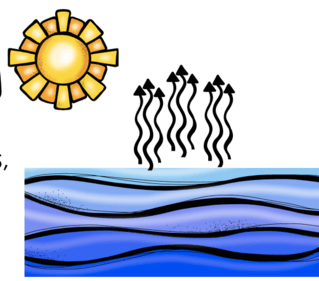
What part of the water cycle does this picture show?
a)
condensation
b)
precipitation
c)
evaporation
d)
accumulation
42.
What is the energy source for the water cycle?
a)
the sun
b)
the earth
c)
water
d)
the moon
43.

What is it called when plants give off water vapor as a waste product?
a)
condensation
b)
evaporation
c)
sublimation
d)
transpiration
44.
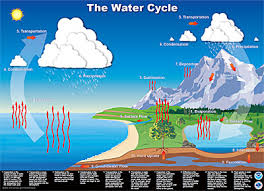
Which stages does liquid water from the ocean turn into water vapor?
a)
condesantion
b)
evaporation
c)
precipitation
d)
run off
45.
what is the main source of freshwater on earth
a)
ocean water
b)
well water
c)
pond water
d)
rainwater
46.
Which gas in our atmosphere is most abundant?
a)
Argon
b)
Oxygen
c)
Nitrogen
d)
Carbon Dioxide
47.
What is the percentage of oxygen in Earth's atmosphere?
a)
1%
b)
21%
c)
78%
d)
90%
48.
What is the percentage of nitrogen in Earth's atmosphere?
a)
1%
b)
21%
c)
78%
d)
90%
49.
What percentage of our atmosphere is made up of other gases such as argon, water vapor, and carbon dioxide?
a)
1%
b)
21%
c)
78%
d)
90%
50.
In which layer of the atmosphere does weather occur?
a)
Mesosphere
b)
Thermosphere
c)
Stratosphere
d)
Troposphere
51.
What decreases as you go up in the atmosphere?
a)
Altitude
b)
Atmosphere
c)
Meteors
d)
Air Pressure
52.
The layers of the atmosphere are classified according to changes in _________.
a)
altitude
b)
density
c)
composition
d)
temperature
53.
What are the 2 most abundant gases in Earth's atmosphere?
a)
carbon dioxide and oxygen
b)
carbon dioxide and nitrogen
c)
nitrogen and oxygen
d)
nitrogen and hydrogen
54.
James plans to climb to the top of Mount Everest. Which of the following statements about his climb will be the most accurate?
a)
Air pressure will rise and the temperature on a thermometer will increase.
b)
Air pressure will fall and the temperature on a thermometer will decrease.
c)
Air pressure will rise and the temperature on a thermometer will decrease.
d)
Air pressure and thermometer will not change.
55.
From Earth to space, the main layers of the atmosphere are
a)
Mesosphere, Troposphere, Ionosphere, Thermosphere
b)
Troposphere, Stratosphere, Mesosphere, Thermosphere
c)
Troposphere, Mesosphere, Ionosphere, Thermosphere
d)
Stratosphere, Troposphere, Ionosphere, Thermosphere
56.
Which layer of the atmosphere contains the ozone layer?
a)
Mesosphere
b)
Stratosphere
c)
Ionosphere
d)
Exosphere
57.
A mixture of gases and particles that surround a planet, held by gravity is called the-
a)
greenhouse effect
b)
atmosphere
c)
jet stream
d)
blanket
58.
Out of the following, choose the outermost layer of the atmosphere-
a)
Troposphere
b)
Thermosphere
c)
Stratosphere
d)
Mesosphere
59.
Where weather occurs.
a)
stratosphere
b)
thermosphere
c)
troposphere
d)
mesosphere
60.
Where we live.
a)
stratosphere
b)
thermosphere
c)
troposphere
d)
mesosphere
61.
The coldest layer.
a)
troposphere
b)
thermosphere
c)
exosphere
d)
mesosphere
62.
The hottest layer.
a)
troposphere
b)
thermosphere
c)
exosphere
d)
mesosphere
63.
What does the earth's atmosphere do?
a)
help to regulate the temperature on Earth
b)
Help UV rays to reach the Earth's surface
c)
Creates meteors in the sky
d)
Keep ocean waters cold
64.
What is the function of the ozone layer?
a)
to allow UV rays to get to Earth
b)
to block UV rays from getting to Earth
c)
To keep oxygen in
d)
to allow meteors to get to Earth
100 %

