
 Worksheets
Static Electricity
Total questions: 34
Worksheet time: 24mins
Name
Class
Date
1.
Ms Jo Jo rubbed two balloons with a piece of wool. What will happen when the balloons are brought near each other?
a)
The balloons will repel each other.
b)
The balloons will attract each other.
c)
The balloons will become positively (+) charged.
d)
The balloons will pop.
2.
The difference between attract and repel is that to attract is to pull something closer and repel is to push something away.
a)
True
b)
False
3.
When socks get stuck to towels in your dryer, this is an example of________________
a)
current electricity
b)
static electricity
4.
What types of charges attract?
a)
Positive and Positive
b)
Positive and Neutral
c)
Negative and Neutral
d)
Positive and Negative
5.
The accumulation of excess electric charge on an object is called
a)
Static electricity
b)
Electric discharge
c)
Resistance
d)
Circuit
6.
Electric charges that are alike _______ each other.
a)
Attract
b)
Repel
7.
Electric charges that are different _______ each other.
a)
Attract
b)
Repel
8.
What charge does a proton have?
a)
negative (-)
b)
positive (+)
c)
neutral or no charge (0)
9.
What charge does an electron have?
a)
negative (-)
b)
positive (+)
c)
neutral or no charge (0)
10.
If a substance has a higher number of electrons than protons on its surface, what type of charge does it have?
a)
A positive charge.
b)
A negative charge.
c)
A neutral charge
d)
No charge at all
11.
How do electrons differ from protons?
a)
They are the same thing
b)
Electrons hold a negative charge and protons hold a positive charge.
c)
Electrons are positively charged and protons are negatively charged.
d)
Protons are neutral
12.
What happens when you touch a metal doorknob after rubbing your shoes on the carpet?
a)
The doorknob sends a burst of electric current into your body
b)
Millions of electrons go from your finger into the doorknob
c)
The doorknob sends millions of electrons into your finger
d)
our finger becomes negatively charged
13.
Which of the following is caused by static electricity?
a)
a stove getting hot when it is turned on
b)
a magnet being attracted to a refrigerator
c)
a lightning strike during a storm
d)
a light bulb coming on when a switch is turned on
14.
True or False, Lighting is a form of static electricity.
a)
True
b)
False
15.
Electrical charge built up on the surface of an object is called _________________.
a)
static electricity
b)
current electricity
c)
lightning
d)
electrons
16.
Why can you get a shock if you touch a metal doorknob after walking across a wool carpet?
a)
You have gained electrons; the doorknob has no electrons.
b)
You have gained neutrons; the doorknob has fewer electrons.
c)
You have lost electrons; the doorknob has many electrons.
d)
You have gained electrons; the doorknob has many electrons.
17.
Why did the small foam plate not stay in place when put on top of the large plate?
a)
Both plates had similar charges.
b)
Both plates have opposite charges.
c)
The plates were not charged
d)
The plates just didn't like each other.
18.
What can cause electrons to jump across a gap and cause a spark?
a)
Rubbing two quarters together
b)
An imbalance of charges between two surfaces
c)
Charging a battery
d)
Allowing a battery to run out of charge
19.
The buildup of charges on an object is called:
a)
positive charge
b)
static charge
c)
negative charge
d)
static discharge
20.

If the two charges represented in the figure were brought near each other, they would
a)
attract each other.
b)
repel each other.
c)
cause static discharge.
d)
have no affect on each other
21.

Walking across a carpet is an example of charge being transferred by
a)
friction.
b)
induction.
c)
contact.
d)
static electricity
22.
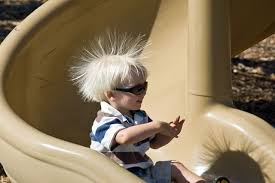
What method of static charging is shown in this picture
a)
Polarization
b)
Friction
c)
Induction
d)
Conduction
23.
True or False, Lighting is a form of static electricity.
a)
True
b)
False
24.

What are the charged parts of an atom?
a)
proton and neutron
b)
proton and electron
c)
neutron and electron
d)
proton, neutron, and electron
25.
What would have to happen for an atom to become positively charged?
a)
Gain protons
b)
Gain electrons
c)
Lose protons
d)
Lose electrons
26.
What would have to happen for an atom to become negatively charged?
a)
Gain protons
b)
Gain electrons
c)
Lose protons
d)
Lose electrons
27.
When a negatively charged object is used to charge a neutral object, the neutral object will ____.
a)
remain neutral
b)
become positive
c)
become negative
28.

Bending water with a charged balloon is an example of what type of charging (charging an object without touching)
a)
friction
b)
induction
c)
conduction
29.
an abrupt electrical discharge
a)
conductor
b)
insulator
c)
spark
d)
charge
30.

the negatively charged particle in an atom. Moves freely. Can be released, shared, or “stolen” from an atom.
a)
proton
b)
neutron
c)
electron
31.
the positively charged particle in an atom. Never leaves the nucleus. Number of protons determines the type of element.
a)
proton
b)
neutron
c)
electron
32.

Lightning occurs because ___.
a)
the negative charges at the bottom of clouds are attracted to the positive charges on the ground.
b)
the positive charges at the bottom of clouds are attracted to the negative charges on the ground.
c)
the positive and negative charges inside clouds are attracted to each other
d)
All of these reasons are correct.
33.

Lightning rods attract lightning.
a)
True
b)
Fase
34.

Why do lightning rods need to be grounded?
a)
They don't. The rod is enough to protect the home
b)
to create a path for the electricity to get to the ground
c)
to direct the electricity to the power grid of the house
d)
to deflect the electricity back into the cloud
100 %

