
 Worksheets
Mid-Year Science Review
Total questions: 40
Worksheet time: 26mins
Name
Class
Date
1.
Which of the following is the smallest unit of life that can carry out all life functions?
a)
the mitochondria
b)
the vacuoles
c)
the nucleus
d)
the cell
2.
When many organ systems work together it can form...
a)
organ
b)
cells
c)
organ system
d)
organism
3.
Which structures are found in every living cell?
a)
cell membrane and cytoplasm
b)
chloroplasts and mitochondria
c)
a cell wall and nucleus
d)
chloroplasts and cell wall
4.
Which cell structure is found in plant and animals cells and controls what can come into or leave a cell?
a)
cell membrane
b)
cytoplasm
c)
nucleus
d)
vacuole
5.
What is the function of the cell nucleus found in both plant and animal cells?
a)
to produce energy
b)
to control cell activity
c)
to remove waste products
d)
to allow molecules to enter the cell
6.
Chloroplasts in plant cells allow the plant to perform a function that animal cells cannot do. What is the main function of the chloroplasts found in plant cells?
a)
to absorb light energy and manufacture food
b)
to remove waste materials by active transport
c)
to manufacture chemical energy from food
d)
to control the shape of the cell
7.
All cells need energy to function. Which cell organelle is responsible for producing energy in the cell?
a)
chloroplasts
b)
mitochondria
c)
nucleus
d)
vacuoles
8.
What is the function of a cell wall?
a)
to protect and support the cell
b)
to perform different functions in each cell
c)
to prevent water from passing through it
d)
to prevent oxygen from entering the cell
9.
In what part of the plant cell does the process of photosynthesis take place?
a)
nucleus
b)
mitochondria
c)
chloroplasts
d)
vacuoles
10.
The basic unit of structure and function in a living things.
a)
chloroplast
b)
nucleus
c)
cell
d)
cell membrane
11.
Which vertebrate groups are warm blooded (have a constant body temperature)
a)
only mammals and birds
b)
mammals, birds and reptiles
c)
only mammals
d)
all vertebrates are warm blooded
12.
Which group of vertebrates is found only in water?
a)
Fish
b)
Crustaceans
c)
Amphibians
d)
Fish and amphibians
13.
Which vertebrate groups lay eggs
a)
Birds and fish only
b)
Birds and amphibians only
c)
Birds only
d)
Birds, reptiles, amphibians and fish.
14.
Which group of vertebrates feeds its young milk (with mammary glands)
a)
mammals
b)
both mammals and birds
c)
reptiles
d)
amphibians
15.
Which vertebrate groups have skin with scales?
a)
Only fish
b)
Only reptiles
c)
Both fish and reptiles
d)
Fish, reptiles and amphibians
16.
Another name for a backbone
a)
invertebrae
b)
humerus
c)
femur
d)
vertebrae
17.
What is an example of an amphibian ?
a)
Lizard
b)
Iguana
c)
Platipus
d)
Tadpole
18.
Which of the following has an exoskeleton?
a)
Foxes
b)
Birds
c)
Lobsters
d)
Fish
19.
I have dry and rough skin, lay eggs, breathe with lungs, and am ectothermic (cold-blooded). What am I?
a)
Fish
b)
Mammals
c)
Amphibians
d)
Reptiles
20.
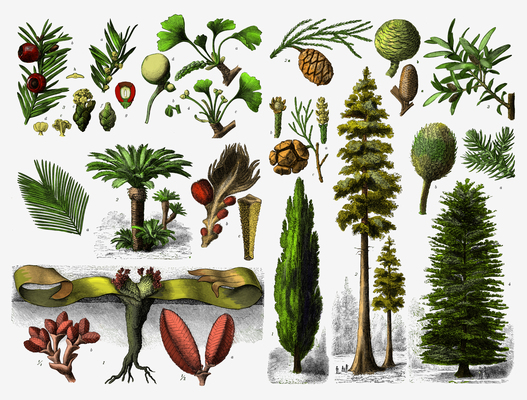
These plants are gymnosperms because
a)
they reproduce through cones
b)
they are coniferous
c)
their seeds are visible
d)
all of the above
21.

These plants are angiosperms because
a)
They reproduce through seeds
b)
They reproduce through cones
c)
They reproduce through spores
d)
They are actually gymnosperms
22.
Which of the following is most likely inherited by flowering plants?
a)
lean on a pole
b)
the ability to produce cones
c)
the ability to produce seeds
d)
forming different shapes when trimmed
23.
Which of these are characteristics of inherited traits?
a)
the ability to speak in front of a crowd
b)
having green eyes and brown hair
c)
mastering multiplication facts
d)
becoming an extrovert
24.

Which of the following describes a learned behavior in a dog?
a)
eating meat
b)
running fast
c)
digging holes
d)
guiding sheep
25.
Which of these is not an instinctive behavior?
a)
a bird building a nest
b)
a turtle burying its eggs
c)
a bear hibernating in winter
d)
a horse pulling a plow
26.
Karen has two sisters and one younger brother. She is the only blonde in her family. However, everyone in her family has brown eyes.
Which of these is being described in the passage?
Which of these is being described in the passage?
a)
gene display
b)
inherited traits
c)
learned behaviors
d)
nature versus nurture
27.
Some birds fly south for the winter. Birds know when and where to fly because of ________________.
a)
camouflage
b)
mimicry
c)
instinct
d)
hibernation
28.
Smelts are fish that lay their eggs in the sand on beaches. When the eggs hatch, the babies know to go to the water. This is an example of _______________________.
a)
instinct
b)
hibernation
c)
camouflage
d)
learned behavior
29.
Why do organisms resemble their parents?
a)
because traits are inherited from parent to offspring
b)
because traits are given as gifts on holidays
c)
because if they don’t look like their parents they wouldn’t match
d)
because people wouldn’t recognize their siblings if they didn’t look alike
30.
Each of the following is a learned behavior EXCEPT which one?
a)
speaking a second language
b)
reading
c)
writing
d)
sleeping
31.
Which is an example of a chemical reaction?
a)
paper cut into small pieces
b)
chocolate melting in a pan
c)
flour and sugar mixed in a bowl
d)
cookies baking in an oven
32.
Which is a physical change?
a)
digesting food
b)
burning natural gas
c)
exploding firework
d)
chopping onions
33.

Photosynthesis is an example of a
a)
physical change
b)
chemical change
34.
Dissolving sugar in water is an example of a
a)
physical change
b)
chemical change
35.
The burning of coal is an example of a
a)
chemical change
b)
physical change
36.
Using a balance to measure mass is an example of
a)
chemical change
b)
physical change
37.
What kind of properties can only be observed when a substance changes into a different substance?
a)
physical properties
b)
chemical properties
c)
liquid properties
d)
real properties
38.
Which of the following is a sign that a chemical reaction has occurred?
a)
change in shape
b)
melting
c)
formation of a gas
d)
dissolving
39.
A change in the size, shape, or state of matter.
a)
chemical change
b)
physical change
c)
chemical reaction
d)
electron change
40.
Jayden asked Gabe what she could do to an egg for a chemical change. Gabe answered correctly and said...
a)
You can drop the egg.
b)
You can cook the egg.
c)
You can crack the egg.
d)
You can paint the egg.
100 %

