wayground logo

Free Printable Worksheets

NEW

Font size

S
M
L
XL
Worksheets

Bonding

Total questions: 43

Worksheet time: 29mins

Name
Class
Date
1.
Which of the below elements will most likely form an Ionic Bond
a)
P and O
b)
Cs and O
c)
Li and Mg
d)
Ne and Cl
2.
Which of the below element swill most likely form an Covalent Bond? 
a)
K and Cl
b)
H and O
c)
Al and Mg
d)
K and Na
3.
What two types of atoms make a covalent bond?
a)
2 Nonmetals
b)
1 Nonmetal and 1 Metal
c)
2 Metals
d)
2 Noble Gases
4.
How are covalent bonds explained?
a)
When one atom takes the other atom's electron
b)
When the atom shares an electron with an another atom
c)
When the two nucleus merge
d)
When the neutrons leave the nucleus
5.
Ionic or covalent?
NaBr
a)
Ionic
b)
Covalent
6.
Ionic or covalent?
H2O
a)
Ionic
b)
Covalent
7.
Positive ions form when atoms _________ valence electrons.
a)
lose
b)
gain
c)
share
d)
gain or share
8.
Ionic compounds form because _______ charges attract.
a)
opposite
b)
like
9.
Nonmetals are most likely to _____________ valence electrons in order to have a stable arrangement.
a)
lose
b)
gain
c)
gain or share
d)
share
10.
Which is most likely to form an ion of -1?
a)
an element from group 17
b)
a metal
c)
an element from group 1
d)
an element with atoms that have eight valence electrons
11.

What is the overall charge of a molecule?

a)

Positive

b)

Negative

c)

Neutral

12.
In the compound aluminum oxide, which is the cation?
a)
Al+3
b)
Al
c)
O-2
d)
O
13.

What is it called when atoms share one pair of electrons?

a)

A double bond

b)

A triple bond

c)

A quadruple bond

d)

A single bond

14.

What is it called when atoms share three pairs of electrons?

a)

A single bond

b)

A double bond

c)

A triple bond

d)

a quadruple bond

15.
How many valence electrons does hydrogen have?
a)
1
b)
2
c)
3
d)
4
16.
When an atom loses an electron, it becomes a:
a)
positive ion
b)
negative ion
c)
neutral ion
d)
neutral atom
17.
Which of the following is NOT a property of ionic compounds?
a)
They have very high melting points
b)
They conduct electricity when in solution
c)
They have high boiling points
d)
They are insoluble in water
18.
Ionic compounds are formed when one or more valence electrons are transferred from _____
a)
a nonmetal atom to a metal atom
b)
a nonmetal atom to a nonmetal atom
c)
a metal atom to a nonmetal atom
d)
a metal atom to a metal atom
19.
This is a correct dot diagram for neon (Ne)
a)
true
b)
false
20.
This could be the dot diagram of
a)
Ne
b)
H
c)
C
d)
F
21.
This is a correct dot diagram for oxygen (O)
a)
true
b)
false
22.
A covalent bond in which electrons are shared unequally is:
a)
polar
b)
a double bond
c)
ionic
d)
polyatomic
23.
How many valence electrons do most atoms need to be stable?
a)
1
b)
2
c)
6
d)
8
24.
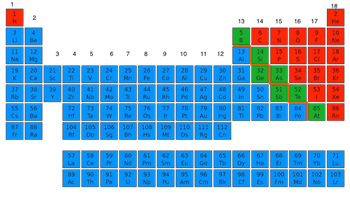
Where are the nonmetals located on the periodic table? 
a)
Blue
b)
Red
c)
Green
25.
Ionic compounds have _______ melting point.
a)
High
b)
Low
26.

Overlapping outer energy levels of two metal atoms allow what kind of bond to form as well as create a sea of electrons?

a)

Ionic

b)

Metallic

c)

Covalent

d)

Polyatomic

27.
Negative ions form when atoms _________ valence electrons.
a)
lose
b)
gain
c)
share
d)
gain or share
28.

A covalent bond in which electrons are not shared equally, because one element is more electronegative, is called______________________. The EN difference ranges from 0.3 to 1.65.

a)

Polar covalent bond

b)

Ionic bond

c)

Lopsided bond

d)

Unfair bond

29.
A anion will be a ____ ion.
a)
negative
b)
positive
c)
neutral
30.
A cation is a ____ ion.
a)
negative
b)
positive
c)
neutral
31.
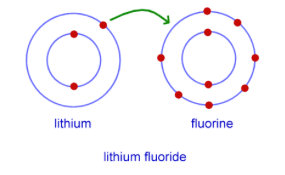
What type of bond is this?
a)
ionic
b)
polar covalent
c)
nonpolar covalent
d)
metallic
32.
How many electrons are needed in the outer energy levels of an atom to be stable?
a)
2
b)
4
c)
6
d)
8
33.
What are valence electrons?
a)
The sum of neutrons and protons.
b)
The electrons in the outermost energy level of an atom.
c)
A type of bond.
d)
A popular compound.
34.
What is it called when atoms share two pairs of electrons?
a)
A double covalent bond
b)
A single covalent bond
c)
A triple covalent bond
d)
A quadruple bond
35.

Which of these substances has only covalent bonds in it?

a)

NaCl

b)

Pb(NO3)2

c)

CO2

d)

AlCl3

36.

The compound 02 would be classified as a(n)____. The EN difference between the oxygen atoms is 0.

a)

Nonpolar Covalent Bond

b)

Ionic Bond

c)

Polar covalent

d)

Metallic Bond

37.
When Calcium forms a bond, what will occur? 
a)
Calcium with give away it two valence electrons to form an covalent bond. 
b)
Calcium will share its two valence electrons to form an covalent bond
c)
Calcium will give away its two valence electrons to form an ionic bond
d)
Calcium will share its two valence electrons to form an ionic bond. 
38.

Which one of these compounds would be classified as covalently bonded?

a)

CaCl2

b)

P2O5

c)

KI

d)

MgO

39.
When the electronegativity difference between two elements is greater than 1.65, then the bond formed is likely to be
a)
ionic
b)
polar covalent
c)
nonpolar covalent
40.
When the electronegativity difference between two atoms is between 0 and 0.3, then the bond formed between them is likely to be
a)
ionic
b)
polar covalent
c)
nonpolar covalent
41.

Two atoms are found to have an electronegativity difference of 1.1. The bond formed between them is likely to be

a)

ionic

b)

polar covalent

c)

nonpolar covalent

42.
How many valence electrons does calcium have?
a)
2
b)
4
c)
6
d)
7
43.
What type of bond transfers (gains/lose) electrons? 
a)
Metallic
b)
Ionic
c)
Covalent