
Font size
 Worksheets
Chemistry Unit 7 Review
Total questions: 38
Worksheet time: 1hrs 3mins
Which formula below is rearranged correctly for frequency?
c=λv
v=cλ
v=λc
v=cλ

What formula calculates the energy of a photon?
c=λv
λ=vc
E=hv
v=λc

Light represent by arrow B. is best described as...
Reflected
Absorbed
Transmitted
Refracted
If most of the light is transmitted, what is the color of the object?
Blue/Purple
Red/Orange
Green/Yellow
Blue/Green
When using this formula: c=λv what units can you use? Select the ones that apply.
nm
m
Hz
GHz
The frequency of violet light is 7.5x10¹⁴ Hz. What is its wavelength?
4.0x10⁻⁷ m
4.0x10⁷ m
2.25x10²³m
2.25x10²³ Hz
Violet light has a wavelength of
4.10 x 10⁻⁷ m. What is the frequency?
1.23 x 10⁻³ Hz
7.31 x 10¹⁴ Hz
1.37 x 10¹² Hz
3.0 x 10⁸ Hz
What is Planck's Constant (h)?
h = 6.626x10⁻³⁴ Js
h = 6.626x10 34 J/s
h= 3.0x10⁸ ms
h = 3.0x10⁸ m/s
What is the energy of a photon with a frequency of 5x10¹⁴ Hz?
2.5x10⁻¹⁹ J
3.0x10⁻¹⁹ J
3.3x10⁻¹⁹ J
4.5x10⁻¹⁹ J
Which of the following has the smallest wavelength?
Blue
Yellow
Red
As wavelength goes down, the energy per photon goes....
up
down
stays the same
What is the molarity of 4.00 g of NaCl (MM=58.45 g/mol) in 3.8 L of solution?
How many moles of solute are dissolved in 125.0 mL of 5.00 M
0.625 mol
625 mol
25 mol
0.04 mol
Which solution would have the greatest absorbance?
1 M
3 M
3.1 M
2.5 M
How many grams of AgNO3 (molar mass = 169.87 g/mol) are in 250 mL of a 0.125 M.
0.03g
How many mL of stock solution of 2M NaCl do you need to prepare 100 mL of 0.150M NaCl? (dilution solve for V1)
7.5 mL
15 mL
1333 mL
200 mL
A solution is made by dissolving 0.50 mole of NaCl in enough water to give a final volume of 400.0 mL. What is the molarity of the solution?
0.10 M
0.40 M
1.25 M
2.33 M
What is the molarity of a solution made by diluting 26.5 mL of 6.00 M HNO3 to a volume of 250 mL?
What is the phase of AgCl(?)
aq
s
g
Na2CrO4
slightly soluble
When Fe3+ and S2- are combined the compound formed will be
slightly soluble
Ca(OH)2
soluble
slightly soluble
insoluble
Which is the correct net ionic equation when AgNO3 and CaCl2 are combined.
CuCl2 + NaOH → Cu(OH)2 + NaCl
Which product is insoluble?
What are the spectator ions in this reaction?
CuCl2(aq) + NaOH(aq) → Cu(OH)2(s) + NaCl(aq)
Cu2+ and OH-
Na2+ and Cl2-
Na+ and Cl-
Na+ and OH-
2NaOH(aq) + CuCl2(aq) → 2NaCl(aq) + Cu(OH)2(s)

(honors) Using the graph, what is the concentration of a solution that has an absorbance of 0.067?
0.511 M
0.532 M
0.126 M
0.504 M

(honors) Using the graph, what would be the absorbance of a solution that has a concentration of 1.14 M?
1.14
0.133
0.144
0.126
If a solution is red, which wavelength would be a BAD choice if you want to measure its absorbance.
410 nm
450 nm
535 nm
680 nm
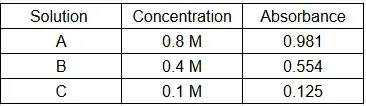
Solution D has an absorbance of 0.781. What is the best estimate of concentration for solution D.
0.1 M
0.95 M
0.6 M
0.3 M
Which of the following combination will produce a precipitate?
NaCl + KOH
Na2CrO4 + LiNO3
Na3PO4 + Ba(OH)2
Na2SO4 + (NH4)2S
What is the molar mass of aluminum chloride: AlCl3
62.4 g/mol
132 g/mol
133.5 g/mol
97.9 g/mol
What is the volume of a solution with 0.01 moles of solute and a concentration of 0.5 M
20 mL (0.02 L)
200 mL (0.200 L)
5 mL (5000 L)
50 mL (0.05 L)

The image shows two purple solution of KMnO4. Which solution absorbs more purple light?
Solution A
Solution B
A trick question! Purple objects do not absorb purple light.
What electrolytes are produced when Ca(NO3)2 is dissolved in water?
Ca2+ and 2NO3-
Ca2+ and NO3-
Ca and NO3
No electrolytes produced. This compound is insoluble.
What electrolytes are produced when Mg(OH)2 is dissolved in water?
Mg2+ and 2OH-
Mg2+ and OH-
Mg and OH
No electrolytes produced. This compound is insoluble.
(Honors) What mass of precipitate can be produced from the reaction of 2.0 L of 0.006 M AgCH3CO2 with an excess Li2CrO4?
2 AgCH3CO2(aq) + Li2CrO4(aq) --> 2 LiCH3CO2(aq) + ________ (s)
2.0 g
0.95 g
4.0 g
25.3 g
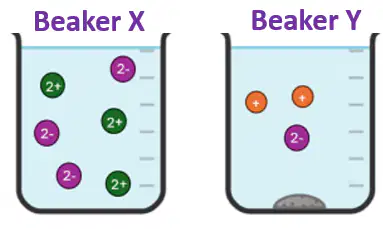
Select the correct choice
Beaker X represents a more soluble solute and a more conductive solution
Beaker Y represents a more soluble solute and a more conductive solution
Beaker X represents a more soluble solute but a less conductive solution
Beaker Y represents a less soluble solute but a more conductive solution

