
 Worksheets
Bonding Review
Total questions: 42
Worksheet time: 41mins
Name
Class
Date
1.
Are the atoms more stable when they are bonded together or when they are apart?
a)
Bonded Together
b)
Apart
2.
Ionic Bonding involves...
a)
The transfer of protons
b)
The transfer of nuetrons
c)
The transfer of electrons
d)
None Of the above
3.
What usually forms the positive ion?
a)
Metal
b)
Non Metals
c)
None
4.
What usually forms the negative ion?
a)
nonmetals
b)
metal
c)
none
5.
Covalent compounds
a)
Share electrons
b)
transfer electrons
c)
contain a sea of electrons
d)
conduct electricity
6.
What two types of atoms make a covalent bond?
a)
2 Nonmetals
b)
1 Nonmetal and 1 Metal
c)
2 Metals
d)
2 Noble Gases
7.
What happens when an atom loses an electron?
a)
Neutral (no charge)
b)
Positive charge
c)
Negative charge
8.
What happens when an atom gain an electron?
a)
Neutral(no charge)
b)
Positive charge
c)
Negative charge
9.
What charges attract?
a)
Opposite
b)
Same
10.
What charges repel?
a)
Same
b)
Opposite
11.
Predict the bond that will form between Be and F.
a)
Ionic
b)
Covalent
12.
Predict the bond that will form between Se and Cl.
a)
Ionic
b)
Covalent
13.
What is a valence electron?
a)
an electron that is found in the outermost shell of an atom.
b)
an electron found in the innermost shell of an atom.
c)
an electron found in the middle shell.
14.
What is the number of valence electrons for Oxygen?
a)
8
b)
6
c)
2
d)
1
15.
What is the number of valence electrons for Beryillum?
a)
1
b)
4
c)
2
d)
7
16.

How many valence electrons in this structure?
a)
6
b)
5
c)
4
d)
7
17.
What two types of atoms make an ionic bond?
a)
2 Nonmetals
b)
1 Nonmetal and 1 Metal
c)
2 Metals
d)
2 Noble Gases
18.
What is the VSEPR theory used to predict?
a)
Bond Strength
b)
Polarity
c)
Molecular Shape
d)
Electronegativity
19.
According to VSEPR, molecules adjust their shapes to keep which of the following as far away as possible?
a)
Valence shell electrons
b)
Inner shell electrons
c)
Bonded electrons
d)
Lone pair electrons
20.
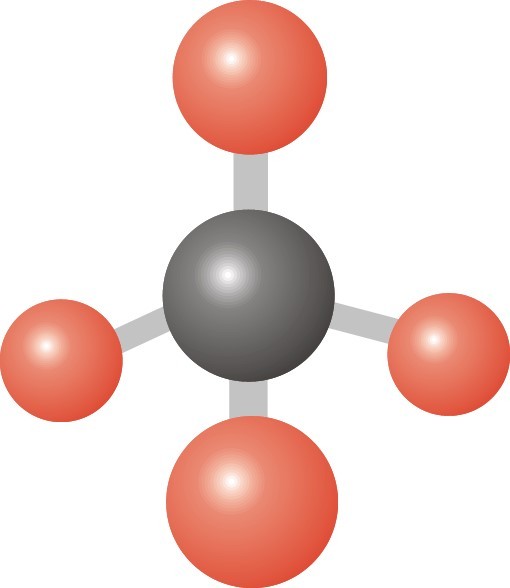
What is the name of this molecular shape?
a)
Tetrahedral
b)
Trigonal planar
c)
Trigonal pyramid
d)
Trigonal bipyramidal
21.
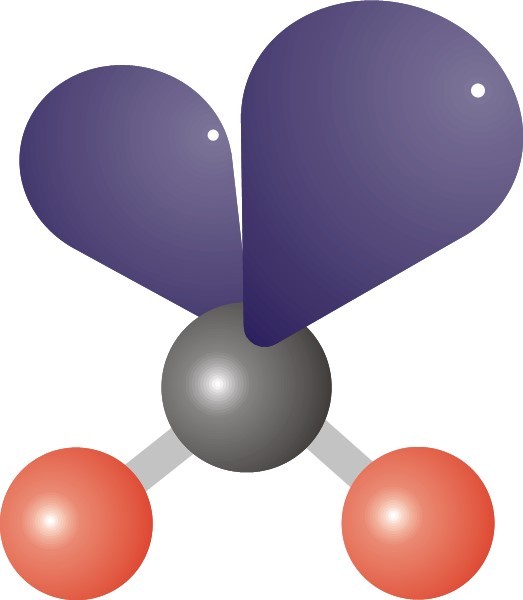
What is the name of this molecular shape?
a)
Trigonal Planar
b)
Linear
c)
Bent
d)
Tetrahedral
22.
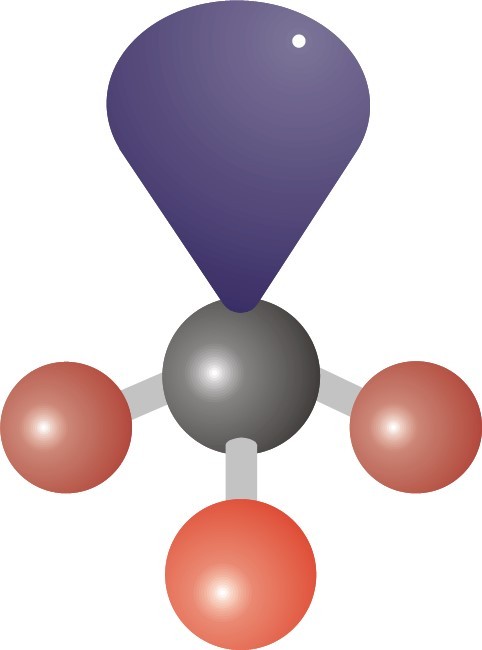
What is the name of this molecular shape?
a)
Bent
b)
Trigonal Pyramid
c)
Tetrahedral
d)
Trigonal Planar
23.
Which of the following is nonpolar?
a)
PH3
b)
H2O
c)
SiO2
d)
SeS2
24.
Which of the following elements has the weakest attraction for electrons in a chemical bond?
a)
S
b)
Cl
c)
O
d)
F
25.
The polarity of a bond between two elements can be best determined by
a)
The difference in electronegativity between the elements
b)
The difference in first ionization energy between the elements
c)
The number of electrons shared in the bond
d)
The difference in atomic radius between the elements
26.
Which formula represents a polar molecule?
a)
H2
b)
H2O
c)
CO2
d)
CCl4
27.
The ability of an atom to attract electrons to itself is called
a)
geometry
b)
conductivity
c)
electronegativity
d)
ionization energy
28.

What word describes when water is attracted to other substances?
a)
cohesion
b)
adhesion
c)
capillary action
d)
surface tension
29.

Attractions between water molecules are called
a)
Covalent bonds
b)
Ionic bonds
c)
Polar bonds
d)
Hydrogen bonds
30.

tendency of molecules of the same kind to stick to one another
a)
cohesion
b)
adhesion
c)
solution
d)
polar molecule
31.

molecule in which opposite ends have opposite electric charges
a)
cohesion
b)
polar molecule
c)
hydrogen bond
d)
solution
32.
Why does ice float?
a)
As water freezes, it expands and its density decreases.
b)
As water freezes, it takes up more hydrogen from the atmosphere, causing it to have a greater buoyancy.
c)
As water freezes, air becomes trapped between the hydrogen bonds of water molecules.
d)
As water freezes, it takes up more oxygen from the atmosphere, causing it to have a greater buoyancy.
33.
Which types of compounds dissolve easily in water?
a)
Polar and Nonpolar
b)
Polar and Ionic
c)
Nonpolar and Ionic
d)
Covalent and Nonpolar
34.
Water is a universal solvent because it...
a)
It can be found anywhere
b)
It freezes when it gets cold
c)
floats when frozen
d)
Dissolves most substances
35.
A high specific heat means...
a)
It heats up quickly with energy added
b)
It requires more energy to change temperature
36.
What is surface tension?
a)
Water's ability to stick to itself
b)
Water's ability to stick to other substances
c)
The strength of the cohesion of all the water molecules combined
d)
Tape, glue and other adhesives
37.
Covalent compounds
a)
Share electrons
b)
transfer electrons
c)
contain a sea of electrons
d)
conduct electricity
38.
Ionic Bonding involves...
a)
The transfer of protons
b)
The transfer of nuetrons
c)
The transfer of electrons
d)
None Of the above
39.
Which IMF contains a temporary dipole?
a)
London Dispersion Forces
b)
Dipole Dipole
c)
Hydrogen Bonding
d)
Both London Dispersion Forces and Dipole Dipole
40.
What is the predominant IMF for H2O?
a)
London dispersion forces
b)
Dipole dipole
c)
Hydrogen bonding
41.
Which is the strongest intermolecular force below
a)
Ionic
b)
Dispersion
c)
Hydrogen bonding
d)
dipole-dipole
42.
In general, substances with stronger intermolecular forces have ________ boiling points than those with weaker forces
a)
Higher
b)
Lower
c)
Forces and boiling point are not related
100 %

