
 Worksheets
M/J Physical Science Midterm Review Semester 1
Total questions: 96
Worksheet time: 1hrs 19mins
Name
Class
Date
1.
If a lab fire erupts, immediately:
a)
A. Notify (or tell) your teacher
b)
B. Run and scream
c)
C. Throw water at the fire
d)
D. Open the windows
2.
Why are approved eye protection devices (such as goggles) are worn in the lab?
a)
A. To improve your vision
b)
B. To make you look like a bug
c)
C. To give you headaches
d)
D. To protect eyes around chemicals, heat, or glassware
3.
What should you do when gathering materials for an experiment?
a)
A. Read all directions carefully
b)
B. Check all materials for chips or cracks (or broken)
c)
Clean the materials if they seem dirty/used
d)
D. All of the above
4.

You may eat or drink in the science laboratory...
a)
after you have washed your hands.
b)
on the days you are not doing a lab.
c)
only from the beakers.
d)
at no time unless given teacher approval.
5.
This type of force is when one object pushes or pulls on another object by touching it
a)
contact
b)
gravity
c)
friciton
6.
This type of force is an attraction between two objects
a)
contact
b)
gravity
c)
friction
7.
This type of force resist motion between two surfaces that are pressed together
a)
contact
b)
gravity
c)
friction
8.
If the net force is equal to zero, the forces acting on the object are
a)
balanced
b)
unbalanced
9.
Balanced forces do not change the objects speed or
a)
direction
b)
distance
c)
time
d)
mass
10.
The unit of force is
a)
m/s
b)
m/s^2
c)
newton
d)
kg
11.
What is defined as a push or pull?
a)
force
b)
motion
c)
vector
d)
speed
12.
Jupiter has about 317 times more mass than Earth. What can you infer from this fact?
a)
That Jupiter’s gravitational force is much weaker than on Earth’s gravitational force.
b)
That Jupiter’s gravitational force is much stronger than Earth’s gravitational force.
c)
That Jupiter’s and Earth’s gravitational forces are equal.
d)
Mass has no effect on the gravitational force between two objects
13.

What type of force?
a)
Magnetic
b)
Gravitational
c)
Applied
d)
Normal
14.

What type of force is holding this balloon to the wall?
a)
Applied
b)
Gravitational
c)
Magnetic
d)
Electrical
15.

What force brings the pencil down?
a)
Applied
b)
Magnetic
c)
Normal
d)
Gravitational
16.
Simon wanted to know if the height of a ramp affected how fast the car went down it. What part of this experiment is Simon's INDEPENDENT (Test) Variable?
a)
height of the ramp
b)
the type of car
c)
the speed of the car
d)
there isn't one
17.
Simon wanted to know if the height of a ramp affected how fast the car went down it. What part of this experiment is Simon's Dependent (Outcome) Variable?
a)
there isn't one
b)
the height of the ramp
c)
the type of car
d)
the speed of the car
18.
An _______ force must act on an object for it to CHANGE it's motion
a)
balanced
b)
unbalanced
c)
gravitational
d)
electrical
19.
Speed is
a)
the distance covered per unit of time
b)
the time it takes something to move a certain distance
c)
distance x time
d)
time x distance
20.
What two quantities must I know to calculate something's speed?
a)
time and weight
b)
position and distance
c)
distance and time
d)
distance and speed
21.
What does the strength of gravity between two objects depend upon?
a)
Mass & distance
b)
Mass & weight
c)
Gravity & inertia
d)
Inertia & mass
22.

What is the speed of the object at 10 km?
a)
1.5 km/hr
b)
15 km/hr
c)
.67 km/hr
d)
67 km/hr
23.

What is the average speed of the movement of this object?
a)
5 m/sec
b)
13 m/sec
c)
65 m/sec
d)
.2 m/sec
24.
The Law of Conservation of Energy states:
a)
Energy can created or destroyed but not transformed
b)
Energy cannot be created or destroyed, it can only transformed
c)
Energy can't be created, destroyed or transformed
25.
According to the Law of Conservation of energy, the amount of energy before and after a reaction must be the same. Which statement below is true?
a)
The total amount of energy is conserved
b)
The total amount of energy is less after a reaction
c)
The total amount of energy is more after a reaction
26.
Which energy transformation below matches?
Animals eating food?
Animals eating food?
a)
electrical to potential
b)
chemical to kinetic
c)
potential to chemical
27.
Potential or kinetic?
Stretched bow and arrow?
Stretched bow and arrow?
a)
kinetic
b)
potential
28.
When a roller coaster is at the bottom of the hill...
a)
The potential energy is greatest, and kinetic energy is least
b)
The kinetic energy is greatest, and potential energy is least
c)
Kinetic and Potential energy are equal
29.
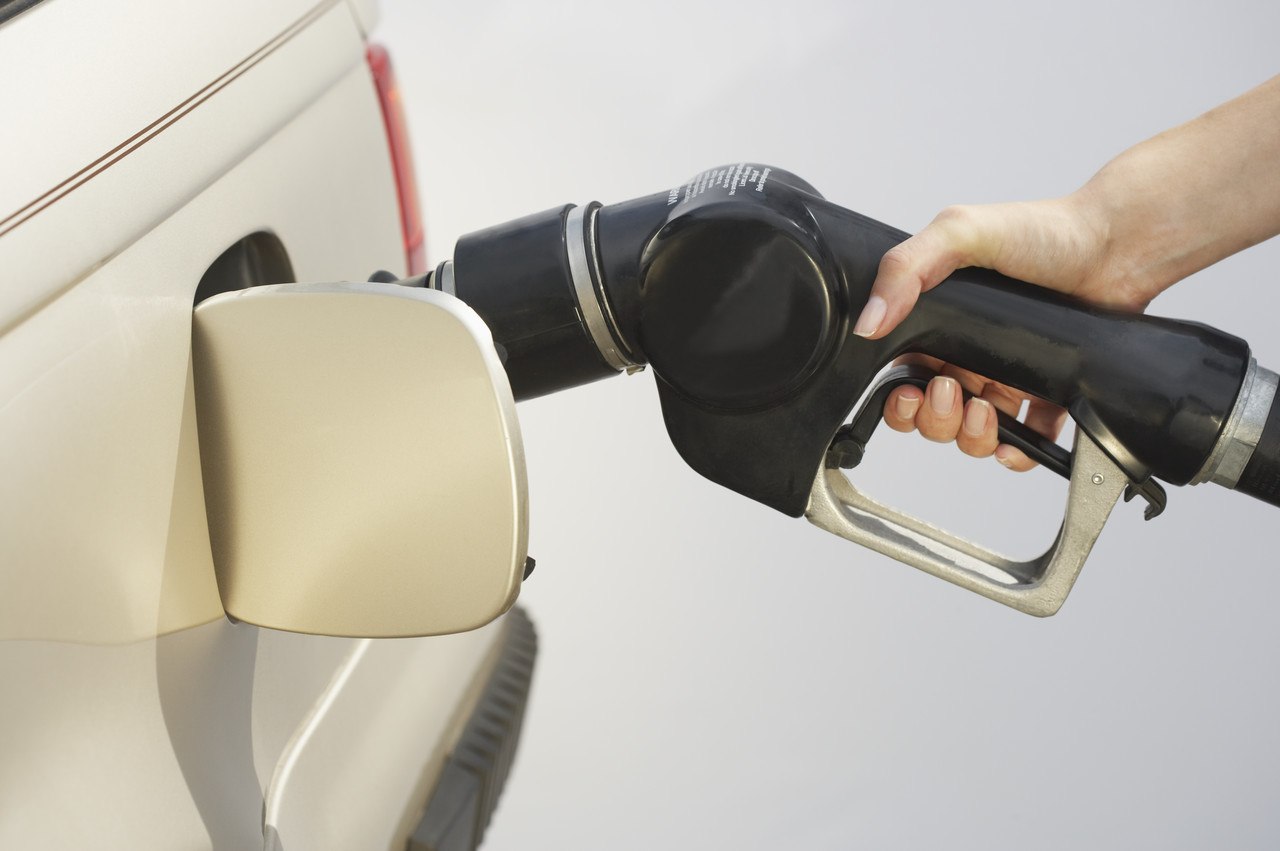
Which energy conversion is taking place when you put gasoline in a car?
a)
thermal -> electrical
b)
mechanical -> electrical
c)
chemical -> mechanical
d)
mechanical -> electromagnetic
30.

what type of energy is stored in a battery?
a)
electrical
b)
chemical
c)
thermal
d)
mechanical
31.

When you eat pizza, Chemical Energy is transferred to _____ Energy.
a)
Solar
b)
Electrical
c)
Mechanical
d)
Chemical
32.
Heat transfer always goes from-
a)
Cold to Hot
b)
Hot to Cold
c)
Heat doesn't transfer
d)
Freezing to Cold
33.
What happens to particles as they heat up?
a)
They slow down
b)
Nothing
c)
They don't move
d)
They speed up
34.
What happens to particles as they cool down?
a)
They slow down
b)
Nothing
c)
They don't move
d)
They speed up
35.
Which sentence explains why a cold metal spoon placed in a pot of boiling water becomes hot?
a)
Thermal energy is transferred from the spoon to the water.
b)
Thermal energy is transferred from the water to the spoon.
c)
Thermal energy in the water is transformed into kinetic energy in the spoon.
d)
Thermal energy in the spoon is transformed into kinetic energy in the water.
36.
When holding a cup of ice water, your warm hand becomes cold. How does the heat transfer?
a)
From the cold cup to your hand
b)
From the cold cup to the warm air
c)
From the ice to your hand
d)
From your warm hand to the cold cup.
37.
What is heat?
a)
How fast something warms up.
b)
The measure of the average kinetic energy of all the particles in an object.
c)
The transfer of energy from one object to another because of a temperature difference.
d)
The amount of kinetic energy in a substances
38.
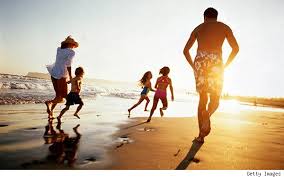
The sun shines down on this family as the play on the beach.
a)
conduction
b)
convection
c)
radiation
39.

A group of friends gather around a fire to stay warm.
a)
conduction
b)
convection
c)
radiation
40.
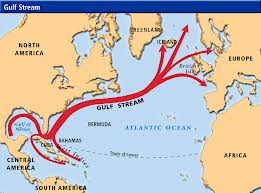
The Gulf Stream is a current that brings warm ocean water from the south to the north.
a)
conduction
b)
convection
c)
radiation
41.
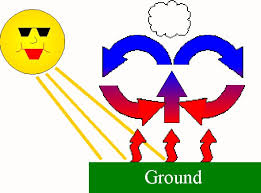
Warm air rises and the cool air sinks.
a)
conduction
b)
convection
c)
radiation
42.
What is the definition of CONDUCTION?
a)
When heat is transferred from objects like rays of light or electromagnetically.
b)
a hot liquid or air that expands, becomes less dense, and rises or becomes more dense, and sinks.
c)
When heat transfers from objects that are touching.
d)
When heat transfers through the heater or AC in your house.
43.
What is the definition of CONVECTION
a)
When heat transfers through waves.
b)
When heat transfers from objects that are touching.
c)
a hot liquid or air that expands, becomes less dense, and rises or becomes more dense, and sinks.
d)
Heat traveling from the sun
44.
Transfer of thermal energy through "space"
a)
conduction
b)
convection
c)
radiation
45.
What are the states of matter?
a)
solid, liquid, and juice
b)
solid and liquid
c)
solid and gas
d)
solid, liquid, and gas
46.

Which form of matter has a definite shape and takes up space (has definite volume)?
a)
liquid
b)
solid
c)
gas
d)
clay
47.

Which form of matter take the shape of a container like this juice?
a)
liquid
b)
solid
c)
glass
d)
gas
48.

Which form of matter fills the space like it has in the balloon?
a)
liquid
b)
string
c)
solid
d)
gas
49.
What is happening when my ice cream changes from a solid to a liquid?
a)
freezing
b)
melting
c)
burning
d)
evaporation
50.
What is happening when my water bottle in the freezer goes from a liquid state to a solid state?
a)
melting
b)
evaporating
c)
freezing
d)
cutting
51.
What happens when my glass of water is sitting in the sun and disappears into a gas?
a)
evaporation
b)
burning
c)
melting
d)
freezing
52.
My glass of ice water is sitting in the sun and has droplets of water on the outside of the glass. What is happening?
a)
condensation
b)
evaporation
c)
melting
d)
freezing
53.
Which form of matter does not take the shape of its container?
a)
liquid
b)
gas
c)
solid
d)
air
54.
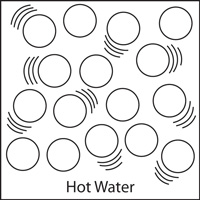
The speed of the molecules determines the _____.
a)
volume
b)
density
c)
pressure
d)
temperature
55.

What does this picture represent?
a)
solid
b)
liquid
c)
gas
d)
plasma
56.

What does this picture represent?
a)
solid
b)
liquid
c)
gas
d)
plasma
57.

The molecules in the picture are tightly held together with little movement. They have shape and energy. Therefore, the picture represents _________.
a)
solid
b)
liquid
c)
gas
d)
plasma
58.

Refract or Reflect?
a)
Refract
b)
Reflect
59.

Refract or Reflect?
a)
Refract
b)
Reflect
60.

Refract or Reflect?
a)
Refract
b)
Reflect
61.

Absorb or Reflect all colors?
a)
Absorb
b)
Reflect
62.

Does the frog reflect or absorb green?
a)
Reflect
b)
Absorb
63.

Does the scarf reflect or absorb yellow?
a)
Reflect
b)
Absorb
64.

Does the rose reflect or absorb red?
a)
Reflect
b)
Absorb
65.
What is a property of a transparent object?
a)
Almost all of the light rays that reach it are scattered.
b)
Almost all of the light rays that reach it are absorbed.
c)
Almost all of the light rays that reach it are reflected.
d)
Almost all of the light rays that reach it pass through it.
66.
Which is translucent?
a)
tissue paper
b)
air
c)
wood
d)
clear plastic
67.
What is most likely to happen to light that hits an opaque object?
a)
All of the light passes through the object.
b)
None of the light passes through the object.
c)
Most of the light disappears.
d)
Some of the light passes through the object.
68.
Which is transparent?
a)
a wooden fence
b)
clean water
c)
aluminum foil
d)
a purple balloon
69.
What does it mean to refract? (refraction)
a)
bounce off
b)
to bend
c)
curve outward
70.
What happens when light hits a mirror?
a)
it makes a color
b)
it reflects
c)
it makes a rainbow
d)
it passes through
71.
How does light travel?
a)
in a wavy path
b)
in a straight path
c)
in a zig zag path
72.
A convex lens curves ____________.
a)
outward
b)
inward
c)
opaque
d)
refracts
73.
A concave lens curves _____________.
a)
outward
b)
inward
c)
opaque
74.
What do all waves have in common?
a)
nothing
b)
they carry energy
c)
they absorb light
d)
you can see them
75.
What happens when light hits an object you can see?
a)
The light turns corners.
b)
The light curves around the object.
c)
The object reflects the light.
d)
The light and the object do not form a shadow.
76.
What happens to blue light when it hits a shirt that appears blue?
a)
The light is reflected.
b)
The light is absorbed.
c)
The light is refracted.
d)
The light is blocked.
77.
Which is translucent?
a)
tissue paper
b)
air
c)
wood
d)
clear plastic
78.
Why do we see objects as black?
a)
They absorb all the light
b)
They reflect all the light
c)
They absorb some light and reflect
79.
4. What separates white light into different colors?
a)
transmission
b)
absorption
c)
scattering
d)
refraction
80.
Light hitting a prism is an example of
a)
Absorption
b)
Reflection
c)
Yellow Light
d)
Refraction
81.
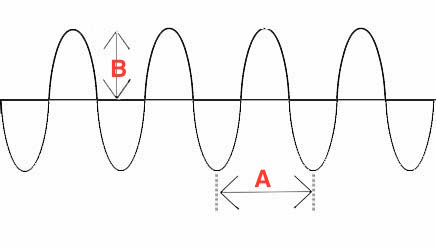
What property of this wave is represented by the letter "A"
a)
amplitude
b)
crest
c)
trough
d)
wavelength
82.
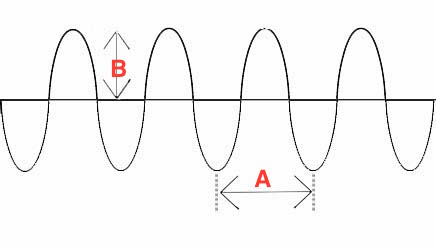
What property of the wave is represented by the letter "B"?
a)
amplitude
b)
crest
c)
trough
d)
wavelength
83.
The highest point on a wave is:
a)
the crest
b)
the trough
c)
the top
d)
the coast
84.
The lowest point on a wave is the:
a)
Amplitude
b)
Crest
c)
Trough
d)
Wavelength
85.
The number of wavelengths that pass a point each per second is:
a)
frequency
b)
period
c)
longitudinal
d)
transverse wave
86.
The type of waves that require medium to pass:
a)
Mechanical Waves
b)
Electromagnetic Waves
87.

Which vocabulary term is used to identify the distance between points C & G?
a)
Amplitude
b)
Crest
c)
Frequency
d)
Wavelength
88.
When the frequency of a wave increases, what happens to the wavelength?
a)
The wavelength is not directly affected by the frequency of a wave.
b)
The wavelength increases.
c)
The wavelength decreases.
d)
More specific information is needed to form a conclusion about the wavelength.
89.
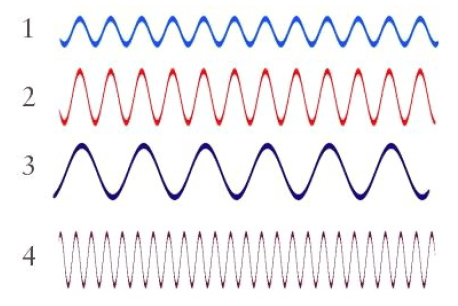
Which wave in the diagram has the greatest frequency?
a)
1
b)
2
c)
3
d)
4
90.
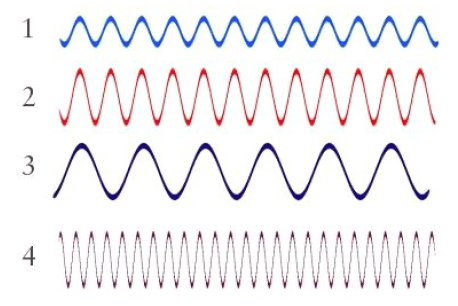
Which wave in the diagram has the greatest wavelength?
a)
1
b)
2
c)
3
d)
4
91.
Which of the following can sound travel through?
a)
solid
b)
liquid
c)
gas
d)
all of the above
92.
which material does sound travel the fastest?
a)
solid
b)
liquid
c)
gases
93.
Which statement best explains the difference between longitudinal and transverse waves?
a)
Longitudinal waves have troughs, while transverse waves have crests.
b)
Longitudinal waves produce energy, while transverse waves consume energy.
c)
Particles in longitudinal waves travel towards a force, while particles in transverse wave travel away from a force.
d)
Particles in longitudinal waves travel in the direction of the wave, while particles in transverse waves travel perpendicular to the wave.
94.
Which of these is the best way to produce a longitudinal wave?
a)
heating a block of iron
b)
freezing a tray of water
c)
squeezing and releasing a metal spring
d)
shaking a rope up and down
95.
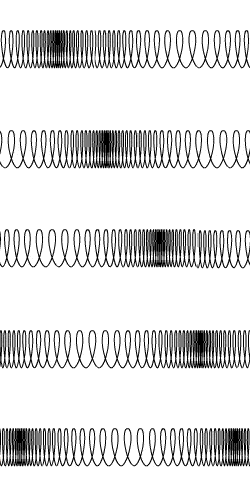
What kind of wave is this?
a)
Transverse
b)
Longitudinal
96.
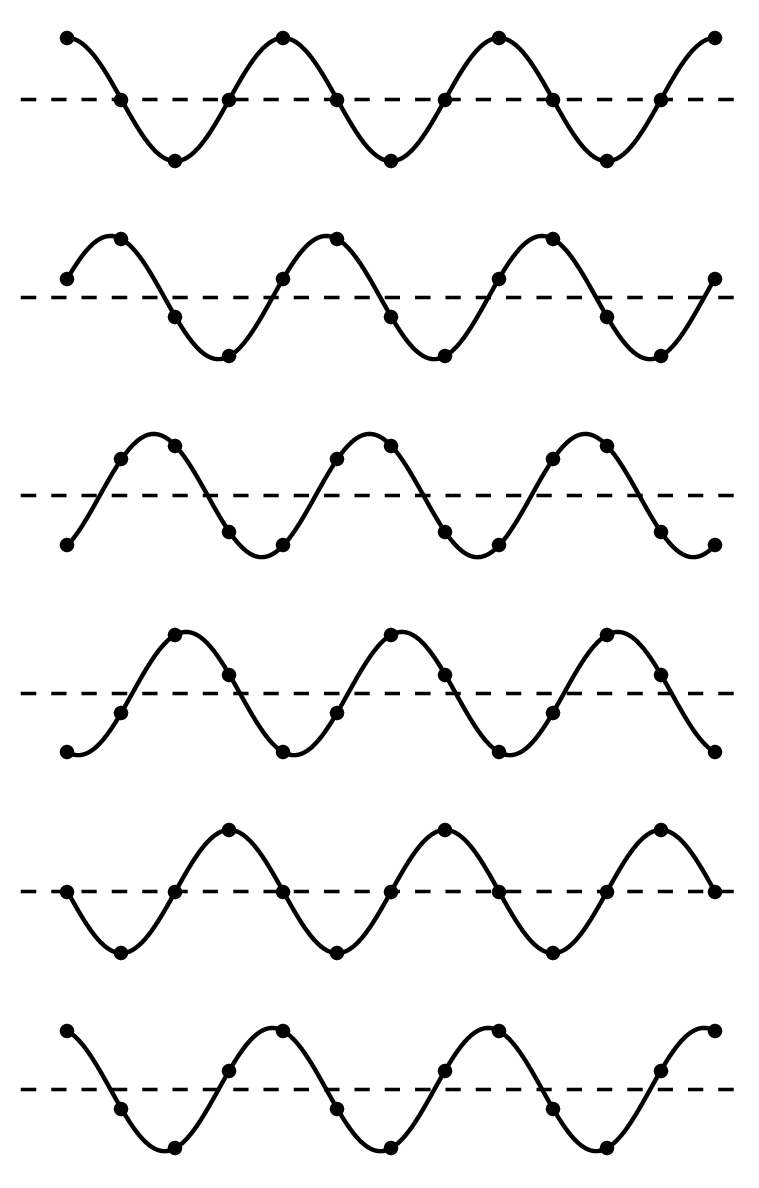
What kind of wave is this?
a)
Transverse Wave
b)
Longitudinal Wave
100 %

