
 Worksheets
Geologic Processes
Total questions: 61
Worksheet time: 44mins
Name
Class
Date
1.
How many layers does the Earth have?
a)
2
b)
1
c)
4
2.
What layer do we live on?
a)
crust
b)
mantle
c)
core
3.
What is the layer under the crust?
a)
mantle
b)
outer core
c)
inner core
4.
Even though it's hottest part of the earth, which layer is still solid?
a)
crust
b)
mantle
c)
outer core
d)
inner core
5.

The core is made-up of what two elements?
a)
iron and nickel
b)
iron and oxygen
c)
nickel and silicon
d)
oxygen and silicon
6.

What is the thinnest layer of the earth’s composition?
a)
mantle
b)
inner core
c)
crust
d)
outer core
7.

The thickest layer of the earth is the
a)
crust
b)
mantle
c)
inner core
d)
outer core
8.

What are the two kinds of crust that the Earth has?
a)
Oceanic and Crustatious Crust
b)
Oceanic and Continental Crust
c)
Optic and Continental Crust
9.
This layer of the Earth is found between the core and the crust.
a)
mantle
b)
outer core
c)
inner core
d)
crust
10.
The layer that lies beneath the mantle and surrounds the inner core.
a)
mantle
b)
outer core
c)
inner core
d)
crust
11.
The solid, dense center of our planet that extends from the bottom of the outer core to the center of the Earth..
a)
mantle
b)
outer core
c)
inner core
d)
crust
12.
The driving force of the tectonic plates are convection currents, where can these be found?
a)
inner core
inner core
inner core
b)
crust
c)
mantle
d)
outer core
13.
Which causes rocks in a stream to be smooth?
a)
weathering
b)
air currents
c)
earthquakes
d)
movement of fish
14.
Which action can be used to prevent soil erosion?
a)
Raising grazing animals
b)
Planting grass
c)
Digging ditches
15.
The most common cause of earthquakes is —
a)
a. the sinking of the ocean floor
b)
b. movements in the Earth’s crust
c)
c. giant tidal waves called tsunamis
d)
d. unequal heating of the atmosphere
16.
Earth is composed of four layers. Many scientists believe that as Earth cooled, the denser materials sank to the center and the less dense materials rose to the top. The least dense layer is the —
a)
inner core
b)
outer core
c)
crust
d)
mantle
17.
What layer of Earth is located just below the crust?
a)
inner core
b)
mantle
c)
outer core
d)
crust
18.
Which of these best describes the relationship between Earth’s layers?
a)
The more liquid layers are closest to the crust.
b)
The lightest layers are closest to the core
c)
The more metallic layers are closest to the crust.
d)
The hottest layers are closest to the core.
19.
Which of these activities is most likely to have a positive impact on the environment of Earth?
a)
Building factories
b)
Expanding neighborhoods
c)
Creating nature preserves
d)
Constructing highways
20.
Which layer consists of about 70% water?
a)
Crust
b)
Inner core
c)
Mantle
d)
Outer core
21.
Which layer of made of dense, liquid iron?
a)
Crust
b)
Mantle
c)
Outer core
d)
Inner core
22.
Which layer of earth molten, semi-liquid rock?
a)
Crust
b)
Mantle
c)
Outer core
d)
Inner core
23.

Where is the earth’s crust the thickest?
a)
A. (ocean)
b)
B. (mountain)
c)
C. (North pole)
d)
D. (Equator)
24.
Earth's plates are...
a)
constantly moving and changing the face of the earth
b)
Never moves
c)
Moves seldom and very fast
d)
Moves when it feels like it
25.
Oceanic crust is
a)
Younger and less dense than continental crust
b)
Thinner, younger and more dense than continental crust
c)
Older, thicker and less dense that continental crust
d)
Bigger and younger than continental crust
26.
Mountains form from ...
a)
plates sliding past one another
b)
collision of plates
c)
plates moving away from each other
27.
Associated with transform boundaries.
a)
Volcanoes
b)
mountains
c)
trenches
d)
earthquakes
28.
Which of the following is where one plate slides under another plate?
a)
submarine zone
b)
divergence zone
c)
subduction zone
d)
lower zone
29.

Name the boundary
a)
convergent boundary
b)
divergent boundary
c)
transform boundary
d)
sergent boundary
30.

Name the boundary
a)
convergent boundary
b)
divergent boundary
c)
transform boundary
d)
sergent boundary
31.

Name the boundary
a)
convergent boundary
b)
divergent boundary
c)
transform boundary
d)
sergent boundary
32.
Which of the following occurs because of convection currents?
a)
Tectonic plates on the crust move.
b)
The mantle increases in size.
c)
Pressure in the crust increases.
d)
Pressure in the crust decreases.
33.
Which of these layers is ALL solid iron and nickle?
a)
inner core
b)
outer core
c)
lithosphere
d)
mesosphere
34.
What was the name given to all the continents when they were joined as one super continent?
a)
Supreme Continent
b)
Eurasia
c)
Plate tectonics
d)
Pangea
35.
Which of the following occurs because of convection currents?
a)
Tectonic plates on the crust move.
b)
The mantle increases in size.
c)
Pressure in the crust increases.
d)
Pressure in the crust decreases.
36.
If you traveled from the center of Earth to the surface, the pressure would...
a)
increase
b)
decrease
c)
stay the same
d)
unsure
37.
Where does the heat come from that drives this convection current in the mantle?
a)
The sun
b)
The crust
c)
the mantle
d)
the core
38.
Two tectonic plates collide at a _______ plate boundary.
a)
convergent
b)
divergent
c)
transform
39.
Which of the following is NOT a tectonic boundary?
a)
Convergent
b)
Divergent
c)
Sedergent
d)
Transform
40.
Transform boundaries are most likely to produce what geological event?
a)
volcanoes
b)
deep sea trenches
c)
underwater mountain ranges
d)
earthquakes
41.
Earthquakes and volcanoes are most likely found in which locations?
a)
At plate boundaries
b)
in oceans
c)
in the middle of continents
d)
in the middle of plates
42.
subduction zones can create
a)
Trenches
b)
volcanoes
c)
earthquakes
d)
all of the above
43.
What are the two types of crust
a)
continental and oceanic
b)
ocean and upper
c)
lower and upper
d)
pizza and subway
44.
Which type of plate boundary would cause mountains to form
a)
Transform
b)
Convergent
c)
Divergent
d)
Reform
45.
This landform can occur at a divergent plate boundary.
a)
ocean trench
b)
mid-ocean ridge
c)
tall mountains
d)
transform fault
46.
The area where two tectonic plates meet.
a)
mantle
b)
focus
c)
plate boundary
d)
convection
47.

What type of boundary is the SAN ANDREAS FAULT on?
a)
Covergent
b)
Transformers
c)
Divergent
d)
Transform
48.
Geologists obtain evidence about Earth's interior by...
a)
measuring pressure at the surface
b)
studying seismic waves
c)
drilling through each layer
d)
estimation of temperature in the layers
49.
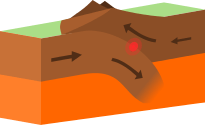
What type of plate boundary is this?
a)
Plate
b)
Divergent
c)
Convergent
d)
Transform
50.

What type of event will occur at this boundary?
a)
Earthquake
b)
Volcano Eruption
c)
Tornado
d)
Mountain Building
51.
Humans use the natural environment for all of the following EXCEPT -
a)
as an energy source
b)
as a resources for making new technology
c)
as a food supply
d)
as a source for industrial products
52.

The pictures shows a change to the surface caused by a flowing river. What is the process that has caused these changes?
a)
erosion
b)
evaporation
c)
condensation
d)
digging
53.
The Rocky Mountains in Colorado are a lot pointier and rougher than the Blue Ridge Mountains in Virginia. What do you think the most likely cause for this is?
a)
Virginia has a lower altitude than Colorado.
b)
The Blur Ridge Mountains have more wild life that wears them down.
c)
The Blue Ridge Mountains are much older and have been exposed to more weathering.
d)
It is just something that happens in nature.
54.
This is the process of dropping sediment in a new location.
a)
Weathering
b)
Erosion
c)
Deposition
55.
The driveway is long and winding because it bends around a huge old oak tree. The pavement near the tree bulges upward and has many more cracks than the other sections of the driveway
a)
Weathering
b)
Erosion
c)
Deposition
56.
A beautiful display of bluebonnets bloomed along the bank of the river, but after the storm last night, the flowers and a large section of the soil in which they grew is gone.
a)
Weathering
b)
Erosion
c)
Deposition
57.
When we walk along the seashore, we look for shark teeth in the sand. Sometimes we also find unbroken sand dollars, too.
a)
Weathering
b)
Erosion
c)
Deposition
58.
________ is the setting down of sediment.
a)
weathering
b)
erosion
c)
deposition
d)
compaction
59.
Valleys are created by what process?
a)
weathering
b)
erosion
c)
deposition
d)
cementation
60.
Sand dunes are created through what process?
a)
deposition by water
b)
deposition by ice (glaciers)
c)
deposition by wind
61.
What is it called when sediment is moved from one place to another?
a)
weathering
b)
erosion
c)
deposition
d)
convection
100 %

