
 Worksheets
Science review 100 questions
Total questions: 101
Worksheet time: 2hrs 35mins
Name
Class
Date
1.
Why are approved eye protection devices (such as goggles) are worn in the lab?
a)
A. To improve your vision
b)
B. To make you look like a bug
c)
C. To give you headaches
d)
D. To protect eyes around chemicals, heat, or glassware
2.
Flammable materials should never be dispensed (or used) near:
a)
A. An open door
b)
B. An open flame
c)
C.Another student
d)
D. A sink
3.

If you see a science experiment set up in the classroom...
a)
do not touch anything until instructed.
b)
immediately begin working on the lab.
c)
go and check all equipment.
d)
walk around and check each station.
4.
Which of the following should not be worn during laboratory activities?
a)
loose clothing
b)
dangling jewelry
c)
open-toed shoes
d)
all of the above
5.
What should you do if you break glass in the lab?
a)
Tell the teacher, sweep up the glass, and put it in the broken glass container
b)
Tell the teacher, sweep up the glass, and dump it into the garbage
c)
Pick up the glass with your hands
d)
Ignore it; the teacher will clean it up
6.

What type of graph is this?
a)
Bar Graph
b)
Line Plot
c)
Pictograph
d)
Tally Chart
7.
What are graphs used for?
a)
To show data
b)
To keep track of things so you don't forget
c)
To catch the eye and look colorful
d)
To draw pictures on
8.
Type of graph that compares item quantities.
a)
pie graph
b)
table
c)
bar and column graph
d)
line graph
9.
Line graphs display data that shows how the __________ variable , changes in response to another variable the __________ variable.
a)
dependent, independent
b)
independent, dependent
c)
constant, independent
d)
mean, mode
10.
The X axis is labeled with,
a)
the control variable
b)
the independent variable
c)
the sample variable
d)
dependent variable
11.
This variable in an experiment is the one being deliberately changed by the scientist.
a)
dependent variable
b)
independent variable
c)
data
d)
control group
12.
Mr. S. sets up an experiment to see how the mass of a ball affects the distance it rolls off a ramp. Identify the independent variable.
a)
distance traveled by the ball
b)
height of the ramp
c)
mass of the ball
d)
weight of the ball
13.
The part of the experiment that remains the same for the control and experimental group.
a)
constants
b)
control
c)
independent
d)
dependent
14.
A student is planning an experiment to find out how the height from which he drops a ball affects how high the ball bounces. The dependent variable is the _____.
a)
Diameter of the ball
b)
Force acting on the ball
c)
Height that the ball bounces
d)
Height from which the ball is dropped
15.
An experiment is performed on plants to see how different liquids affect plant growth. Each plant in the experiment is given a different liquid; water, apple juice, or milk. Each plant has the same amount of soil, sunlight, and listens to the same music. In this investigation, the independent variable is ...
a)
The type of plant
b)
The amount of sunlight
c)
The type of music
d)
The type of liquid
16.
Acceleration of an object happens when things ________
a)
slow down
b)
go faster
c)
change direction (turn)
d)
All of the above
17.
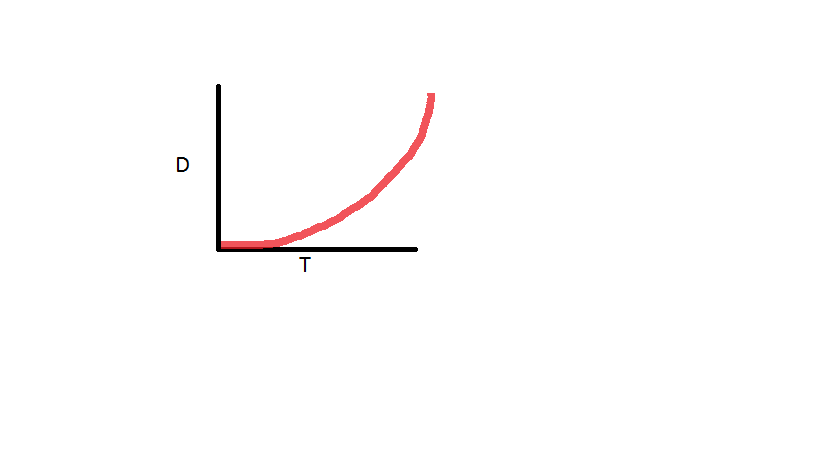
The graph below represents
a)
Speed
b)
Velocity
c)
Acceleration
d)
Deceleration
18.
How much time does it take for a car travelling at 65 miles/hour to travel 300 miles?
a)
4.6 hours
b)
0.22 hours
c)
19,500 hours
d)
none of the above
19.
A runner races in the 100 meter dash. It takes her 10 seconds to finish. What is her average speed?
a)
10 m/s
b)
1000 m/s
c)
100 seconds
d)
10 seconds
20.
What is speed?
a)
how far you go
b)
how much distance is covered over a period of time
c)
how fast you accelerate
d)
the change in the location of a object
21.
What is velocity?
a)
the quickness of an object
b)
the location of an object
c)
acceleration
d)
speed in a specific direction
22.
Total distance divided by total time is
a)
average speed
b)
constant speed
c)
instantaneous speed
d)
acceleration
23.
overs slide a box down the ramp of a truck.
What helps slow the box as it slides to the bottom of the ramp?
What helps slow the box as it slides to the bottom of the ramp?
a)
friction
b)
gravity
c)
inertia
d)
bounciness
24.
A man is pushing a ball up a hill. If the man stops pushing the ball and steps out of the way, what will most likely happen to the ball?
a)
It will stop on the hill.
b)
It will roll down the hill.
c)
It will roll to the side toward the man.
d)
It will fly.
25.
Why is it important for basketball players to wear shoes with tread when playing?
a)
to increase the speed of the player
b)
to decrease the force between the player and the floor
c)
to increase friction between the floor and the player’s feet
d)
to decrease the amount of force needed for the player to move
26.
John stands at the top of a steep hill and pushes a ball over the edge with his foot. Which force causes the ball to continue rolling down the hill?
a)
mass
b)
gravity
c)
friction
d)
air resistance
27.
The type of friction that occurs when two surfaces slip past each other describes...
a)
static friction
b)
sliding friction
c)
rolling friction
d)
fluid fiction
28.
Two factors effecting the magnitude of the force of gravity between 2 objects are...
a)
mass and distance
b)
mass and matter
c)
distance and weight
d)
weight and mass
29.
If Earth's mass was cut in half, what would happen to your weight?
a)
Increase because gravitational force increases
b)
decrease because gravitational force decreases
c)
decrease because gravitational force increases
d)
nothing, weight is not affected by gravitational force
30.
Any object with mass has gravity.
a)
True
b)
Sometimes
c)
False
d)
Never
31.
As distance between two objects increase the pull of gravity
a)
Increases
b)
Decreases
c)
Stays the same
32.
A person would weigh less on on the Moon than on the Earth because . . .
a)
Moon has more mass, and therefore more gravity
b)
Moon has less mass, and therefore more gravity
c)
Moon has more mass, and therefore less gravity
d)
Moon has less mass and therefore less gravity
33.

Wheels on a skateboard most likely experiences-
a)
Rolling Friction
b)
Sliding Friction
c)
Fluid Friction
d)
Static Friction
34.

Sally experiences-
a)
Rolling Friction
b)
Sliding Friction
c)
Fluid Friction
d)
Static Friction
35.

Wheels of a shopping cart experience-
a)
Rolling Friction
b)
Sliding Friction
c)
Fluid Friction
d)
Static Friction
36.

Swimming fish experience-
a)
Rolling Friction
b)
Sliding Friction
c)
Fluid Friction
d)
Static Friction
37.
Friction is a force that acts in an ___________ direction of movement.
a)
similar
b)
opposite
c)
parallel
d)
west
38.

Objects balanced on Timmy's head experiences-
a)
Rolling Friction
b)
Sliding Friction
c)
Fluid Friction
d)
Static Friction
39.
Which type of friction occurs when objects are not moving?
a)
static
b)
sliding
c)
fluid
d)
rolling
40.
How does friction affect speed?
a)
more friction decreases speed
b)
more friction increases speed
c)
less friction decreases speed
41.
How can friction be reduced?
a)
reduce the force acting between the 2 surfaces
b)
reduce the roughness of the 2 surfaces coming in contact
c)
use wax, grease or oil
d)
all of the above are ways of reducing friction
42.
What are 2 factors that determine the amount of friction between 2 objects?
a)
Force and roughness between surfaces
b)
hills and valleys and how smooth or rough the surface is
c)
Amount of force and amount of surface the comes in contact
d)
The force and the weight exerted on the surfaces
43.
Which of the following is an example of friction that is harmful?
a)
Pencil marking on paper
b)
Engine parts wearing out
c)
sand placed on ice in the winter
d)
Using an eraser to erase marks
44.
Which could be an example of an unbalanced force?
a)
A plate sitting on a dining table
b)
A ball at the top of a hill that is not moving
c)
Earth orbiting the Sun
d)
A baseball that has been thrown to home plate.
45.
What will cause an object to move?
a)
Applied forces
b)
Balanced forces
c)
Unbalanced forces
46.

This is an example of what kind of force?
a)
Balanced Force
b)
Pushing Force
c)
Gravity Force
d)
Unbalanced Force
47.

If an object is not moving the forces acting upon it are _____________
a)
unbalanced
b)
weak
c)
balanced
d)
Hulk Smash!
48.
When forces are ___________ the object will move.
a)
unbalanced
b)
balanced
c)
light
d)
gravity
49.
Why does a book on a table not move?
a)
No forces are acting on the book
b)
Gravity is the only force acting on the book
c)
Forces of the table pushing up and gravity pulling down are balanced
50.
The Law of Inertia
a)
Newton's
1st
Law of Motion
1st
Law of Motion
b)
Newton's
2nd
Law of Motion
2nd
Law of Motion
c)
Newton's
3rd
Law of Motion
3rd
Law of Motion
51.
An automobile you are riding in suddenly stops, but you continue to go forward.
a)
Newton's
1st
Law of Motion
1st
Law of Motion
b)
Newton's
2nd
Law of Motion
2nd
Law of Motion
c)
Newton's
3rd
Law of Motion
3rd
Law of Motion
52.
When the force on a car is doubled, the acceleration is doubled.
a)
Newton's
1st
Law of Motion
1st
Law of Motion
b)
Newton's
2nd
Law of Motion
2nd
Law of Motion
c)
Newton's
3rd
Law of Motion
3rd
Law of Motion
53.
For every action, there is an equal and opposite reaction.
a)
Newton's
1st
Law of Motion
1st
Law of Motion
b)
Newton's
2nd
Law of Motion
2nd
Law of Motion
c)
Newton's
3rd
Law of Motion
3rd
Law of Motion
54.
A skater pushes another skater forward, but the one pushing moves backwards.
a)
Newton's
1st
Law of Motion
1st
Law of Motion
b)
Newton's
2nd
Law of Motion
2nd
Law of Motion
c)
Newton's
3rd
Law of Motion
3rd
Law of Motion
55.
The harder you hit a baseball, the faster it accelerates.
a)
Newton's
1st
Law of Motion
1st
Law of Motion
b)
Newton's
2nd
Law of Motion
2nd
Law of Motion
c)
Newton's
3rd
Law of Motion
3rd
Law of Motion
56.
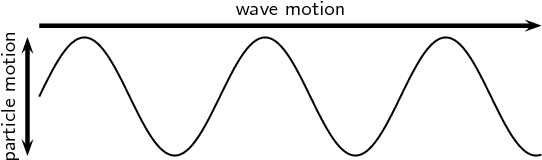
What kind of wave is pictured below?
a)
compressional wave
b)
transverse wave
c)
sound wave
d)
mechanical wave
57.
A mechanical wave cannot travel through...
a)
a vacuum(empty space).
b)
water.
c)
air.
d)
glass.
58.
Which of the following best explains the difference between transverse and longitudinal waves?
a)
Only transverse waves vibrate.
b)
Only longitudinal waves can travel through a solid.
c)
Particles only travel in a circular pattern along a longitudinal wave.
d)
Particles only travel perpendicular to the direction the energy travels in a transverse wave.
59.

What do you call location B on the diagram?
a)
Rarefaction
b)
Compression
c)
Amplitude
d)
Wavelength
60.

What do you call location C?
a)
Crest
b)
Trough
c)
Amplitude
d)
Wavelength
61.
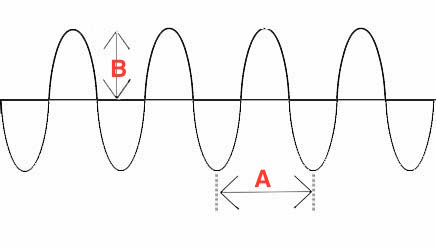
What property of this wave is represented by the letter "A"
a)
amplitude
b)
crest
c)
trough
d)
wavelength
62.
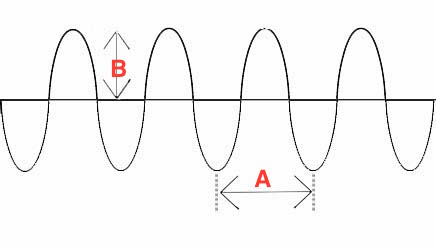
What property of the wave is represented by the letter "B"?
a)
amplitude
b)
crest
c)
trough
d)
wavelength
63.
The number of wavelengths that pass a point each per second is:
a)
frequency
b)
period
c)
longitudinal
d)
transverse wave
64.
When the frequency of a wave increases, what happens to the wavelength?
a)
The wavelength is not directly affected by the frequency of a wave.
b)
The wavelength increases.
c)
The wavelength decreases.
d)
More specific information is needed to form a conclusion about the wavelength.
65.
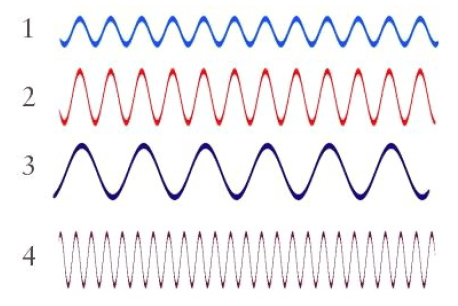
Which wave in the diagram has the greatest frequency?
a)
1
b)
2
c)
3
d)
4
66.
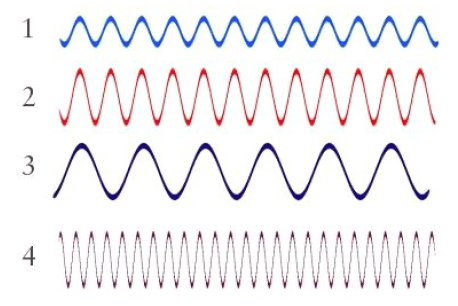
Which wave in the diagram has the greatest wavelength?
a)
1
b)
2
c)
3
d)
4
67.
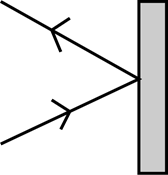
The illustration shows a light ray striking an object.
In the illustration, the light ray striking the object is-
In the illustration, the light ray striking the object is-
a)
absorbed
b)
stopped
c)
reflected
d)
refracted
68.
The bouncing off of light rays from the surface of an object such as a mirror or other shiny surface is called:
a)
mirror
b)
laser
c)
reflection
d)
refraction
69.

A student placed a pencil in a cup of water. The pencil appears broken because light-
a)
always travels in a straight line
b)
bends when it passes through water
c)
makes the water in the glass evaporate
d)
reflects the pencil on the water's surface
70.
A rainbow forms when white light separates into different colors during?
a)
Absorption
b)
Scattering
c)
Refraction
d)
Transmission
71.
The bending of a wave as it passes at an angle from one medium to another is called?
a)
Convex Lens
b)
Refraction
c)
Concave Lens
72.

The pictures shows what a student observed when he looked through a hand lens at a penny.
What happens to light passing through a hand lens that makes the image of the penny appear larger? The light is-
What happens to light passing through a hand lens that makes the image of the penny appear larger? The light is-
a)
absorbed
b)
reflected
c)
refracted
d)
stopped
73.
Which has the LONGEST wavelength and, therefore, the lowest frequency/energy
a)
Gamma Rays
b)
Radio Waves
c)
Visible Light
d)
Infrared rays
74.
Select the correct order of waves on the EMS
a)
Radio, Micro, Infra, Visible, Ultra, X-ray, Gamma
b)
Gamma, X-ray, Ultra, Vis, Infra, Micro, Radio
c)
Vis, Micro, Infra, Ultra, X-ray, Gamma, Radio
d)
Micro, Radio, Vis, Infra, Ultra, X-ray, Gamma
75.
Which section of the spectrum is the ONLY one we can see?
a)
X-rays
b)
Visible Light
c)
Gamma Rays
d)
Ultraviolet Rays
76.
Which has the SHORTEST wavelength and, therefore, the highest frequency/most energy
a)
Radio waves
b)
Ultraviolet Rays
c)
Gamma Rays
d)
X-rays
77.
Which of the following electromagnetic waves is given off as heat?
a)
Radio Waves
b)
Infrared Rays
c)
Visible Light
d)
Gamma Rays
78.
Which of the following has the longest wavelength?
a)
microwaves
b)
visible light
c)
x-rays
d)
infrared waves
79.

Which object or material is translucent?
a)
water
b)
brick
c)
waxed paper
d)
window glass
80.
Which word describes a sheet ofclear glass?
a)
opaque
b)
translucent
c)
transparent
d)
mirrored
81.
Which of the following is opaque?
a)
wood
b)
frosted glass
c)
water
d)
clear plastic
82.
Which object does NOT make a shadow on a sunny day?
a)
a tree branch
b)
a sheet of clear glass
c)
a penny
d)
a paper bag
83.
If you were building a house in Alaska (where it can be daylight for months!), what type of material would be best to cover your windows with that would help keep the Sun out of your room so you can sleep?
a)
transparent material
b)
translucent material
c)
opaque material
d)
glass material
84.
Your grandma has plants in her kitchen. They need lots of light! What type of windows should she have installed that will be best for her indoor garden?
a)
opaque windows
b)
translucent windows
c)
transparent windows
d)
no windows, just walls
85.
A mixture of cyan and yellow paints gives ________ paint.
a)
Green
b)
Red
c)
Black
d)
Blue
86.
Adding red and green spotlights gives us what color?
a)
Cyan
b)
Yellow
c)
Blue
d)
Magenta
87.
To see an afterimage of a red, white, and blue Texas flag one would first stare at a flag with the colors:
a)
Yellow, Violet, and Green
b)
Cyan, Yellow, and Magenta
c)
Cyan, Black, and Yellow
d)
Yellow, Cyan, and Green
88.
A mixture of magenta and green light gives white light. These two colors are _________
a)
Additive primaries
b)
Secondary colors
c)
Complementary colors
d)
Fluorescent colors
89.
What color would red cloth appear if it were illuminated by cyan light?
a)
Cyan
b)
Red
c)
Yellow
d)
Black
90.
If you look at the yellow Sun just before sunset for a few seconds and then look at a white cloud you see ______ afterimages of the Sun
a)
Red
b)
Green
c)
Blue
d)
Cyan
91.
How do we see colors?
a)
The colors reflect off the object
b)
We just do
c)
We dont
d)
there is a pa
92.
Color is determined by which three factors EXCEPT:
a)
Absorption
b)
Reflection
c)
Transition
d)
Perception
93.
Grass is green because of:
a)
Reflection
b)
Refraction
c)
Absorption
d)
Chlorophyll
94.
A REAL IMAGE forms when
a)
Rays of light parallel
b)
Rays of light meet
c)
Rays of light are reflected
d)
Rays of light are refracted
95.
The clear tissue that covers the front of the eye.
a)
Lens
b)
Pupil
c)
Iris
d)
Cornea
96.
This part protects the eye, especially the iris, pupil and lens.
a)
rods
b)
cornea
c)
optic nerve
d)
retina
97.
This part of the eye has photoreceptors called rods and cones. They help us to see color and see at night. It is called:
a)
optic nerve
b)
brain
c)
retina
d)
cornea
98.
The pupil is
a)
The adjustable opening in the center of the eye through which light enters
b)
light reflected off objects
c)
a light sensistive inner surface container receptor rods and cones
d)
near the cochlea
99.
Regulates the amount of light entering the eye and gives the eye its color.
a)
Iris
b)
Lens
c)
Pupil
d)
Retina
100.
This part of the eye focuses light/images onto the retina.
a)
lens
b)
cornea
c)
cones
d)
vitreous humor
101.
This part of the eye sends messages to the brain
a)
rods
b)
retina
c)
optic nerve
d)
cones
100 %

