
 Worksheets
Final Exam- Chemistry
Total questions: 72
Worksheet time: 55mins
Name
Class
Date
1.
Jack has a rock. The rock has a mass of 14g and a volume of 2cm3. What is the density of the rock?
a)
7 mL
b)
7 g/cm3
c)
28 g/cm3
d)
1/7 g/cm3
2.
What is the formula for density?
a)
density = mass x volume
b)
density = mass / volume
c)
density = mass + volume
d)
density = mass - volume
3.

If this substance has a mass of 8 grams, what is its volume?
a)
8grams
b)
4ml
c)
8ml
d)
6ml
4.

What is the density of this substance?
a)
1 g/ml
b)
1 gram
c)
1ml
d)
10 g/ml
5.

What is the mass of this substance when occupying a space of 10ml?
a)
100 grams
b)
5 g/ml
c)
50 ml
d)
50 grams
6.
Which lab tool might you use to measure the volume of a liquid?
a)
electric scale
b)
bunsen burner
c)
test tube
d)
graduated cylinder
7.
This variable in an experiment is the one being deliberately changed by the scientist.
a)
dependent variable
b)
independent variable
c)
data
d)
control group
8.
The summary at the end of an experiment that explains the results.
a)
conclusion
b)
procedures
c)
materials
d)
responding variable
9.
An experiment is performed on plants to see how different liquids affect plant growth. Each plant in the experiment is given a different liquid; water, apple juice, or milk. Each plant has the same amount of soil, sunlight, and listens to the same music. In this investigation, what is the dependent variable?
a)
Type of plant
b)
Water, apple juice, milk
c)
Plant growth
d)
Color of the plant's leaves
10.
This part of the experiment serves as a basis of comparison; the one variable being tested has been omitted.
a)
experimental group
b)
control group
c)
data
d)
variables
11.
An experiment is performed on plants to see how different liquids affect plant growth. Each plant in the experiment is given a different liquid; water, apple juice, or milk. Each plant has the same amount of soil, sunlight, and listens to the same music. In this investigation, the independent variable is ...
a)
The type of plant
b)
The amount of sunlight
c)
The type of music
d)
The type of liquid
12.

What is being changed in this experiment?
a)
ramp height
b)
the speed that the ball rolls
c)
type of ball
13.

What is being measured or the result/effect of this experiment?
a)
ramp height
b)
the speed that the ball rolls
c)
type of ball
14.

What is being kept constant?
a)
ramp height
b)
speed of the ball rolling
c)
type of ball
15.

What is being changed in this experiment?
a)
temperature of the stove
b)
how fast the water boils
c)
amount of water
16.

What is being measured or the result/effect of this experiment?
a)
how fast the water boils
b)
amount of water
c)
temperature of stove
17.

What is being kept constant?
a)
how fast the water boils
b)
amount of water
c)
temperature of stove
18.

Cations are...
a)
Positive
b)
Negative
c)
Neutral
d)
Purring
19.

Anions are...
a)
Positive
b)
Negative
c)
Neutral
d)
Crying
20.

An atom becomes _________ when it gains electrons.
a)
Positive
b)
Negative
c)
Neutral
d)
Invinsible
21.

An atom becomes _______ when it loses electrons.
a)
Positive
b)
Negative
c)
Neutral
d)
Invinsible
22.
If an element has 3 valence electrons, what charge will likely form on its ion ?
a)
+3
b)
+5
c)
-3
d)
-5
23.
Valence electrons are:
a)
Electrons farthest away from the nucleus
b)
Electrons closest to the nucleus
c)
Electrons that just come and go - they don't stay with the atom
24.
What is the charge of an atom that has lost one electron?
a)
-1
b)
-2
c)
+1
d)
+2
25.
What is the charge of an atom that has gained one electron?
a)
-1
b)
-2
c)
+1
d)
+2
26.
If an atom has an equal number of protons and electrons it is a...
a)
Positive ion
b)
Negative ion
c)
Isotope
d)
Neutral atom
27.
Particles in an atom that are neutral and have no charge are
a)
negatrons
b)
electrons
c)
neutrons
d)
protons
28.
the central region of an atom where its neutrons and protons are is its
a)
nucleus
b)
electron cloud
c)
core
d)
center
29.
The positive particles of an atom are
a)
electrons
b)
positrons
c)
neutrons
d)
protons
30.
How many neutrons does chlorine have?
a)
17
b)
35
c)
18
31.
Determine the protons, electrons, and neutrons that potassium has.
a)
19 p, 19 e, 20 n
b)
20 p, 39e, 19 n
c)
19 p, 20 e, 19 n
32.

How many neutrons does the an element with an atomic number of 3 and a mass of 6.9 contain?
a)
6.9
b)
4
c)
3
d)
7
33.

How many neutrons does oxygen have?
a)
16
b)
15.99
c)
8
d)
Doesn't contain any neutrons
34.
The esophagus is the tube that connects the mouth to the stomach. Heartburn occurs when some of the stomach juices flow backwards up the esophagus. To help relieve heartburn, a person should take medicine that is
a)
neutral
b)
basic
c)
acidic or basic.
acidic or basic.
d)
acidic
35.
Which of the following statements is correct?
a)
Blue litmus paper turns red when placed in a base.
b)
Red litmus paper turns blue when placed in a base.
c)
Blue litmus paper stays blue when placed in an acid.
d)
Red litmus paper stays red when placed in a base.
36.
The pH of a solution is tested, and it is found to be a basic solution. Of the following choices, what could the pH have been?
a)
3
b)
9
c)
7
d)
5
37.
Holly has an unknown substance in a beaker. She wants to determine the relative pH of the unknown substance. She places a piece of blue litmus paper into the substance, and the litmus paper stays blue.
The substance in the beaker
The substance in the beaker
a)
is a base.
b)
has a neutral pH.
c)
is an acid.
d)
does not have a pH.
38.
When using pH paper, the pH of a solution can be determined by looking at the _______ of the paper.
a)
texture
b)
color
c)
length
d)
mass
39.
Pure water has a pH of 7. Pure water _______.
a)
is a base
b)
is a neutral substance
c)
could be either an acid or a base
d)
is an acid
40.
Which of the following word pairs correctly completes the sentence below?
_______ are corrosive substances characterized as having a strong smell, a sour taste, and a _______.
_______ are corrosive substances characterized as having a strong smell, a sour taste, and a _______.
a)
Acids; pH less than 7
b)
Acids; pH greater than 7
c)
Bases; pH greater than 7
d)
Bases; pH less than 7
41.
Fill in the blank:
The law of conservation of mass states that matter cannot be created nor __________________.
The law of conservation of mass states that matter cannot be created nor __________________.
a)
destroyed
b)
rearranged
c)
transferred
d)
changed
42.
Fill in the blank:
A __________________ chemical equation shows that the same number of atoms in the reactants are also in the product.
A __________________ chemical equation shows that the same number of atoms in the reactants are also in the product.
a)
balanced
b)
transferred
c)
rearranged
d)
beautiful
43.
The following chemical reaction occurs:
2S + 3O2 -> 2SO3
How many atoms of oxygen are there in the reactant?
2S + 3O2 -> 2SO3
How many atoms of oxygen are there in the reactant?
a)
2 atoms of oxygen
b)
3 atoms of oxygen
c)
6 atoms of oxygen
d)
1 atom of oxygen
44.
The following chemical equation occurs:
CH4 + 2O2 -> CO2 + 2H2O
Does this equation follow the law of conservation of mass? In other words, are there the same number of carbon, hydrogen, and oxygen atoms in the reactants and the products?
CH4 + 2O2 -> CO2 + 2H2O
Does this equation follow the law of conservation of mass? In other words, are there the same number of carbon, hydrogen, and oxygen atoms in the reactants and the products?
a)
Yes
b)
No
c)
You can't tell with the given information
45.
KNO3 --> KNO2 + O2
What coefficients are needed to balance the reaction?
What coefficients are needed to balance the reaction?
a)
2, 2, 1
b)
2, 3, 2
c)
1, 2, 2
d)
1, 3, 1
46.
Which of these is NOT a chemical reaction?
a)
Two liquids mix to give a new color
b)
Two gases react to make a liquid
c)
A liquid and a solid mix to make a gas
d)
Melting an aluminum can
47.
Which of these is not a chemical reaction?
a)
Burning of wood
b)
Milk going bad
c)
Mixing vinegar and baking soda
d)
Melting of ice
48.
Cu2O + C --> Cu + CO2
What coefficient goes in front of Cu?
What coefficient goes in front of Cu?
a)
1
b)
2
c)
3
d)
4
49.
Ca + O2 --> CaO
What coefficient goes in front of CaO?
What coefficient goes in front of CaO?
a)
1
b)
2
c)
3
d)
4
50.

Is this equation balanced?
a)
yes
b)
no
c)
Not enough information
51.

Is this equation balanced?
a)
yes
b)
no
c)
Not enough information
52.
Substance that consists of one type of atom. It is a pure substance. Found on the Periodic Table.
a)
Element
b)
Compound
c)
Mixture
d)
I don't know
53.
Combinations of 2 or more substances (elements and compounds) that are physically blended together.
a)
Compound
b)
Mixture
c)
Element
d)
Substance
54.
Salad is an example of...
a)
a mixutre
b)
an element
c)
a compound
55.
Pure oxygen (O) is an example of...
a)
an element
b)
a mixture
c)
a compound
56.

An example of ...
a)
A mixture
b)
A compound
c)
An element
57.
Who stated that all atoms of the same element are excacty alike?
a)
Democritus
b)
Dalton
c)
Thomson
d)
Borh
58.

What contribution did John Dalton make to atomic theory?
a)
He discovered that every atom was positively charged.
b)
He discovered that every element consisted of one type of atom.
c)
He discovered that atoms had nuclei.
d)
He discovered that atoms could be divided into smaller parts.
59.

Place the following scientists in order, from earliest to latest:
A) Ernest Rutherford
B) J.J. Thomson
C) John Dalton
A) Ernest Rutherford
B) J.J. Thomson
C) John Dalton
a)
B,C,A
b)
C,A,B
c)
A,C,B
d)
C,B,A
60.
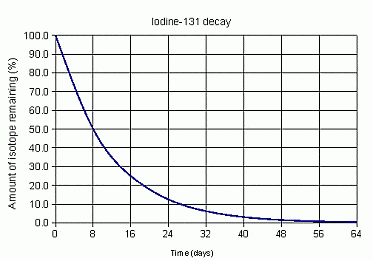
What is the half-life of iodine-131?
a)
32 days
b)
8 days
c)
16 days
d)
24 days
61.
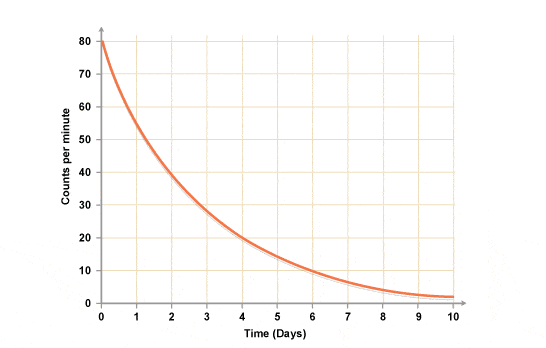
what's the half life of this substance?
a)
1 day
b)
2 days
c)
3 days
d)
4 days
62.

Which line segment demonstrates vaporization occurring?
a)
B-C
b)
C-D
c)
D-E
d)
E-F
63.

As substance goes from D to E what happens to the distance between the particles?
a)
particles get closer together
b)
particles disappear
c)
particles get far apart
64.

At what temperature is this substance melting?
a)
50C
b)
100C
c)
0C
65.

Between what two points is the most energy being added to the system
a)
A -B
b)
B-C
c)
C-D
d)
D-E
66.

At point temperature does this substance finish melting?
a)
B
b)
C
c)
D
d)
E
67.

Point A is a _____?
a)
solid
b)
liquid
c)
gas
d)
melt
68.

What scientist is best known for his "Plum Pudding" model of the atom?
a)
J.J. Tomson
b)
Ernest Rutherford
c)
John Dalton
d)
Democritus
69.
Discovered the electron
a)
J J thomson
b)
Dalton
c)
Chadwick
d)
Rutherford
70.
1 pound = 453.6 grams
Using the conversion above, how many grams are in 1.5Ibs of apples?
Using the conversion above, how many grams are in 1.5Ibs of apples?
a)
680.40grams
b)
0.0033 grams
c)
302.4 grams
71.
1 pound = 453.6 grams
Using the conversion above, how many grams are in 1/2 Ibs of apples?
Using the conversion above, how many grams are in 1/2 Ibs of apples?
a)
9072
b)
226.8
c)
907.2
72.
1 pound = 453.6 grams
Using the conversion above, how many grams are in 3/4 Ibs of apples?
Using the conversion above, how many grams are in 3/4 Ibs of apples?
a)
340.2
b)
604.8
c)
0.0016
100 %

