
 Worksheets
Earth Science Unit 5: Plate Tectonics
Total questions: 76
Worksheet time: 38mins
Name
Class
Date
1.
The study of Earth's composition and the processes that it goes through is known as...
a)
astronomy
b)
geology
c)
hydrology
d)
meteorology
2.
Which two metals make up the Earth's core?
a)
iron and copper
b)
copper and nickel
c)
nickel and silver
d)
iron and nickel
3.
Which layer is made of molten rock?
a)
mantle
b)
crust
c)
inner core
d)
outer core
4.
Which layer is made of solid metal?
a)
mantle
b)
crust
c)
inner core
d)
outer core
5.
Which layer is made of liquid metal?
a)
mantle
b)
crust
c)
inner core
d)
outer core
6.
Which layer is made of solid rock?
a)
mantle
b)
crust
c)
inner core
d)
outer core
7.
Earth's magnetic field is generated by the metal in the...
a)
crust
b)
mantle
c)
inner core
d)
outer core
8.
In reference to rocks, "plastic" means that the rock is...
a)
totally solid
b)
solid but bendable
c)
liquid but still keeps its shape
d)
totally liquid
9.
The topmost mantle and crust make up the ___, which is mostly solid.
a)
lithosphere
b)
aesthenosphere
c)
mesosphere
d)
troposphere
10.
The upper mantle makes up the ___, which is mostly plastic.
a)
lithosphere
b)
aesthenosphere
c)
mesosphere
d)
troposphere
11.
The lower mantle makes up the ___, which is mostly molten.
a)
lithosphere
b)
aesthenosphere
c)
mesosphere
d)
troposphere
12.
Studies of ___ have revealed what Earth's interior is made of.
a)
seismic waves
b)
tides
c)
tsunamis
d)
tectonic plates
13.
The crystals in magnetic rocks in the seafloor align with...
a)
north only
b)
east only
c)
north and south in stripes
d)
east and west in stripes
14.
Huge pieces of lithosphere that slide around are called...
a)
monoclines
b)
strike-slips
c)
continental shelves
d)
tectonic plates
15.
At which boundaries do plates crash into each other?
a)
convergent
b)
divergent
c)
transform
16.
At which boundaries do plates pull apart from each other?
a)
convergent
b)
divergent
c)
transform
17.
At which boundaries do plates slide past one another in opposite directions?
a)
convergent
b)
divergent
c)
transform
18.
What happens at oceanic-oceanic divergent boundaries?
a)
seafloor spreading
b)
rift valley
c)
mountain range
d)
volcanic arc and oceanic trench
19.
What happens at continental -continental divergent boundaries?
a)
seafloor spreading
b)
rift valley
c)
mountain range
d)
volcanic arc and oceanic trench
20.
What happens at continental -continental convergent boundaries?
a)
seafloor spreading
b)
rift valley
c)
mountain range
d)
volcanic arc and oceanic trench
21.
What happens at oceanic-continental convergent boundaries?
a)
seafloor spreading
b)
rift valley
c)
mountain range
d)
volcanic arc and oceanic trench
22.
What happens at oceanic-oceanic convergent boundaries?
a)
seafloor spreading
b)
rift valley
c)
mountain range
d)
island arc and oceanic trench
23.
When one plate goes under another, that's called...
a)
subduction
b)
transduction
c)
permutation
d)
inflammation
24.
Intraplate activity occurs where there is a(n)...
a)
convergent boundary
b)
hotspot in the mantle
c)
subduction zone
d)
divergent boundary
25.
A force being applied upon a rock is called...
a)
stress
b)
strain
c)
focus
d)
fault
26.
Any change a rock undergoes due to a force is called...
a)
stress
b)
strain
c)
focus
d)
fault
27.
A large crack created when rock breaks is called a...
a)
stress
b)
plate boundary
c)
epicenter
d)
fault
28.
Rocks being pushed together causes this type of stress.
a)
compression
b)
tension
c)
shearing
d)
confining stress
29.
Rocks being pulled apart causes this type of stress.
a)
compression
b)
tension
c)
shearing
d)
confining stress
30.
Rocks being rubbed together in opposite directions causes this type of stress.
a)
compression
b)
tension
c)
shearing
d)
confining stress
31.
Rocks being piled on top of one another causes this type of stress.
a)
compression
b)
tension
c)
shearing
d)
confining stress
32.
Rock undergoes strain but returns to its original shape. This is...
a)
elastic deformation
b)
plastic deformation
c)
fracturing
d)
seismograph
33.
Rock undergoes strain and its shape changes. This is...
a)
elastic deformation
b)
plastic deformation
c)
fracturing
d)
seismograph
34.
Rock undergoes strain and breaks into separate pieces. This is called...
a)
elastic deformation
b)
plastic deformation
c)
fracturing
d)
seismograph
35.
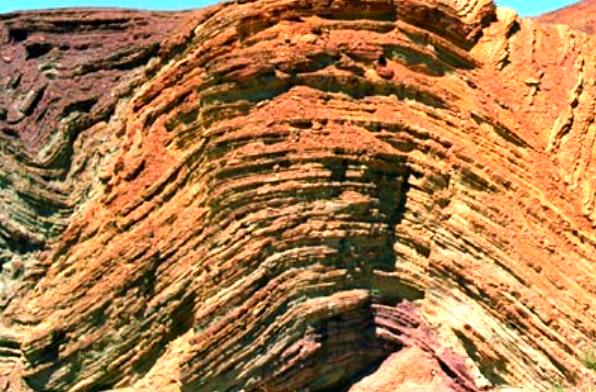
Compression causes rocks to fold. What type of fold is pictured?
a)
monocline
b)
syncline
c)
anticline
d)
idkcline
36.

Compression causes rocks to fold. What type of fold is pictured?
a)
monocline
b)
syncline
c)
anticline
d)
idkcline
37.

Compression causes rocks to fold. What type of fold is pictured?
a)
monocline
b)
syncline
c)
anticline
d)
idkcline
38.
The point where rock broke and seismic waves were released is called the...
a)
fault
b)
focus
c)
epicenter
d)
syncline
39.
The place on the surface directly above where an earthquake occurred is called the...
a)
fault
b)
focus
c)
epicenter
d)
syncline
40.

A crack down rock where the rock broke is called...
a)
fault
b)
focus
c)
epicenter
d)
syncline
41.

The block on the left is the...
a)
hanging wall
b)
footwall
42.
The block on the right is the...
a)
hanging wall
b)
footwall
43.

The top fault is a...
a)
normal dip-slip
b)
reverse dip-slip
c)
normal strike-slip
d)
reverse strike-slip
44.
The bottom fault is a...
a)
normal dip-slip
b)
reverse dip-slip
c)
normal strike-slip
d)
reverse strike-slip
45.

This is a ___ fault.
a)
strike-slip
b)
normal dip-slip
c)
reverse dip-slip
d)
divergent
46.
Which instruments detect seismic waves?
a)
barometers
b)
seismographs
c)
spectroscopes
d)
tachometers
47.
Which type of seismic waves travel fastest?
a)
p-waves
b)
s-waves
c)
surface waves
48.
Which type of seismic waves cannot travel through liquid?
a)
p-waves
b)
s-waves
c)
surface waves
49.
Which type of seismic waves cause most damage to structures?
a)
p-waves
b)
s-waves
c)
surface waves
50.
Which type of seismic waves bend as they pass through Earth's interior layers?
a)
p-waves
b)
s-waves
c)
surface waves
51.
How many locations must detect an earthquake in order to determine where the epicenter was?
a)
one
b)
two
c)
three
d)
four
52.
Large waves created by an earthquake that causes flooding are called...
a)
tsunamis
b)
typhoons
c)
pahoehoe
d)
a'a
53.
How must stronger is a 5.0 earthquake than a 3.0 earthquake?
a)
2x
b)
10x
c)
100x
d)
20x
54.
Fracking helps break rock so companies can get oil and gas from the ground. What is fracking?
a)
injection of high pressure water
b)
dropping massive rods from cranes
c)
using buried explosives
d)
drilling deep enough to release magma
55.
Magma is ___ while lava is ___ .
a)
below the surface; above the surface
b)
mafic; felsic
c)
plastic; solid
d)
high viscosity; low viscosity
56.
Viscosity refers to...
a)
the temperature at which magma cools
b)
how easily a rock fractures
c)
the force applied to a rock
d)
a fluid's resistance to flow
57.
The hole at the top of a volcano is the...
a)
vent
b)
fissure
c)
chamber
d)
fumarole
58.
Which statement about mafic rock is FALSE?
a)
its lava is lower viscosity than felsic rock
b)
it is denser than felsic rock
c)
it is darker in color than felsic rock
d)
it is primarily found in continental crust
59.
Which statement about felsic rock is FALSE?
a)
its lava is lower viscosity than mafic rock
b)
it is primarily found in continental crust
c)
it is lighter in color than mafic rock
d)
it is less dense than mafic rock
60.
Explosive eruptions occur in volcanoes that have ___ lava.
a)
mafic
b)
felsic
61.
Most damage from explosive eruptions comes from...
a)
lava
b)
pyroclastic flow
c)
ash clouds
d)
seismic waves
62.
Most damage from effusive eruptions come from...
a)
lava
b)
pyroclastic flow
c)
ash clouds
d)
seismic waves
63.
Aftershock earthquakes are caused by...
a)
settling of rock after a fracture
b)
initial breaking of rock
c)
tsunamis
d)
magma chambers emptying
64.

Which type of lava is pictured here?
a)
a'a
b)
pahoehoe
c)
felsic
65.

Which type of lava is pictured here?
a)
a'a
b)
pahoehoe
c)
felsic
66.

Which type of volcano is this?
a)
cinder cone
b)
stratovolcano or composite volcano
c)
shield volcano
d)
supervolcano
67.

Which type of volcano is this?
a)
cinder cone
b)
stratovolcano or composite volcano
c)
shield volcano
d)
supervolcano
68.
Composite volcanoes form from high-viscosity...
a)
felsic lava
b)
mafic lava
69.

Shield volcanoes form from high-viscosity...
a)
felsic lava
b)
mafic lava
70.

Composite volcanoes form from low-viscosity...
a)
felsic lava
b)
mafic lava
71.
A volcano hasn't erupted for about 2000 years. It would be considered...
a)
active
b)
dormant
c)
extinct
72.
A volcano hasn't erupted for about 200 hundred years. It would be considered...
a)
active
b)
dormant
c)
extinct
73.
A volcano erupted within the past 100 years. It would be considered...
a)
active
b)
dormant
c)
extinct
74.

What's pictured?
a)
geyser
b)
hot spring
c)
cinder cone
d)
caldera
75.

What's pictured?
a)
geyser
b)
hot spring
c)
cinder cone
d)
caldera
76.

What's pictured?
a)
geyser
b)
hot spring
c)
cinder cone
d)
caldera
100 %

