
 Worksheets
Earths Forces
Total questions: 79
Worksheet time: 1hrs 5mins
Name
Class
Date
1.
The epicenter of an earthquake is
a)
The point below the surface where rock begins to break and the first motion occurs
b)
The seismic station closest to the earthquake
c)
The place where the greatest damage occurs
d)
The point on the surface directly above the focus
2.

This famous transform fault is located in the western United States creates significant earthquake activity for California
a)
Sierra Nevada Seismic Zone
b)
Denali Fault
c)
San Fransisco
d)
San Andreas
3.
The Richter scale measures:
a)
the amount of radon gas released
b)
the damage caused
c)
the strength of an earthquake
d)
the weight of tectonic plates
4.
An instrument that detects and measures earthquakes is a
a)
seismogram
b)
focus seismic map
c)
focus
d)
seismograph
5.
How much bigger is a magnitude 8 earthquake compared to magnitude 7 one on the Richter Scale?
a)
1 time bigger
b)
10 times bigger
c)
100 times bigger
d)
1000 times bigger
6.
Earthquakes under the water can cause _________________________________.
a)
tornadoes
b)
tsunamis
c)
lightening
d)
hailstorms
7.
The focus of an earthquake is
a)
The point (below Earth's surface) where rock breaks
b)
The closest seismic station
c)
The place where the greatest damage occurs
d)
A fault
8.
Which kind of wave arrives at seismic stations second?
a)
P (primary)
b)
S (secondary)
c)
L (love)
d)
R (rayleigh)
9.
Which kind of waves usually do the most damage in an earthquake?
a)
P waves
b)
S waves
c)
L waves
d)
Radio waves
10.
Which kind of waves can NOT travel through a liquid?
a)
P waves
b)
S waves
c)
Radio Waves
d)
X rays
11.
A break in the lithosphere along which movement has occurred is a(n)
a)
fault
b)
earthquake
c)
epicenter
d)
volcano
12.
The motion caused by earthquakes travels outward from the focus in the form of
a)
Electromagnetic waves
b)
Seismic waves
c)
Gravity waves
d)
Chemical energy
13.

At about what time did all of the S-waves hit?
a)
20 sec
b)
45 sec
c)
50 sec
d)
10 seconds
14.
We know there are two layers to the Earth’s core because...
a)
S Waves stop at the outer core
b)
P Waves bend as they reach inner core
c)
P Waves bend as they outer core
d)
All of the above
15.

Earthquakes happen every day. Most are too small for humans to notice.
a)
True
b)
False
16.

These are the first waves released during an earthquake
a)
S waves
b)
Surface Waves
c)
P waves
17.

This is the area beneath the Earth's surface where the earthquake begins
a)
epicenter
b)
focus
c)
fault line
d)
tectonic plate
18.
You use a travel-time graph (difference in P and S Wave arrival times) to find:
a)
Distance to epicenter
b)
Distance to fault
c)
Distance to core
19.
The record of a seismic wave is the
a)
Seismograph
b)
Seismogram
c)
Seismometer
d)
Richter scale
20.
Which ocean in the world is known as the 'Ring of Fire'?
a)
Atlantic
b)
Indian
c)
Arctic
d)
Pacific
21.
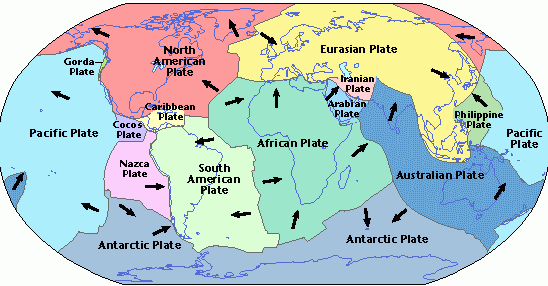
Many earthquakes happen along the borders of...
a)
Countries
b)
Tectonic Plates
c)
Climate Zones
d)
None of the above.
22.
What does S in an S wave stand for?
a)
super
b)
secondary
c)
slow
d)
sideways
23.
P and S waves travel through the earth, and so are called
a)
surface waves
b)
body waves
c)
tsunamis
d)
earth waves
24.
The most damaging type of wave
a)
Love wave
b)
S wave
c)
P wave
d)
Rayleigh wave
25.
The slowest type of wave that is detected by the seismograph.
a)
Surface wave
b)
Body wave
c)
Love wave
d)
Rayleigh wave
26.
What is the proper sequence of the wave detection in a seismograph?
a)
Love, Rayleigh, P, S
b)
S, P, Rayleigh, Love
c)
P, S, Love, Rayleigh
d)
P, S, Rayleigh, Love
27.
Which type of volcano has the widest base?
a)
Cinder
b)
Composite
c)
Shield
28.
Hotspots are found ___.
a)
at divergent boundaries
b)
at convergent boundaries
c)
at transform boundaries
d)
within a plate (intraplate)
29.
What is molten rock that has formed deep within the Earth?
a)
Hot Spot
b)
Magma
c)
Lava
d)
Volcano
30.
The volcanoes on the Hawaiian Islands form due to which of the following?
a)
Divergent Boundary
b)
Hot Spot
c)
Subduction Boundary
d)
Transform Boundary
31.
What are solid rock fragments that are ejected during a volcanic eruption?
a)
Lahar
b)
Magma
c)
Pyroclastic Material
d)
Silica
32.
What type of volcano has steep slopes made of alternating layers of ash and silica rich lava?
a)
Caldera
b)
Cinder Cone
c)
Composite Volcano
d)
Shield Volcano
33.
What do you call a large crater formed by the collapse of a volcano?
a)
Caldera
b)
Cinder Cone
c)
Composite Volcano
d)
Shield Volcano
34.
Where do volcanoes come from?
a)
Places where plates move apart
b)
Places where plates are moving together
c)
Hot Spots
d)
All of these options
35.
Composite Volcano Shape
a)
Steep
b)
Wide and Flat
c)
Bowl Shaped
36.
Shield Volcano
a)
Bowl Shaped
b)
Wide and Flat
c)
Steep
37.
The three main types of volcanoes are
a)
Shield, pahoehoe, and vented
b)
Cinder, cone and composite
c)
Cinder cone, lapilla, and caldera
d)
Cinder cone, composite, and shield
38.
Alternating quiet and violent eruptions are associated with which kind of volcano?
a)
composite
b)
shield
c)
cinder cone
39.
The stress force that pushes the crust where two plates are moving together
a)
tension
b)
compression
c)
shear
40.
The stress force that pulls plates past one another sideways is called
a)
shear
b)
compression
c)
tension
41.
The stress force that pulls plates past one another sideways is called
a)
shear
b)
compression
c)
tension
42.
A fault caused by rocks moving together
a)
normal fault
b)
reverse fault
c)
slip strike fault
43.
a fault caused by rocks moving away from each other
a)
strike slip fault
b)
reverse fault
c)
normal fault
44.

What type of stress is this?
a)
compression
b)
shearing
c)
tension
45.

What type of stress is this?
a)
compression
b)
shearing
c)
tension
46.

What type of stress causes these folds?
a)
compression
b)
shearing
c)
tension
47.

a)
normal fault
b)
reverse fault
c)
strike-slip fault
48.

a)
normal fault
b)
reverse fault
c)
strike-slip fault
49.

a)
normal fault
b)
reverse fault
c)
strike-slip fault
50.

a)
normal fault
b)
reverse fault
c)
strike-slip fault
51.
A force that acts on rock to change its shape or volume?
a)
stress
b)
focus
c)
friction
d)
fracture
52.

Stress that stretches rock so that it becomes thinner in the middle!
a)
tension
b)
compression
c)
sheear
d)
rubber-binder
53.

Stress that pushes masses of rock in opposite directions, in a sideways movement?
a)
shear
b)
compression
c)
tension
d)
constriction
54.
A type of fault where the hanging wall slides down...caused by tension.
a)
normal fault
b)
strike-slip fault
c)
reversynclinese fault
55.
How does a reverse fault form?
a)
The hanging wall moves upward relative to the footwall.
b)
Compression thrusts the fault into reverse.
c)
Blocks slide past each other.
d)
The hanging wall moves downward relative to the footwall.
56.
The type of stress that squeezes and shortens a body is __
a)
compression.
b)
tension.
c)
shear.
d)
deposition.
57.

Name the boundary
a)
convergent boundary
b)
divergent boundary
c)
transform boundary
d)
sergent boundary
58.
A deep valley that forms along a divergent boundary.
a)
rift valley
b)
canyon
c)
mid-ocean ridge
d)
ocean valley
59.
The theory that pieces of Earth's lithosphere are in constant motion, driven by convection currents in the mantle.
a)
Plate tectonics
b)
Continental drift
c)
convection currents
d)
subduction zone
60.

What type of plate boundary is occurring between the Pacific Plate and the Nazca Plate?
a)
Divergent Boundary
b)
Convergent Boundary
c)
Transform Boundary
61.

Using the plate boundaries map to help you, why do you think there are so many earthquakes in California?
a)
Along divergent boundary which cause MAJOR earthquakes
b)
Along convergent boundary which cause MAJOR earthquakes
c)
Along transform boundary which cause MAJOR earthquakes
62.

What type of plate boundary is occurring between the Cocos Plate and the Caribbean Plate?
a)
Divergent Boundary
b)
Convergent Boundary
c)
Transform Boundary
63.
What is a convergent boundary?
a)
where plates move into each other
b)
where plates are moving away form each other
c)
where plates move past each other
d)
area where plate slips under another plate
64.
What forms at a divergent boundary?
a)
mid-ocean ridges
b)
mountains
c)
earthquakes
d)
only volcanoes
65.
What is a subduction zone?
a)
where plates move into each other
b)
where plates are moving away form each other
c)
where plates move past each other
d)
area where plate slips under another plate
66.
What is a transform boundary?
a)
where plates move into each other
b)
where plates are moving away form each other
c)
where plates move past each other
d)
area where plate slips under another plate
67.

When two oceanic plates converge what landform is produced?
a)
A lake
b)
A river
c)
A mountain range
d)
A trench
68.

The deepest point on Earth(The Mariana Trench) was created by what plate movement?
a)
Oceanic/Oceanic
b)
Continental/Continental
c)
Oceanic/Continental
d)
Pacifica/Continental
69.

India and Asia crashed about 55 million years ago. What mountain range was produced?
a)
The Rockies
b)
The Alps
c)
The Himalayas
d)
The Andes
70.
When two landmass plates collide the crust crumples what is produced?
a)
A river
b)
A trench
c)
A lake
d)
A mountain range
71.

What process taking place in the asthensophere enables the plates to move?
a)
radiation
b)
subvection
c)
conduction
d)
convection
72.

The San Andreas Fault is an example of a transform boundary. What is produced in this area?
a)
Trenches
b)
Tornadoes
c)
Earthquakes
d)
Rivers
73.

B is a diagram of a __ fault
a)
Normal
b)
Reverse
c)
Strike - Slip
74.
The block of rock that lies above a fault is called
a)
hanging wall
b)
foot wall
75.
How do faults and folds compare?
a)
Faults are bends in rock where rocks move, and folds are breaks in rocks.
b)
Faults are breaks in rock where rocks move, and folds are bends in rock.
c)
Faults are breaks in rock where rocks do not move, and folds are bends in rock.
d)
Faults are bends in rock where rocks do not move, and folds are breaks in rock.
76.
What fault has little up or down motion?
a)
strike-slip
b)
normal
c)
reverse
77.
The hanging wall slides up and over that footwall is what kind of fault?
a)
strike-slip
b)
normal
c)
reverse
78.
When the hanging wall slips downward below the footwall, what kind of fault is it?
a)
strike-slip
b)
normal
c)
reverse
79.
Compression is the type of stress that causes the crust to become thinner in the middle.
a)
True
b)
False
100 %

