
 Worksheets
Review in Science 7
Total questions: 74
Worksheet time: 46mins
Name
Class
Date
1.

Earthquakes happen every day. Most are too small for humans to notice.
a)
True
b)
False
2.

The shaking and trembling that results from the Earth's plates movement
a)
Mountains
b)
Earthquakes
c)
Volcanoes
d)
Fault-block mountains
3.

When plates break or slip past each other they form these
a)
mountains
b)
tectonic plates
c)
Fault lines
d)
earthquakes
4.

Earthquakes release these which let us study what the Earth is made out of
a)
Tectonic Plates
b)
Seismic Waves
c)
Plateaus
d)
P Waves
5.

These are the first waves released during an earthquake
a)
S waves
b)
Surface Waves
c)
P waves
6.

These are the secondary, or second waves to be released. They cannot travel through the liquid outer core
a)
S waves
b)
Surface Waves
c)
P waves
7.

This is the area beneath the Earth's surface where the earthquake begins
a)
epicenter
b)
focus
c)
fault line
d)
tectonic plate
8.
This is the area above ground where the earthquake starts
a)
focus
b)
epicenter
c)
p waves
d)
plate boundary
9.
This is the type of plate boundary when two plates run into each other or on top of each other
a)
Convergent
b)
Divergent
c)
Transform
10.
This is the type of plate boundary where two tectonic plates move apart
a)
Convergent
b)
Divergent
c)
Transform
11.
This is the type of plate boundary where two plates slip past each other
a)
Convergent
b)
Divergent
c)
Transform
12.
Which type of wave arrives first during an earthquake?
a)
Primary (p-wave) waves
b)
Secondary (s-wave) waves
c)
Rayleigh Waves
d)
Love Waves
13.
Which type of wave is the most destructive wave?
a)
Primary Wave
b)
Secondary Wave
14.
What kind of wave travels through the earth?
a)
Seismic Wave
b)
Ocean Wave
c)
Light Wave
15.
An s-wave is an example of what type of wave?
a)
Longitudinal
b)
Converse
c)
Transverse
d)
Ocean
16.
A p-wave is an example of
a)
Longitudinal
b)
Transverse
c)
Converse
d)
Ocean
17.
A primary wave moves
a)
parallel
b)
perpendicular
c)
in circles
18.
A secondary wave moves
a)
parallel
b)
perpendicular
c)
in circles
19.
What scale is used to measure the
a)
Ricther Scale
b)
A big scale
c)
Seismic Scale
20.
Rocks crack and form an earthquake because of
a)
Time of day
b)
Pressure
c)
Kinetic Energy
d)
The Earth's gravity
21.
What part of the earth is broken in to 12 major tectonic plates?
a)
Crust
b)
Mantle
c)
Inner Core
d)
Outer Core
22.
Which type of wave arrives to a point first?
a)
Primary Waves (P-Waves)
b)
Secondary Waves (S-Waves)
c)
Rayleigh Waves
d)
Love Waves
23.
Which classification of wave does the most damage?
a)
Body Waves
b)
Mega Waves
c)
Surface Waves
d)
Love Waves
24.
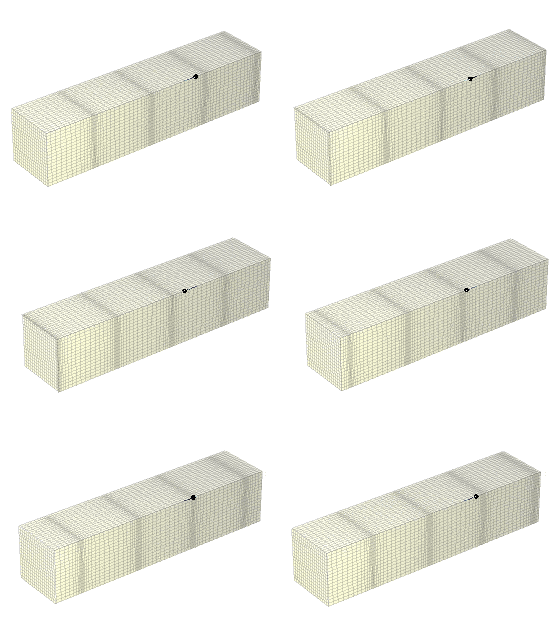
Which body wave is pictured?
a)
P-Wave
b)
S-Wave
c)
Rayleigh Wave
d)
Love Wave
25.
We use this tool to measure seismic waves during earthquakes
a)
Seismographs
b)
magnitude
c)
actual magnitude
d)
sonograph
26.
This is the type of plate boundary when two plates run into each other or on top of each other
a)
Convergent
b)
Divergent
c)
Transform
27.
Earthquakes release these which let us study what the Earth is made out of
a)
Tectonic Plates
b)
Seismic Waves
c)
Plateaus
d)
P Waves
28.
This is the area beneath the Earth's surface where the earthquake begins
a)
epicenter
b)
focus
c)
fault line
d)
tectonic plate
29.
What is a weakness or crack/break in the lithosphere that can shift and create an earthquake?
a)
Earthquake
b)
Epicenter
c)
Fault
d)
Focus
30.
Which body waves cause particles of rock material to move at right angles to the direction in which the waves are traveling?
a)
Body Waves
b)
P- Waves
c)
S- Waves
d)
Surface Waves
31.
What is another term for P- Wave?
a)
Compression Wave
b)
Principal Wave
c)
Shear Wave
d)
Secondary Wave
32.
P Waves travel through...
a)
Solids
b)
Liquids
c)
Both
33.
S Waves travel through...
a)
Soilds
b)
Liquids
c)
Both
34.
Two tectonic plates collide at a _______ plate boundary.
a)
convergent
b)
divergent
c)
transform
35.
The type of stress at a transform plate boundary is...
a)
compression
b)
shear
c)
tension
d)
subsidence
36.
The stress that squeezes rock until it folds or breaks is...
a)
tension
b)
compression
c)
shear
d)
uplift
37.
The area where two tectonic plates meet.
a)
mantle
b)
focus
c)
plate boundary
d)
convection
38.
Most volcanoes and earthquakes occur...
a)
along the coast
b)
along tectonic plate boundaries
c)
in the Arctic
d)
in the ocean
39.
Earthquakes are caused by...
a)
seismic gaps
b)
sudden movement of water
c)
too much drilling along plate boundaries
d)
sudden movements of rock along a fault
40.
This landform can occur at a divergent plate boundary.
a)
ocean trench
b)
mid-ocean ridge
c)
tall mountains
d)
transform fault
41.
The focus of an earthquake is...
a)
where there is movement along the fault, causing vibrations through the earth
b)
directly above the epicenter
c)
always near the surface
d)
the point on the surface directly above the spot of the earthquake
42.
The type of plate boundary at which you can find volcanic arcs is...
a)
divergent
b)
convergent
c)
transform
43.

If two tectonic plates are moving away from one another, the earthquakes in this area would occur along ____ faults.
a)
normal
b)
reverse
c)
strike-slip
d)
compressional
44.
A continental rift valley can be formed from stretching continental crust at...
a)
transform plate boundaries
b)
convergent plate boundaries
c)
divergent plate boundaries
d)
all plate boundaries
45.
An ocean trench occurs when...
a)
plates divide and magma rises up
b)
oceanic crust subducts below continental crust
c)
we dig a hole in the ocean
d)
when plates slide past each other
46.
Which type of landform occurs from compression stress on rocks?
a)
mid-ocean ridge
b)
continental rift valley
c)
transform fault
d)
tall mountains
47.
Which of the following statements is false?
a)
Oceanic crust is made of basalt
b)
Oceanic crust is thinner than continental crust
c)
Oceanic crust is less dense than continental crust
d)
Oceanic crust is younger than continental crust
48.
A subduction zone is formed...
a)
when one tectonic plate sinks below another
b)
at every type of convergent plate boundary
c)
at every type of divergent plate boundary
d)
at transform boundaries
49.
Whenever a subduction zone is formed a ______ is formed.
a)
Mountain
b)
Island Arc
c)
Rift
d)
Volcano
50.
In what direction do seismic waves carry the energy of an earthquake?
a)
in all directions away from the focus
b)
toward the focus
c)
toward the interior from the surface
d)
away from the inner core to the surface
51.
A high silica volcano makes what type of an explosive?
a)
quiet eruption
b)
explosive eruption
52.
A low silica volcano makes what type of explosion
a)
quiet eruption
b)
explosive eruption
53.

This volcano is most likely which type of volcano?
a)
Felsic
b)
Composite
c)
Shield
d)
Cinder cone
54.

Once magma reaches the earth's surface it is called.....
a)
Silica
b)
Rock
c)
lava
55.
Which of the following is an opening through which molten rock and gas leave a volcano
a)
pipe
b)
magma chamber
c)
crater
d)
vent
56.
An opening in the Earth's crust through which molten rock, gases, and ash erupts is called a(n) _____________.
a)
explosion
b)
volcano
c)
vent
d)
geyser
57.
A volcano made from alternating layers of ash and lava is called a(n) _________________ volcano
a)
composite
b)
cinder cone
c)
shield
d)
fissure
58.
Most volcanoes occur at which 2 types of plate boundaries?
a)
convergent w/ subduction and divergent
b)
divergent and transform
c)
divergent and hot spots
d)
convergent w/ subduction and hot spots
59.
A volcano with a broad base and gently sloping sides is called a _________ volcano.
a)
shield
b)
cinder cone
c)
composite
d)
fissure
60.
Smaller volcanoes that typically throw ash into the air during eruption
a)
cinder cone
b)
shield
c)
composite
d)
fissure
61.

This famous transform fault is located in the western United States creates significant earthquake activity for California
a)
New Madrid
b)
Denali Fault
c)
Ramapo Seismic Zone
d)
San Andreas
62.
Which characteristic of magma mainly determines its explosiveness?
a)
color
b)
temperature
c)
amount
d)
silica content
63.
What causes the magma to rise towards the surface of the earth?
a)
high temperature
b)
low density
c)
molten state
d)
silica content
64.
How will we described lava that has low silica content?
a)
thick and viscous
b)
thick and fluid
c)
thin and viscous
d)
thin and fluid
65.
What are the three main types of volcanoes?
a)
extinct, active, dormant
b)
cinder cone, composite, shield
66.
How are lava and magma most different?
a)
their location
b)
their heat
c)
their color
d)
what they eat for lunch
67.
Lava begins as
a)
water
b)
crust
c)
magma
d)
pumice
68.

At what type(s) of plate boundaries do MOST volcanoes form?
a)
transform
b)
convergent
c)
divergent
d)
ocean and mountain
69.
Hawaii was created from a hot spot.
a)
True
b)
False
70.
A hot spot is different because it...
a)
spits out hotter magma
b)
is extremely explosive
c)
They do not occur at plate boundaries
71.
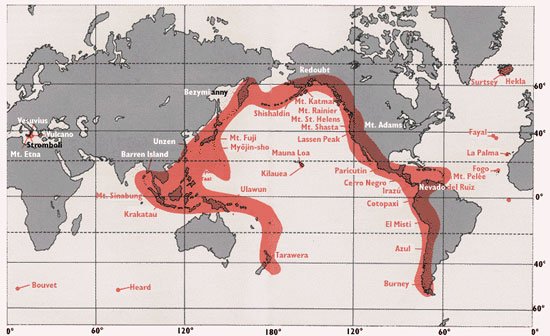
This is the name for the chain of volcanoes around the edge of the Pacific Plate.
a)
Circle of Fire
b)
Ring of Lava
c)
Ring of Fire
d)
Circle of Magma
72.

The volcanoes on the Hawaiian Islands form from to which of the following?
a)
Divergent Boundary
b)
Hot Spot
c)
Subduction Boundary
d)
Transform Boundary
73.
What is the most explosive type of magma?
a)
Rhyolitic Magma
b)
Andesitic Magma
c)
Basaltic Magma
74.
Which type of magma has the lowest gas content?
a)
Basaltic Magma
b)
Andesitic Magma
c)
Rhyolitic Magma
100 %

