
 Worksheets
1st Semester Exam Review
Total questions: 75
Worksheet time: 2hrs 31mins
Name
Class
Date
1.

A test is set up to test which brand of soda creates the biggest foam explosion when adding a Mentos candy. Three different sodas were tested. They measured the height of the foam eruption. What is the dependent variable?
a)
Brand of soda
b)
Number of mentos candies used
c)
Height of foam eruption
d)
Temperature of soda
2.

Research Question: Does the type of gasoline put in a car effect how fast the car can drive? What is the independent variable?
a)
Type of gasoline
b)
which car the gas is put into
c)
how fast the car can drive
d)
how much gas is put into the car
3.
Things that stay the same throughout the whole experiment are called
a)
controls
b)
dependent variables
c)
independent variables
d)
constants
4.
This variable in an experiment is the one being deliberately changed by the scientist.
a)
dependent variable
b)
independent variable
c)
data
d)
control group
5.

Which of the following is not a measurement of length?
a)
3 cm
b)
4 m
c)
6 mL
d)
8 km
6.

What is happening to the temperature in New York City?
a)
It is remaining about the same.
b)
It is mostly decreasing.
c)
It is mostly increasing.
d)
There is a pattern of increasing and decreasing.
7.

What is the temperature on the thermometer?
a)
35
b)
28
c)
32
d)
30
8.
Mass is measured in -
a)
grams
b)
liters
c)
meters
9.
Liquid is measured in -
a)
grams
b)
liters
c)
meters
10.
A graduated cylinder contains exactly 40 ml of water. A rock was dropped into the cylinder. The water level rose to 52 ml. What is the volume of the rock?
a)
12 ml
b)
40 ml
c)
52 ml
d)
92 ml
11.

A student conducted an experiment about the movement of a marble through four different liquid substances. Looking at the figure designed by the student, what is an error in his experiment?
a)
The amount of liquid substances used is not consistent.
b)
The type of liquid substances are not labeled correctly.
c)
The type of marble used is not consistent.
d)
The marbles are not dropped from the same distance.
12.

According to the graph below, how many more pounds of garbage was collected at Cedar Hills in 2008 than in 2004?
a)
2000 lbs
b)
2750 lab
c)
3000 lbs
d)
1000 lbs
13.

Look at the way the sea otter population changed from 1940 until 2000. If this trend continues, what do you think the population of sea otters was in 2010?
a)
Less than 20 otters
b)
More than 57 otters
c)
Between 40 - 50 otters
d)
Exactly 22 otters
14.

What can you infer about the temperature for E.coli bacterial growth?
a)
E. coli does not grow well at low and high temperatures.
b)
E coli will continue to grow at very high temperatures.
c)
E.coli grows best at very low temperatures
d)
E.coli grows best at very high temperatures.
15.

What is the name of this instrument?
a)
Graduated Cylinder
b)
Pipet
c)
Triple Beam Balance
d)
Beaker
16.
What is the formula for density?
a)
density = mass x volume
b)
density = mass / volume
c)
density = mass + volume
d)
density = mass - volume
17.
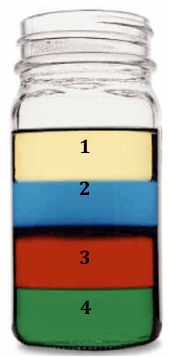
Put the liquids in order from most dense to least dense?
a)
4, 3, 2, 1
b)
1, 2, 3, 4
c)
3, 4, 2, 1,
d)
4, 3, 1, 2
18.

The map shows how gypsy moths have spread across Virginia over the years. Based on the map, gypsy moths —
a)
live in every state in the United States
b)
will be in all of Virginia by 2010
c)
first came to Virginia in 1960
d)
stopped spreading in 1996
19.
A possible explanation to a problem, that can be tested is what
a)
observation
b)
prediction
c)
hypothesis
d)
experiment
20.

In August, how many metric tons did Clark's Paper Mill and Tyler Paper Mill produce all together?
a)
10
b)
70
c)
80
d)
90
21.

What is the name of this line at 0 degrees latitude?
a)
Prime Meridian
b)
Equator
c)
North Pole
d)
South Pole
22.

What is the name of the line at zero degrees longitude?
a)
Equator
b)
Prime Meridian
c)
North Pole
d)
South Pole
23.

What is the approximate location of letter B?
a)
80oN, 0o
b)
0o, 80oW
c)
80oS, 0o
d)
0o, 80oE
24.

Which letter would you find at 15oS, 60oW?
a)
A
b)
C
c)
L
d)
H
25.

What is the elevation of A?
a)
10 meters
b)
20 meters
c)
40 meters
d)
120 meters
26.

What feature is formed at B?
a)
river
b)
rift valley
c)
sink hole
d)
mountain
27.

Which side of Holland Hill is the steepest?
a)
North
b)
South
c)
East
d)
West
28.

If we were in a plane, Path B --> C is about the same distance as path E --> N. But, which path is the easier walk?
a)
B --> C is the easier walk
b)
E --> N is the easier walk
c)
B --> C and E --> N are the same walking distance
29.
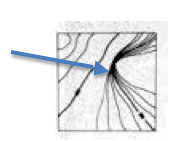
What feature is at the arrow?
a)
volcano
b)
mountain
c)
cliff
d)
river
30.

Which topographic map matches formation C?
a)
1
b)
2
c)
3
d)
4
31.
The earth is located between which 2 planets?
a)
Jupiter & Saturn
b)
Mercury & Venus
c)
Venus & Mars
d)
Saturn and Uranus
32.
One of the main differences between the outer and inner planets is __________.
a)
The inner planets all have water
b)
the inner planets are much bigger than the outer planets
c)
the outer planets are gas planets
d)
the inner planets have rings, and the outer planets don't
33.
As the Earth travels around the sun, this tilt causes different areas of the Earth’s surface to get different amounts of daylight at different times of the year. The angle of the Sun’s rays to the surface also causes areas to have more or less of the Sun’s energy. This causes the ________.
a)
months
b)
day and night
c)
seasons
d)
years
34.
What is one of the inner planets?
a)
Uranus
b)
Jupiter
c)
Earth
d)
Saturn
35.
What planet has a density less than water?
a)
Jupiter
b)
Earth
c)
Saturn
d)
Neptune
36.
Earth's distance from the Sun allows it to be the only planet to have -
a)
auroras
b)
liquid water
c)
frozen water
d)
an atmosphere
37.
What do we call a tide that has a large range?
a)
gravity
b)
wind
c)
spring
d)
neap
38.

What type of tides would this arrangement of earth-moon-sun create?
a)
neap tide
b)
spring tide
c)
new moon tide
d)
full moon tide
39.
Tides are caused by ___________
a)
wind
b)
gravitational pull of moon
c)
waves gravitation toward land
d)
rain
40.

What is a difference between spring and neap tides?
a)
Spring tides occur when the earth and sun are IN LINE with the new or full moon.
b)
Spring tides occur when moon in 3rd or 1st quarter phases
c)
Spring tides are LOWER than neap tides
d)
Spring tides occur in Spring and neap tides can occur in any season
41.
Air is composed of 78 % of this element.
a)
Carbon Dioxide
b)
Nitrogen
c)
Oxygen
d)
Water Vapor
42.
Air is composed of 21% of this element.
a)
Carbon Dioxide
b)
Nitrogen
c)
Oxygen
d)
Water Vapor
43.
The lowest layer of the atmosphere, this is also where weather occurs.
a)
Exosphere
b)
Mesosphere
c)
Troposphere
d)
Stratosphere
44.
The _______ in the Stratosphere protects us from harmful UV rays.
a)
aurora
b)
weather
c)
convection currents
d)
ozone
45.
When warm air rises and cools high in the atmosphere and then sinks to the earth creates _________ currents
a)
convection
b)
surface
c)
deep
d)
precipitaiton
46.
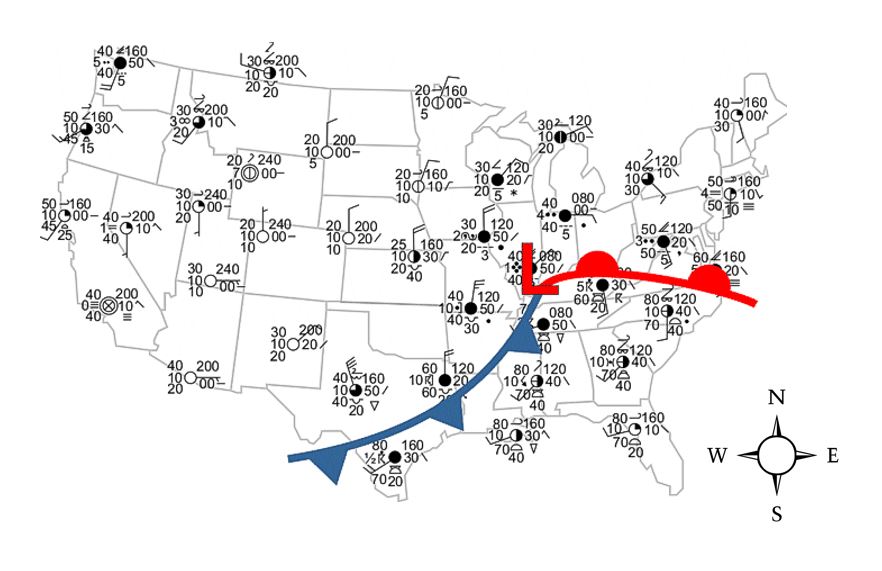
What direction is the warm front moving on the map?
a)
North
b)
South
c)
East
d)
West
47.
Which of the following best describes the origin of oxygen in the atmosphere?
a)
photosynthesis by cyanobacteria
b)
oxidation of cyanobacteria
c)
respiration by primitive plants
d)
combustion of fossil fuels
48.
Lines on a weather map that connect equal points of air pressure
a)
Dew point
b)
Fronts
c)
Air masses
d)
Isobars
49.

What does this image represent?
a)
Cold front
b)
Red bulbous things
c)
Warm front
d)
Sarah Ju
50.
The _____________ the isobars on a map are to/from one another the ___________ the wind.
a)
closer, slower
b)
closer, faster
c)
farther, faster
51.
What type of cloud produces thunderstorms?
a)
cumulonimbus cloud
b)
stratus cloud
c)
cirrus cloud
52.
In what areas of the world do hurricanes form?
a)
Warm ocean waters
b)
Polar ocean waters
c)
On lakes and rivers
d)
Over the central plains of the U.S
53.
A barometer measures ___.
a)
amount of rain
b)
temperature
c)
air pressure
d)
amount of snow
54.
What is the name of the steady winds that flow from west to east between latitudes 30*N and 60*N and 30*S and 60*S?
a)
trade winds
b)
land breeze
c)
westerlies
d)
jet stream
55.
Large bodies of water will be warmer than the land at night because -
a)
Water is a solvent.
b)
Water heats and cools more slowly than land.
c)
Water acts as a buffer.
d)
Water is non-polar.
56.
Which evidence was not used by Wegener to support his continental drift theory?
a)
South America & Africa coastlines
b)
Coal beds in Antarctica & Britain
c)
Plant & reptile fossils
d)
Earthquake patterns
57.
When the sea floor spreads apart, volcanoes and ridges are formed because
a)
underwater earthquakes
b)
sediments deposit forming ridges
c)
magma moves to the surface as the plates pull apart
d)
ocean water pushes down surrounding sea floor pushing up the ridges
58.

What type of stress causes these folds?
a)
compression
b)
shearing
c)
tension
59.
The land feature that happens when there is subduction is called a...
a)
mid-ocean ridge
b)
deep-ocean trench
c)
asthenosphere
60.

Determine the contour interval
a)
10 m
b)
20 m
c)
50 m
d)
100 m
61.

What is the elevation of point B?
a)
800 ft
b)
850 ft
c)
900 ft
d)
1000 ft
62.

Trilobites were alive during the _____________.
a)
Cenozoic
b)
Mesozoic
c)
Paleozoic
d)
Cretaceous
63.
What was the first mission to successfully land on the moon?
a)
Apollo 8
b)
Luna 3
c)
Apollo 11
d)
Mariner 6
64.
The International Space Station was created by the collaboration between the US and Russia in -
a)
1993
b)
1920
c)
1889
d)
2013
65.

Which letter is pointing to a trench?
a)
A
b)
D
c)
G
d)
B
66.
Which statement is an observation?
a)
That house is empty because there are no lights on.
b)
Her hair is brown.
c)
Her hair is brown because she dyed it.
d)
Her hair has not been cut in two years.
67.

Which statement is an inference about this picture?
a)
The van is tan.
b)
The van ran into KFC.
c)
The driver was hungry.
d)
Red and white are part of the KFC building.
68.
The Hertzprung Russell Diagram consists of two axis that are labelled...
a)
Luminosity and Size
b)
Luminosity and Temperature
c)
Luminosity and Age
69.

Look at the H-R diagram. Which star is
sort of cool, dim (not too much light), and red?
sort of cool, dim (not too much light), and red?
a)
Betelguse
b)
Sirius B
c)
Procyon B
d)
Barnard's star
70.
The Big Bang Theory explains the formation of the -
a)
Earth
b)
Sun
c)
Universe
d)
Solar System
71.
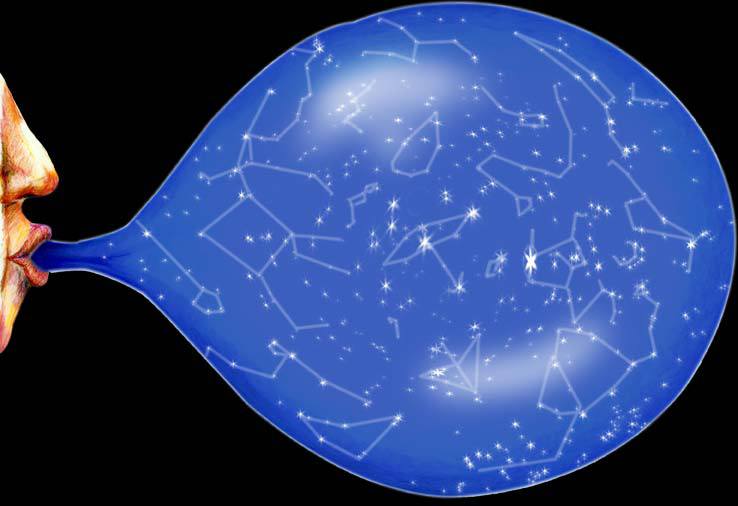
What does the Big Bang theory suggest?
a)
The universe was just there
b)
The Milky Way is the only solar system
c)
The universe is continually expanding
d)
The universe is collapsing in toward a single point
72.
How are stars distributed in space?
a)
evenly, with no significant clumping
b)
in clumps that are evenly distributed, with scattered stars in between
c)
in clumps that are evenly distributed
d)
in clumps that are unevenly distributed
73.
What are galaxies held together by?
a)
Gravity of a black hole
b)
Stars
c)
Other galaxies
d)
Dust and Gas
74.
The force of a column of air pressing down is called what?
a)
Air Mass
b)
Air Pressure
c)
Air
d)
Heavy
75.
What happens to the density (thickness)/ air pressure of the air as you increase in altitude?
a)
density increases
b)
density decreases
c)
density stays the same
d)
density disappears
100 %

