
 Worksheets
Atomic Theory
Total questions: 76
Worksheet time: 1hrs 20mins
Name
Class
Date
1.
Ernest Rutherford discovered that the atom is
a)
Compound of mostly empty space with negative electrons surrounding a positive nucleus
b)
A highly dense sphere of positive
c)
A highly dense sphere of a negative space
d)
Composed mostly of empty space with positive electrons surrounding a negative nucleus
2.

J.J. Thompson discovered the ____________.
a)
proton
b)
electron
c)
neutron
d)
nucleus
3.

The experiment used by Ernest Rutherford to discover the nucleus of an atom.
a)
Cathode Ray Experiment
b)
Gold Foil Experiment
c)
Reflector Experiment
d)
Plum Pudding Experiment
4.

Who came up with this model of an atom?
a)
J.J. Thompson
b)
Ernest Rutherford
c)
Neils Bohr
d)
James Chadwick
5.

Subatomic particle that has a negative charge and is located outside of the nucleus.
a)
Electron
b)
Proton
c)
Neutron
d)
Voltron
6.
True or False: All matter is made up of atoms.
a)
True
b)
False
7.
What subatomic particle changes the name of the atom?
a)
Neutron
b)
Proton
c)
Voltron
d)
Electron
8.
What two particles affect the charge of an atom?
a)
Electrons & Neutrons
b)
Protons & Electrons
c)
Neutrons & Protons
9.
True or False: The majority of an atom is made up of empty space
a)
True
b)
False
10.
An atom's overall charge is ________.
a)
positive
b)
depends
c)
neutral
d)
negative
11.

What does the nucleus of an atom contain?
a)
Electrons and neutrons
b)
Protons and neutrons
c)
Neutrinos and positrons
d)
DNA and RN
12.
a neutron has this charge
a)
negative
b)
positive
c)
neutral
13.
an electron has this charge
a)
positive
b)
negative
c)
neutral
14.
The positive particles of an atom are
a)
electrons
b)
positrons
c)
neutrons
d)
protons
15.
the central region of an atom where its neutrons and protons are is its
a)
nucleus
b)
electron cloud
c)
core
d)
center
16.
Niels Bohr suggested that electrons.......
a)
are found in specific orbits
b)
electrons are scattered throughout the atom
c)
electrons move according to their energy level
d)
electrons are positive
17.
The electron cloud model states that .....
a)
protons exist in a could like region and move according to their energy level
b)
neutrons exist outside the nucleus in a cloudlike region
c)
electrons move in orbits in a cloudlike region
d)
electrons exist in a cloudlike region and their movement is related to their energy level
18.
Contributes basically no mass to an atom.
a)
protons
b)
neutrons
c)
electrons
d)
protons and neutrons
19.
All matter is made of what?
a)
energy
b)
atoms
c)
electrons
d)
compounds
20.
How did Rutherford discover the proton?
a)
Cathode tube ray experiment
b)
Gold Foil Experiment
c)
Planetary Model
d)
Plum Pudding Model
21.
Who stated that all atoms of the same element are exactly alike?
a)
Democritus
b)
Dalton
c)
Thomson
d)
Borh
22.

What scientist is best known for his "Plum Pudding" model of the atom?
a)
J.J. Thomson
b)
Ernest Rutherford
c)
John Dalton
d)
Democritus
23.

What contribution did John Dalton make to atomic theory?
a)
He discovered that every atom was positively charged.
b)
He discovered that every element consisted of one type of atom.
c)
He discovered that atoms had nuclei.
d)
He discovered that atoms could be divided into smaller parts.
24.

Place the following scientists in order, from earliest to latest:
A) Ernest Rutherford
B) J.J. Thomson
C) John Dalton
A) Ernest Rutherford
B) J.J. Thomson
C) John Dalton
a)
B,C,A
b)
C,A,B
c)
A,C,B
d)
C,B,A
25.

John Dalton modeled the atom as a...
a)
tiny solid sphere, with a known mass
b)
a hollow sphere
c)
a marble in the middle of a stadium
d)
planets orbiting around a star
26.

J.J. Thomson provided evidence that an atom...
a)
is the smallest particle of matter
b)
contains negatively charged particles
c)
has an overall negative charge
d)
has an overall positive charge
27.

The gold foil experiment provided evidence that...
a)
negative and positive charges are spread evenly throughout the atom.
b)
alpha particles have a positive charge.
c)
gold is not a dense as previously thought.
d)
there is a dense positively charged nucleus at the center of an atom.
28.
Which word would closely define the term "atomos"?
a)
Incredible
b)
Indivisible
c)
Indelible
d)
Independent
29.

Which is the correct sequence of the scientists who made major changes in the model of the atom?
1-JJ Thomson
2-Erwin Schrodinger
3-John Dalton
4-Niels Bohr
5-Ernest Rutherford
1-JJ Thomson
2-Erwin Schrodinger
3-John Dalton
4-Niels Bohr
5-Ernest Rutherford
a)
2, 1, 4, 3, 5
b)
3, 1, 5, 4, 2
c)
5, 3, 2, 1, 4
d)
4, 3, 2, 1, 5
30.

Which of the following is proposed by Erwin Schrodinger?
a)
Solar system model of the atom
b)
Plum pudding model of the atom
c)
Billiard ball model of the atom
d)
Electron cloud model of the atom
31.
The majority of an atom's mass exists where?
a)
In the nucleus
b)
In the electron cloud
c)
In the space between the nucleus and the electrons
d)
In the neutrons
32.
Ernest Rutherford discovered that atoms were mostly:
a)
Negatively charged
b)
Positively charged
c)
Electrons
d)
Empty space
33.
The electron cloud model is also called the:
a)
Heisenberg Uncertainty principle
b)
Quantum Mechanical Model
c)
Planetary Model
d)
None of these
34.

This image represents which type of diagram:
a)
Lewis dot structure
b)
Electron dot diagram
c)
Bohr diagram
d)
None of these
35.
Each row in the periodic table is called a
a)
group
b)
period
c)
cluster
d)
unit
36.
Each column in the periodic table is called a
a)
period
b)
group
c)
cluster
d)
unit
37.
The atomic number tells you what?
a)
number of electrons
b)
number of protons
c)
number of neutrons
d)
both electrons and protons in an atom.
38.
Which group of the periodic table is composed of inert (not reactive) gases?
a)
alkali metals
b)
alkaline earth metals
c)
halogens
d)
noble gases
39.

The atomic number of this pictured element is
a)
28
b)
58.6934
c)
Ni
d)
Nickel
40.
How many electrons do atoms need to be stable?
a)
1
b)
2
c)
6
d)
8
41.

What does the H stand for?
a)
Hydrogen
b)
atomic number
c)
atomic mass
d)
atomic explosion
42.

What does the 1 stand for?
a)
Hydrogen
b)
atomic number
c)
atomic mass
d)
atomic explosion
43.

What does the 1.00794 stand for?
a)
Hydrogen
b)
atomic number
c)
atomic mass
d)
atomic explosion
44.
What does Li mean?
a)
Lanthanum
b)
Lawrencium
c)
Lutetium
d)
Lithium
45.
An isotope is the same element with a different number of...? (4.3)
a)
Protons
b)
Neutrons
c)
Electrons
46.
How many Valance electrons does Iodine Have?
a)
6
b)
16
c)
7
d)
17
47.

The period for Bromine is ___________.
a)
3
b)
2
c)
4
48.

Beryllium is in group number______.
a)
Group 2
b)
Group 3
c)
Group 4
d)
Group 7
49.
An element's identity is determined by the number of
a)
electrons.
b)
protons.
c)
neutrons.
d)
valence.
50.
What period and group is Silver (Ag)?
a)
Period 2, Group 1
b)
Period 3, Group 16
c)
Period 5, Group 11
d)
Period 2, 14
51.

A horizontal row on the periodic table is called a?
a)
group
b)
period
c)
family
d)
actinides
52.

How many electrons does a Copper atom have?
a)
63
b)
29
c)
92
d)
34
53.

What's a valence electron?
a)
electrons in the second energy level
b)
electrons in the outermost energy level
c)
the atomic number
d)
electrons in the first level
54.

What is the chemical symbol for Lithium?
a)
H
b)
He
c)
Li
d)
N
55.

How many neutrons are in a Gold atom?
a)
79
b)
196
c)
118
d)
275
56.

What element is represented in this Bohr Model?
a)
Carbon
b)
Hydrogen
c)
Aluminum
d)
Lithium
57.

How many neutrons does the isotope of lithium have?
a)
8
b)
3
c)
4
d)
5
58.
How many electrons should Lithium have around its Lewis dot model?
a)
1
b)
2
c)
3
d)
4
59.
How many electrons should Beryllium have around its Lewis dot model?
a)
1
b)
2
c)
3
d)
4
60.
How many electrons should Nitrogen have around its Lewis dot model?
a)
1
b)
3
c)
4
d)
5
61.
How many electrons should Carbon have around its Lewis dot model?
a)
1
b)
3
c)
4
d)
5
62.

How many electrons does potassium K contain? (click to see image)
a)
19
b)
39
c)
20
d)
40
63.
How many electrons should Sodium have around its Lewis dot model?
a)
1
b)
2
c)
3
d)
4
64.
How can I use the periodic table to determine valence electrons?
a)
look at the atomic number
b)
look at the period
c)
look at the group
d)
subtract mass number from atomic number
65.
How can I use the periodic table to determine how many energy level an atom will have?
a)
look at the group
b)
look at the atomic number
c)
look at the period
d)
subtract the mass number from the atomic number
66.
How many neutrons are found in a Chlorine atom?
a)
13
b)
14
c)
15
d)
18
67.
How many neutrons in C-14?
a)
6
b)
7
c)
14
d)
8
68.
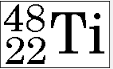
How many protons does this isotope of titanium have?
a)
48
b)
22
c)
26
d)
70
69.
How many neutrons does uranium-235 have?
a)
238
b)
92
c)
146
d)
143
70.

What do these isotopes of carbon all have in common?
a)
neutrons & mass number
b)
atomic number and neutrons
c)
atomic number and electrons
d)
protons, atomic number, and mass number
71.
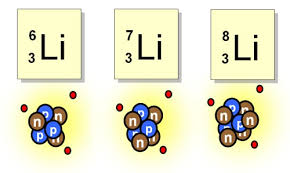
which atom has 4 neutrons?
a)
Li-6
b)
Li-7
c)
Li-8
d)
they have the same # of neutrons
72.
How does the size of an electron compare to the size of a proton?
a)
larger
b)
smaller
c)
equal
73.
A neutral atom of the isotope 2612Mg would consist of
a)
12 protons, 26 neutrons, 26 electrons
b)
26 protons, 12 neutrons, 26 electrons
c)
26 protons, 14 neutrons, 14 electrons
d)
12 protons, 14 neutrons, 12 electrons
74.
An atom is electrically neutral when
a)
protons and neutrons are the same
b)
protons and electrons are the same
c)
neutrons and electrons are the same
d)
neutrons balance the protons and electrons
75.
Isotopes of the same element have the same number of
a)
protons
b)
neutrons
c)
electrons
d)
not enough information
76.
Four isotopes of lead include lead-204, lead-206, lead-207, and lead-208. The average atomic mass of lead is 207.2. Which isotope of lead is likely to be the most abundant.
a)
204
b)
206
c)
207
d)
208
100 %

