
 Worksheets
Chemistry Reviewer for 3rd Quarter
Total questions: 74
Worksheet time: 3hrs 31mins


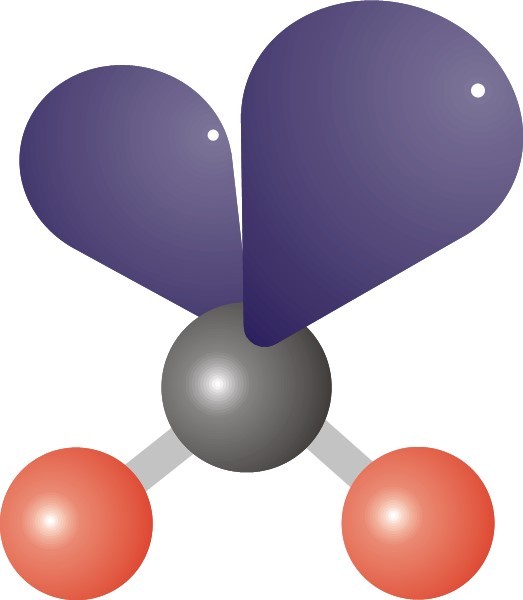
What molecule could this be? (Each purple cloud represents a lone pair of electrons.)
CO2
NH3
H2S
CH4
What is the molecular geometry of CO2?
Bent
Trigonal planar
Trigonal pyramidal
Linear
What determines the polarity of molecules?
Size of the molecule
Geometrical shape of the molecules
Number of atoms in the molecule
Color of the molecule
What is represented by an electric dipole in a molecule?
One positive end and one negative end
Two positive ends
Two negative ends
No charge
Which atom becomes the partial negative pole in a polar covalent bond?
The atom with higher electronegativity value
The atom with lower electronegativity value
The smallest atom
The largest atom
What is the connection between electronegativity and the polarity of bonds?
Electronegativity repels electrons
Electronegativity has no effect on bond polarity
Lower electronegativity attracts electrons more strongly
Higher electronegativity attracts electrons more strongly

It is the ability of an atom in a particular molecule to attract electrons to itself
(a)

It is a bond formed when there is an equal sharing of electrons between molecules.
Polar bond
Nonpolar bond
Ionic bond
None of the above

A polar compound has
Two positive ends
Two negative ends
One positive and one negative end
No charges between the ends

HBr is an example of a/an _____
Ionic compound
Polar compound
Nonpolar compound
None of the above

Diatomic molecules are considered as
Polar
Nonpolar
Ionic
Metallic

The bigger the electronegativity, the more nonpolar the bond is
TRUE
FALSE

To classify compounds using their electronegativity values, we get the electronegativity ________ between molecules.
Difference
Sum
Quotient
Product

Water
Polar
Nonpolar

δ+ means that an element is partially (a)

δ− means that the atom is ___
Less electronegative
More electronegative

Ca (1.0) and Br (2.8)
⬅️
➡️
↕️
↗️

What is the electronegativity difference between O2
0
1
2
3

These compounds are soluble in water
Polar
Nonpolar
What must the difference in electronegativity between two atoms be in order for the bond between them to be nonpolar covalent?
less than 0.4
greater than 1.7
between 0.4 and 1.7
exactly 0
The electrons in a polar covalent molecule are shared...
Evenly
Unevenly
Electrons are not shared
None of the Above
The law of conservation of mass states that matter ___________________.
cannot enter into chemical reactions
cannot be created or destroyed
cannot form different substances
cannot be modeled
Chemical formulas are used to represent _________________.
reactions
substances
processes
none of the above
Chemical equations are used to represent _________________.
reactions
substances
processes
none of the above
The small numbers under and to the right of element symbols in a formula are called _________________.
element symbols
exponents
coefficients
subscripts
The large numbers before a chemical formula that are used as multipliers are known as __________________.
element symbols
exponents
coefficients
subscripts
The materials we start with in a reaction are known as __________________.
chemicals
reactants
products
creations
The materials we end with in a reaction are known as __________________.
chemicals
reactants
products
creations
Reactants are found on the _______________ side of the arrow in a chemical equation.
Right
Left
Products are found on the _______________ side of the arrow in a chemical equation.
Right
Left
What is the correct "inventory" for KClO3
K = 1 Cl = 3 O = 3
K = 3 Cl = 3 O = 3
K = 1 Cl = 1 O = 3
K = 1 C = 1 l = 1 O = 3

What is the coefficient in the formula?
2
N
H
3
What does the arrow in a chemical equation represent?
created
makes
yields
destroys
What is the correct "inventory" for 3Al2O4
Al = 6 O = 4
Al = 6 O = 12
Al = 2 O = 4
Al = 3 O = 4
What is the correct "inventory" for 4Ag(NO3)2
Ag = 4 N = 2 O = 6
Ag = 4 N = 4 O = 6
Ag = 4 N = 8 O = 24
Ag = 1 N = 2 O = 6
Which of the following symbols is NOT a correct indication of the phase of a substance in a reaction?
(s)=solid
(g)=grams
(l)=liquid
(aq)= aqueous
Which is the correct chemical equation for the following: Solid Zn reacts with silver (I) chloride to produce Zinc (II) chloride and silver metal
Zn + AgCl → ZnCl2 + Ag
ZnCl2 + Ag → Zn + AgCl
ZnCl2 + Ag2 → Zn + AgCl
Zn2Cl + Ag → Zn + AgCl
Which of the following is a diatomic molecule?
fluorine
silver
boron
helium
How many carbon atoms are present on the reactant side? C2 + O2 ⇢ CO2
0
1
2
3
Fe + S --> FeS
Which of the following equations are correctly balanced?
12CO2 + H2O ---> C6H12O6 + O2
CO2 + 9H2O ---> C6H12O6 + O2
CO2 + H2O ---> 3C6H12O6 + O2
6CO2 + 6H2O ---> C6H12O6 + 6O2
Balance this equation:
H2 + Cl2 ---> HCl
It is balanced.
3H2 + Cl2 ---> 6HCl
H2 + Cl2 ---> 2HCl
H2 + 3Cl2 ---> 6HCl
What is the right ratio of chemicals for the balanced chemical equation?
__H2SO3 + __KOH--> __H2O+ __K2SO3
2,1 --> 2,1
1,2 --> 1,1
1,2 --> 1,2
1,2 --> 2,1
What is the right ratio of chemicals for the balanced chemical equation?
__AgNO3 + __H2S --> __Ag2S+ __HNO3
2,1 --> 1,2
1,2 --> 1,1
1,2 --> 1,2
1,2 --> 2,1
What is the right ratio of chemicals for the balanced chemical equation?
__Na + __H2O --> __NaOH + __H2
4,4 --> 4,1
1,2 --> 2,4
1,2 --> 2,1
2,2 --> 2,1
What is the right ratio of chemicals for the balanced chemical equation?
__Ca + __H2O --> __Ca(OH)2 + __H2
2,1 --> 2,1
1,2 --> 1,1
1,2 --> 2,4
1,2 --> 2,1
What is the right ratio of chemicals for the balanced chemical equation?
__CO + __Fe2O3--> __Fe + __CO2
3,2 --> 1,1
3,2 --> 2,4
3,1 --> 2,3
3,2 --> 2,1
What is the right ratio of chemicals for the balanced chemical equation?
__MnO2 + __HCl --> __MnCl2 + __H2O __Cl2
4,1 --> 2,1,2
1,2 --> 1,1,4
1,4 --> 1,2,1
1,4 --> 2,2,1
For the equation below, which of the following is the oxidizing agent?
H2 + O2 --> H2O
H2
O2
H2O
O
How many electrons are gained per Cu from the reaction below?
Al + Cu+2 --> Al+3 + Cu
1
2
3
4
What is the numerical coefficient of H2O in a balanced chemical equation below?
Cr2O3 + H2 --> Cr + H2O
1
2
3
4
What is the oxidation number of chlorine in HClO?
0
-1
+1
+5
Oxidation is the _________ of electrons.
loss
gain
sharing
transfer
Reduction is the ___________ of electrons.
loss
gain
sharing
transfer
Which of the following represents oxidation?
C → CH4
Fe3+ → Fe2+
Cl2 → 2Cl-
Zn → ZnO
In the reaction Zn + 2HCl --> ZnCl2 + H2
which element, if any, is oxidized?
Zinc
Hydrogen
Chlorine
None
Mg → Mg2+ + 2e–

