wayground logo

Free Printable Worksheets

Font size

S
M
L
XL
Worksheets

Stage 5 VALID Revision

Total questions: 71

Worksheet time: 2hrs 35mins

Name
Class
Date
1.

A 60kg person sprints from a standing start with an acceleration of 3m/s2. Calculate the force involved.

a)

180N

b)

18N

c)

196N

d)

166N

2.

A 0.5kg ball is kicked with an acceleration of 6m/s2. How much force was used?

a)

3N

b)

0.3N

c)

30N

d)

2N

3.
This scientist came up with the idea of natural selection.
a)
Jean Baptiste Lamarck
b)
Gregor Mendel
c)
Charles Darwin
d)
Thomas Malthus
4.
Inherited trait that helps an organism survive is a(n) __________.
a)
Fossil
b)
Adaptation
c)
Ancestor
d)
Natural selection
5.
The diagram shows fossils in different rock layers. Which of these statements about the age of these fossils is most likely correct?
a)
Fossil A and C are the same age
b)
Fossil B is older than fossil C
c)
Fossils A is older than fossil B
d)
Fossil D is older than fossil C
6.
The ability of an organism to survive and reproduce in its specific environment 
a)
diversity.
b)
evolution
c)
adaptation
d)
 fitness
7.
Why are advantageous traits more likely to be passed onto offspring?
a)
Because they are more likely to survive and reproduce.
b)
Because they come from dominant alleles.
c)
Because they come from recessive alleles.
d)
Because the trait is an acquired phenotype.
8.
The gradual change in species over time is...
a)
Evolution
b)
Nucleotide 
c)
Adaptation
d)
Natural Selection
9.
Which term refers to the process by which individuals that are better suited to the environment survive and reproduce therefore passing down their genes to their offspring? 
a)
Evolution 
b)
Variation 
c)
Adaptation
d)
Natural Selection 
10.
A well-tested concept that explains a wide range of observations is called a(an):
a)
hypothesis
b)
experiment
c)
cause and effect
d)
scientific theory
11.

Scientists have collected millions of fossils of different organisms, and have developed a timeline of life on Earth. What do we call this?

a)

Mutation

b)

Natural Selection

c)

The theory of evolution

d)

Fossil Record

12.
Darwin's theory of evolution is supported by his idea on...
a)
natural selection and adaptation
b)
natural living animals like fossils
c)
chickens have the same amount of genes
13.
Genetic variation can arise from a random change in the DNA of a gene.  The change is called a(n)
a)
mutation
b)
gene flow
c)
gene pool
d)
allele
14.
The fossil record provides evidence that 
a)
Fossils cannot be dated.
b)
All species were formed during Earth’s formation and have changed little since then.
c)
The fossilized species have no connection to today’s species.
d)
Older species gave rise to more-recent species.
15.

Natural selection results in change in a population's _____________ traits over time.

a)

inherited

b)

acquired

16.
One disadvantage of nuclear energy is ___.
a)
it is a fossil fuel
b)
it leaves behind radioactive waste
c)
it emits large amounts of pollution into the atmosphere
d)
there are no disadvantages
17.
One advantage of nuclear energy over coal energy is ______.
a)
it is very cheap to build and maintain a nuclear power plant
b)
there is very little dangerous waste with nuclear energy
c)
the nuclear plant emits more greenhouse gases
d)
the nuclear plant does not emit as many greenhouse gases
18.

What is inside the nucleus of the atom?

a)

electrons and protons

b)

protons and quarks

c)

protons and neutrons

d)

neutrons and electrons

19.
Almost all of the mass of an atom is found in what part?
a)
The electron cloud
b)
The nucleus
c)
The protons
d)
The charge
20.
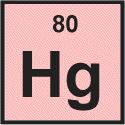
What is the name of this element?
a)
Helium
b)
Rubidium
c)
Hydrogen
d)
Mercury
21.
What is the atomic number of Oxygen?
a)
6
b)
7
c)
8
d)
9
22.

Give the CHEMICAL SYMBOL of the following chemical compound magnesium oxide

a)

MaO

b)

MgO

c)

Mg2O

d)

MgO2

23.

Give the CHEMICAL SYMBOL of the following chemical compound water

a)

h2o

b)

H2O

c)

HO2

d)

H2O

24.

NaCl is

a)

sodium chloride

b)

sodalite

c)

sodium carbide

d)

nitrogen chloride

25.

C is

a)

carbon

b)

calcium

c)

carbonite

d)

carmolite

26.

Cl is

a)

chlorine

b)

chlorite

c)

chloroform

d)

clinine

27.

Na is

a)

sodium

b)

naturum

c)

nitrogen

d)

sodate

28.

How many oxygen atoms does a molecule of ozone contain?

a)

1

b)

2

c)

3

d)

4

29.
The shortest wavelength in visible light is______.
a)
violet
b)
red
c)
blue
d)
yellow
30.
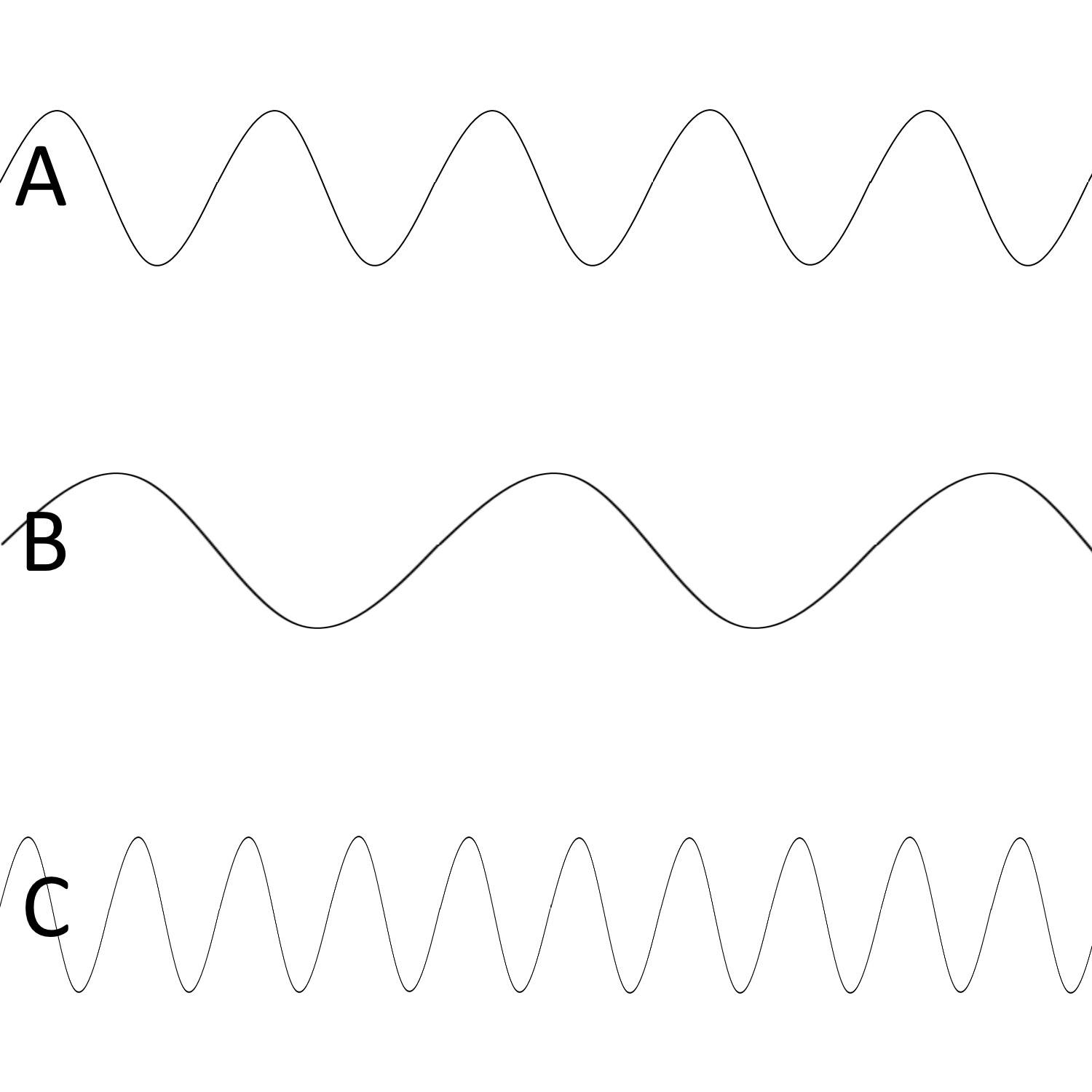
Which wave has the largest wavelength?
a)
A
b)
B
c)
C
d)
None (same wavelength)
31.
Which wave has the largest frequency?
a)
A
b)
B
c)
C
d)
None (same frequency)
32.
If all three are waves of light, which wave has the largest speed?
a)
A
b)
B
c)
C
d)
None (same speed)
33.

To calculate the frequency of an electromagnetic wave, you need to know the speed of the wave and its

a)

wavelength.

b)

intensity.

c)

refraction.

d)

amplitude.

34.

Electromagnetic waves vary in

a)

the speed they travel in a vacuum.

b)

wavelength and frequency.

c)

the way they reflect.

d)

the orientation of their electric and magnetic fields.

35.

The full range of frequencies of electromagnetic radiation is called

a)

visible light.

b)

radio waves.

c)

the electromagnetic spectrum.

d)

invisible radiation.

36.

Newton’s prism experiments showed that white sunlight is made up of

a)

the full electromagnetic spectrum.

b)

only blue light.

c)

all the colors of the visible spectrum.

d)

only the longest wavelengths.

37.
Which one is NOT an example of a decomposer?
a)
mushroom
b)
leaves
c)
mold
d)
worm
38.
A tree is a ....
a)
composer
b)
decomposer
c)
producer
39.
What is a producer?
a)
an organism that gets energy from eating other organisms
b)
an organisms that uses sunlight to make its own food
c)
an organism that gets energy from eating dead organisms, non-living material or waste
d)
an organism that uses chemical energy to make its own food
40.
Which best describes what a food chain shows you?
a)
Energy flow through an ecosystem
b)
Food flowing through an ecosystem
c)
Consumers going into other consumers
d)
Who eats who
41.
The living part of an ecosystem
a)
Biotic
b)
Abiotic
c)
Mother Earth
d)
Flowers
42.
The non-living part of an ecosystem
a)
Ocean
b)
Lava Flow
c)
Birds
d)
Abiotic
43.

The chemical symbol for copper is

a)

C

b)

Co

c)

Cp

d)

Cu

44.
Which organ system does the brain belong to?
a)
Reproductive
b)
Cardiovascular
c)
Integumentary
d)
Nervous
45.
Which organ belongs to the reproductive system?
a)
ovaries
b)
spleen
c)
large intestine
d)
liver
46.
Which organ belongs to the reproductive system?
a)
gluteus maximus
b)
humerus
c)
radial artery
d)
testes
47.
Which organ belongs to the respiratory system?
a)
left lung
b)
small intestine
c)
spleen
d)
pancreas
48.
Which of the following is NOT part of the skeletal system?
a)
humerus
b)
appendix
c)
femur
d)
cranium
49.
Which of the following best describes a DNA molecule?
a)
double helix
b)
contains ribose
c)
made of amino acids
d)
contains uracil
50.
What determines the code, or information, of a DNA molecule?
a)
the shape (structure) of the nitrogen bases
b)
the order (sequence) of the nitrogen bases
c)
the color of the nitrogen bases
d)
the frequency (number) of nitrogen bases
51.
Who was given credit for determining the shape of DNA? 
a)
Avery
b)
Watson and Darwin
c)
Watson and Crick
d)
Franklin and Crick
52.

Which of these are well known theories in biology? (check all that apply)

a)

The Theory of Species

b)

The Theory of Evolution

c)

Cell Theory

d)

Germ Theory

53.

____________________ is a change in the characteristics of living things over time.

a)

Evolution

b)

Cell Theory

c)

Germ Theory

d)

none of these

54.

What causes evolution to occur?

a)

Pathogenic Theory

b)

Cell Theory

c)

Natural Selection

d)

it is currently unknown

55.

According to the cell theory which of these are true? (Check all that apply)

a)

the cell is the smallest unit of structure and function of all living organisms

b)

all living organisms are made up of millions of cells

c)

living cells always come from other living cells

d)

all cells have a nucleus that controls the reactions inside the cell

56.
Match the scientific theory to the correct definition:
The Big Bang Theory
a)
Animals and plants change gradually over a long period of time through a process of natural selection
b)
The planets move around the sun, not the other way around
c)
An explosion of heat that occurred 15 billion years ago and from which the Universe originated
d)
The force which makes two objects move towards each other, most commonly when an object falls to the ground
57.
Evolution
a)
Animals and plants change gradually over a long period of time through a process of natural selection
b)
The planets move around the sun, not the other way around
c)
An explosion of heat that occurred 15 billion years ago and from which the Universe originated
d)
The force which makes two objects move towards each other, most commonly when an object falls to the ground
58.
A scientific theory...
a)
is based on lots of evidence
b)
is not valid
c)
is not reliable
d)
has not been tested many times
59.

Theories can change when....

a)

we discover new information and new technology

b)

whenever the scientist decides

c)

the decade changes

d)

cows jump over the moon

60.
How do scientists learn about the world around us?
a)
By making laws
b)
By making theories
c)
Guessing
d)
Asking questions
61.

Is there a pattern to the locations of earthquakes and volcanoes around the globe?

a)

No, earthquakes and volcanoes are random.

b)

Yes, earthquakes and volcanoes usually occur near the boundaries of tectonic plates.

c)

yes, earthquakes and volcanoes usually occur in the middle of tectonic plates.

d)

No, earthquakes and volcanoes usually occur under water.

62.

A force caused the continents to drift apart over time. Once scientists figured out what that force was, the theory of plate tectonics was born! The image above shows what Geologists think the Earth looked like millions of years ago. What name was given to this land mass.

a)

Plate Tectonics

b)

Oceana

c)

Pangea

d)

North America

63.

The theory of plate tectonics revolutionized scientific thought because it

a)

explained the movement of oceanic and continental crusts.

b)

demonstrated how tidal forces affect coastlines.

c)

mapped the pattern and frequency of earthquakes.

d)

explained the mineral differences between continents
64.

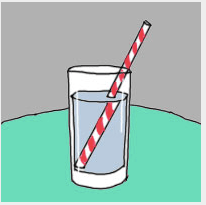
Why does the straw appear to be bent?

a)

light is reflected

b)

light is absorbed

c)

light is turned

d)

light is refracted

65.

What is the best explanation for Mickey seeing himself in the mirror?

a)

refraction

b)

absorbed

c)

reflection

d)

flipped

66.

What do we call a material that light can travel through?

a)

air

b)

water

c)

medium

d)

pathway

67.
When light bends it is ______
a)
Reflection
b)
Absorption
c)
refraction 
d)
optical density
68.
When light bounces back it is _____
a)
Reflected
b)
Refracted
c)
Absorbed
d)
Optical Density
69.
We see the color _______ when a material absorbs all visible light.
a)
white
b)
black
70.
The distance between two crests or two troughs is the...
a)
Crest/Peak
b)
Trough
c)
Wavelength
71.
Light is a form of _______ that is needed to support life on Earth.
a)
Vibration
b)
Compression
c)
Energy
d)
Motion