
 Worksheets
Water Cycle
Total questions: 43
Worksheet time: 1hrs 9mins
Name
Class
Date
1.

What part of the water cycle does this picture show?
a)
condensation
b)
precipitation
c)
evaporation
2.
Which of these is an example of precipitation?
a)
snow
b)
air
c)
clouds
d)
vapor
3.
Which is the opposite of condensation?
a)
runoff
b)
evaporation
c)
precipitation
d)
transpiration
4.
Which best explains why runoff is important?
a)
It returns water to other locations on Earth
b)
It increases the chance of flooding
c)
It makes evaporation occur faster
d)
It increases condensation
5.
Snow, sleet, hail, and rain are all examples of ________________.
a)
evaporation
b)
condensation
c)
accumulation
d)
precipitation
6.

Does evaporation happen before or after condensation?
a)
before
b)
after
c)
during
7.

What is it called when WATER is FORMED from an LIQUID to a WATER VAPOR Oor an [GAS]?
a)
EVAPORATION
b)
PRECIPITATION
c)
TRANSPIRATION
8.

What is the next stage after EVAPORATION in the water cycle?
a)
CONDENSTATION
b)
GROUNDWATER
9.

What does groundwater do?
a)
It sends water to our buildings, houses, and water transplant places
b)
to the sky
c)
to the sun
d)
To the Earth's surfaces
10.

What is it called when plants give off water vapor as a waste product?
a)
condensation
b)
evaporation
c)
sublimation
d)
transpiration
11.
When water _________, dew forms.
a)
Melts
b)
Evaporates
c)
Condenses
d)
Precipitates
12.

What is the water cycle?
a)
the 3 forms of water
b)
the movement of water on, above, or below the surface of the Earth
c)
when water melts
d)
when clouds form
13.
Which of these is not an example of precipitation?
a)
rain
b)
clouds
c)
sleet
d)
snow
14.
Which of these is an example of precipitation?
a)
snow
b)
air
c)
clouds
d)
vapor
15.

Is humidity the amount of water in the air?
a)
Yes
b)
No
16.

Does warm water evaporate quicker than cold water?
a)
Yes
b)
No
17.
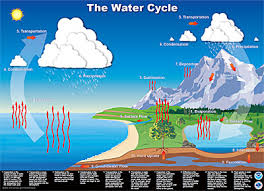
Which stages does liquid water from the ocean turn into water vapor?
a)
condesantion
b)
evaporation
c)
precipitation
d)
run off
18.
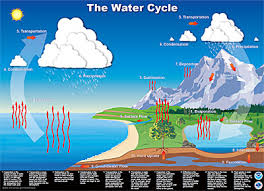
During which stage do clouds form?
a)
condensation
b)
evaporation
c)
precipitation
19.
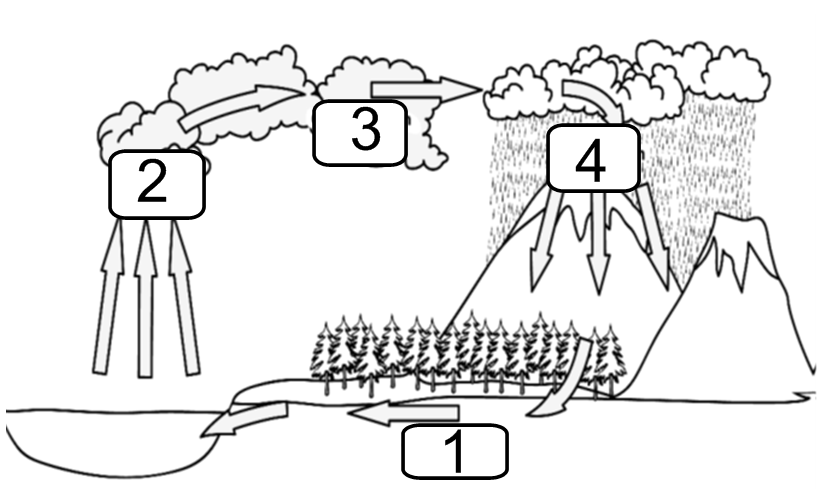
Which stage does the #2 show in the diagram?
a)
condensation
b)
evaporation
c)
precipitation
d)
run off
20.

Which stage does the #3 show in the diagram?
a)
condensation
b)
evaporation
c)
precipitation
d)
run off
21.

what does the #4 show in the diagram?
a)
condensation
b)
evaporation
c)
precipitation
d)
run off
22.
What source of energy evaporates the most water from Earth’s surface?
a)
volcanoes
b)
the sun
c)
lightning
d)
wind
23.
What percentage of Earth’s water is freshwater?
a)
75%
b)
3%
c)
1%
d)
97%
24.

What is D?
a)
Evaporation
b)
Condensation
c)
Precipitation
d)
Runoff
25.
Where is most water found on Earth?
a)
glaciers
b)
lakes
c)
rivers
d)
oceans
26.

What is the process of water droplets or ice crystals falling from the sky?
a)
evaporating
b)
condensing
c)
precipitating
d)
runoff
27.
On which kind of day would you expect the most evaporation from the surface of a pond?
a)
cold, rainy
b)
cold, sunny
c)
warm, rainy
d)
warm, sunny
28.
The oceans absorb much of the sunlight reaching Earth. When water in the oceans absorb sunlight and heat up, what process can happen to the water?
a)
accumulation
b)
condensation
c)
evaporation
d)
precipitation
29.
Which of the following causes all of the water on the planet to change its state (solid, liquid, gas) and move through the water cycle?
a)
amount of plant matter
b)
location of ice caps
c)
size of ocean
d)
temperature
30.
What is evaporation?
a)
The part of the water cycle when the sun heats up water, turning it from a liquid into water vapor or steam. It rises from the ground into the air.
b)
The part of the water cycle when the water vapor in the air gets cold. The water turns back into a liquid and forms clouds.
c)
The part of the water cycle when clouds get heavy and can no longer hold the liquid water. This causes the water to fall from the sky to the earth as rain, snow, sleet, or hail.
31.
What is condensation?
a)
The part of the water cycle when the sun heats up water, turning it from a liquid into water vapor or steam. It rises from the ground into the air.
b)
The part of the water cycle when the water vapor in the air gets cold. The water turns back into a liquid and forms clouds.
c)
The part of the water cycle when clouds get heavy and can no longer hold the liquid water. This causes the water to fall from the sky to the earth as rain, snow, sleet, or hail.
32.
What is water vapor?
a)
Water on the land (geosphere)
b)
Water in the air (atmosphere)
c)
Water in plants
d)
Water in the water (hydrosphere)
33.
What type of precipitation forms when raindrops fall through cold air and freeze before they hit the ground?
a)
Rain
b)
Freezing Rain
c)
Sleet
d)
Snow
34.
The first step in the water cycle
a)
evaporation
b)
condensation
c)
precipitation
d)
there is no first step
35.
How much new water does the water cycle produce each day?
a)
1 gallon
b)
100 gallons
c)
1,000,000 lagoons
d)
none
36.
Which best explains why runoff is important?
a)
It returns water to other locations on Earth
b)
It increases the chance of flooding
c)
It makes evaporation occur faster
d)
It increases condensation
37.
What is a layer of rock or sediment that holds water?
a)
glacier
b)
well
c)
aquifer
d)
natural spring
38.
How much of our planet is estimated to be covered with water?
a)
68%
b)
50%
c)
97%
d)
75%
39.
How much of our planet's water is saltwater?
a)
75%
b)
1%
c)
99%
d)
97%
40.
More evaporation occurs
a)
at night
b)
during the day
41.
Water in lakes and rivers that does not contain salt-
a)
recycled water
b)
new water
c)
salt water
d)
fresh water
42.
The changes to water when it cycles the earth is called
a)
the moon cycle
b)
the sun cycle
c)
the water cycle
d)
the wind cycle
43.
The water cycle has no start or end
a)
true
b)
false
100 %

