
 Worksheets
ES Unit 3 Review
Total questions: 56
Worksheet time: 52mins
Name
Class
Date
1.
A frog eats a fly. The frog and fly are demonstrating ________.
a)
mutualism
b)
competition
c)
predator/prey
d)
parasitism
2.
A tick and a dog have this type of relationship.
a)
mutualism
b)
commensalism
c)
neutralism
d)
parasitism
3.
A relationship between two organisms in which one organism benefits and the other is unharmed
a)
Mutualism
b)
Competition
c)
Parasitsm
d)
Commensalism
4.
A relationship between two species in which both species benefit
a)
mutualism
b)
commensalism
c)
symbiosis
d)
camouflage
5.
An organism that kills and eats all or part of another organism
a)
coevolution
b)
predator
c)
prey
d)
parasite
6.
When multiple organisms seek the same limited resource, this is referred to as?
a)
Tolerance
b)
Competition
c)
Predation
d)
Parasitism
7.
The number of different species a community contains
a)
richness
b)
evenness
c)
density
d)
abundance
8.
Relative abundance of individuals within each of the species in a community
a)
richness
b)
evenness
c)
density
d)
diversity
9.
The lack of natural predators makes populations of invasive species unmanageable?
a)
True
b)
False
10.
Does an increase of biodiversity follow new species invading?
a)
True
b)
False
11.

How did the zebra mussels end up in the Great Lakes?
a)
In ballast tanks of ships
b)
They were intentionally released
c)
They have always been in the Great Lakes
d)
That's not a zebra mussel
12.
Which of these is abiotic?
a)
fish
b)
bacteria
c)
grass
d)
water
13.
What is a mass extinction?
a)
When all the species in a particular area on earth suddenly go extinct
b)
When multiple species from all over the earth suddenly go extinct
c)
When one species goes extinct due to habitat changes
d)
When all life on earth is wiped out
14.
Humans are causing extiction in which ways?
a)
By over hunting animals for food or products.
b)
By destroying the natural habitat of species.
c)
By polluting the environments of the world.
d)
All of the above.
15.
When the population of a species drops very low and there are very few animals of a species left throughout the world, that species is _____________.
a)
extinct
b)
entrapped
c)
endangered
d)
included
16.
How do the predator- prey relationships in ecosystems effect positive change in the ecosystems?
a)
They allow plants and trees to grow more quickly
b)
They do not make any changes to the ecosystem
c)
They keep the ecosystem in balance where and more species can survive in the ecosystem.
d)
They help the soil and water to build nutrients
17.
What is it called when coral loses its color?
a)
bleaching
b)
white out
c)
colorization
18.
What caused the bleaching of a large part of the Great Barrier Reef in 2015-16?
a)
oil spill
b)
underwater heat wave
c)
formation of iceberg
d)
mass migration of fish out of area
19.
How do zooxanthellae help corals?
a)
Provide sugars to corals
b)
Provide oxygen to corals
c)
Provide pretty colors to corals
d)
Provide protection to corals
20.

What is the overall trend shown with the data?
a)
More coral bleaching with time
b)
Less coral bleaching with time
c)
There is no change in the amount of coral bleaching.
21.
What abiotic factor is causing the bleaching?
a)
Time - as the coral gets older it is bleached more
b)
Temperature causes coral bleaching. Temperatures are increasing because of global warming.
c)
Light - With less light there is more coral bleaching
22.
The relationship between a clownfish and a sea anemone is which type?
a)
mutualism
b)
commensalism
c)
parasitism
d)
competition
23.
Which type of relationship occurs between mistletoe and a tree?
a)
parasitism
b)
mutualism
c)
commensalism
d)
competition
24.
When a non-native species is introduced to an area, what is the most likely relationship it will have with plants and animals already living there?
a)
parasitism
b)
competition
c)
mutualism
d)
commensalism
25.

This commercially important animal is affected by a lack of kelp forests
a)
polar bear
b)
corals
c)
abalone
d)
purple urchins
26.
Invasive species of grasses harm farmers
a)
True
b)
False
27.

What does the graph tell you about biodiversity between 1600 and 1959?
a)
biodiversity has increased
b)
biodiversity has decreased
c)
biodiversity has remained about the same
d)
not enough information to tell
28.
Why do the populations of invasive species grow so quickly?
a)
invasive species require more energy than other organisms
b)
invasive species are prey to many animals.
c)
invasive species have no natural predators.
d)
invasive species keep the ecosystems in equilibrium.
29.
Invasive species are only animals.
a)
True
b)
False
30.
A species that maintain biodiversity by keeping prey populations controlled are called...
a)
Introduced Species
b)
Apex Predators
c)
Invasive Species
d)
Keystone Species
31.
A sea otter and a sea star are examples of...
a)
invasive species
b)
keystone species
c)
native species
d)
symbiotic species
32.

Based on the graph shown, what is the effect of removing a keystone species from an ecosystem?
a)
biodiversity goes up
b)
biodiversity goes down
c)
biodiversity stays about the same
d)
not enough information to tell
33.

Based on the graph shown, how can you tell sea otters are a keystone species?
a)
as the sea otter population decreases, biodiversity increases
b)
as sea otter population increases, biodiversity increases
c)
changes in the sea otter population have little effect on biodiversity
d)
the sea otter population dereases due to the presence of urchins
34.

Study the graph. Based on the data shown, rainbow smelt are a/an _____________.
a)
invasive species
b)
keystone species
c)
symbiotic species
d)
not enough information to tell
35.
_______ is a fungal interaction with plants that helps them absorb minerals like phosphorus.
a)
mycorrhizae
b)
mycelia
c)
penicillium
d)
rhizoid
36.
Unlike plants, fungi can't make their own sugars, so they are classified as ______
a)
heterotrophs
b)
autotrophs
c)
chemotrophs
d)
sporophytes
37.
A type of fungi that has a symbiotic relationship with plants by supplying plants with better nutrients, and the plants provide sugar for fungus.
a)
lichen
b)
mycorrhizae
c)
bacteria
d)
protista
38.
A pearlfish spends the day inside the alimentary tract, or intestines, of a sea cucumber. The fish emerges from the sea cucumber at night to feed on small crustaceans. The pearlfish gets a safe place to live. The sea cucumber does not gain anything from this relationship, nor is it harmed.
a)
Commensalism
b)
Mutualism
c)
Parasitism
39.
Corals feed off the byproducts of a microscopic algae living within their own tissue, called zooxanthellae. The photosynthetic activity of the algae is vital to the survival of the coral animals, which use the energy to extract calcium from the seawater and build their calcareous skeletons. The zooxanthellae are protected by the hard coral and obtain plant nutrients from the coral.
a)
Mutualism
b)
Commensalism
c)
Parasitism
40.

What point on the graph represents the carrying capacity?
a)
A
b)
B
c)
C
d)
D
41.
Why has the human population been able to grow so quickly in such a short period of time?
a)
Doctors have developed easier and safer ways to have babies
b)
People needed more help to work their farms so they had more children
c)
Because people stayed in one place and only moved when crowded out
d)
Because of medical care, clean water and better access to nutritious food
42.

When a population grows past the ecosystem's carrying capacity, what happens to the population?
a)
Continues to grow
b)
The population starts to die off to return to carrying capcity
c)
The population will go extinct due to lack of resources
d)
The population grows then finds a new carrying capacity
43.

If the amount of food or resources available increases, the carrying capacity for an animal:
a)
Stays the same
b)
Increases
c)
Decreases
d)
Fluctuates
44.

Any thing or organism that regulates the size of a population is known as __________.
a)
a limiting measure
b)
a limiting factor
c)
carrying capacity
d)
biodiversity
45.
Limiting factors are sometimes helpful because they can keep the population from getting to large.
a)
True
b)
False
46.

What is the carrying capacity of this population?
a)
100
b)
200
c)
300
d)
400
47.

If a disease destroying barley plants in a field swept through an ecosystem, what would happen to the barley eating bird population in the the field ?
a)
The bird population would stay the same
b)
The bird population would infinitely increase
c)
The bird population would decrease
48.
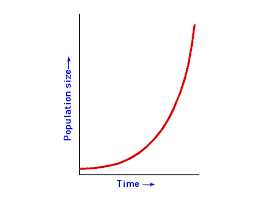
What type of growth is shown in the diagram?
a)
exponential growth
b)
logistic growth
c)
predator-prey cycle
d)
boom-bust curve
49.
What do you call a period of rapid growth?
a)
exponential growth
b)
logistic growth
c)
emigration
d)
predator-prey cycle
50.

Which type of growth is best illustrated by this rabbit population?
a)
exponential
b)
logistic
c)
S-shaped
d)
predator-prey
51.
Type of growth that occurs when disease and parasites are present...
a)
exponential
b)
J-shaped
c)
predator-prey
d)
logistic
52.

What is the approximate carrying capacity of Paramecium aurelia cultured alone?
a)
150
b)
400
c)
450
d)
500
53.
The correct formula to add cell B1 and B2 is
a)
AddB1+C1
b)
=sum(B1+C1)
c)
=B1+B2
d)
=sum(B1-B2)
54.
All formulas in Google Sheets begin with the following symbol:
a)
+
b)
-
c)
=
d)
%
55.
You can have multiple sheets within the same Google Sheet document.
a)
True
b)
False
56.

What is the name of a vertical section of a spreadsheet?
a)
row
b)
cell
c)
column
d)
format
100 %

