
NEW
Font size
S
M
L
XL
 Worksheets
Chemistry review - AIS
Total questions: 45
Worksheet time: 44mins
Name
Class
Date
1.
Which is not a sign of a chemical change?
a)
water evaporating
b)
gas bubbles
c)
color change
d)
temperature change
2.
Which of the following is a sign that a chemical reaction has occurred?
a)
change in shape
b)
melting
c)
formation of a gas
d)
dissolving
3.

Is burning wood a chemical or physical change?
a)
chemical
b)
physical
4.
Is melting butter for popcorn a chemical or physical change?
a)
chemical
b)
physical
5.
How many Al atoms are in this Aluminium Oxide molecule?
4Al2O3
4Al2O3
a)
2
b)
8
c)
6
d)
4
6.
The substances at the beginning of a chemical equation are called the ____
a)
product
b)
yield
c)
chemical symbol
d)
reactants
7.
The Law of Conservation of Mass states
a)
that matter exists in all states and reacts the same
b)
that matter can only be changed into new substances by introducing a catalyst
c)
that matter exists in the same state throughout any chemical change
d)
that matter cannot be created or destroyed and that the mass of the products must equal the mass of the reactants
8.
An example of an endothermic reaction is:
a)
ice forming because it is cold
b)
baking soda and vinegar reacting because the temperature decreases
c)
elephant toothpaste because the substances react and the temperature increases
d)
all three are correct
9.
During an exothermic reaction:
a)
energy is released as heat or light
b)
energy is absorbed, decreasing the temperature
c)
molecules do not change
d)
temperature remains constant
10.
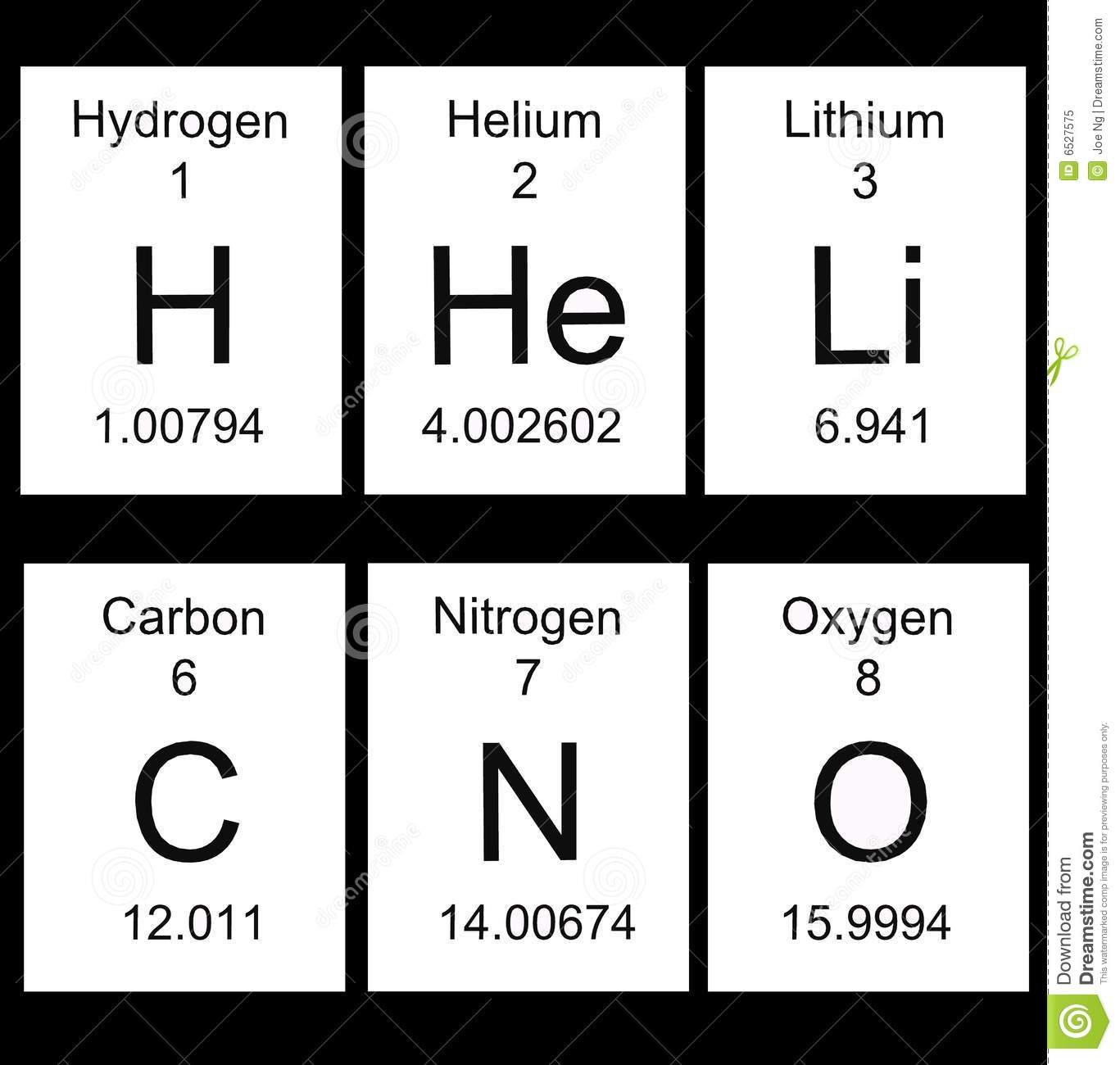
Two numbers are given on the periodic table for each element, the smaller number (at the top of each square in the picture) is the ...
a)
atomic number
b)
atomic mass
c)
Chemical Symbol
d)
Element Name
11.
The positive particles of an atom are called:
a)
electrons
b)
positrons
c)
neutrons
d)
protons
12.

How many protons are in Beryllium?
a)
4
b)
9
c)
5
d)
2
13.

How many valence electrons does this atom have?
a)
2
b)
4
c)
6
d)
8
14.
1st shell of an atom can hold maximum of
a)
2
b)
4
c)
6
d)
8
15.
The atomic number tells you what?
a)
number of electrons
b)
number of protons
c)
number of neutrons
d)
number of protons + electrons
16.

How many neutrons does this element have?
a)
8
b)
3
c)
4
d)
5
17.

What is the name of this element?
a)
Krypton
b)
Potassium
c)
Lithium
d)
Neon
18.
What is the chemical symbol for carbon?
a)
Cr
b)
C
c)
Mg
d)
Li
19.

What is the name of this element?
a)
Mercury
b)
Hydrogen
c)
Helium
d)
Calcium
20.

What is the name of this element?
a)
Neon
b)
Fluorine
c)
Hydrogen
d)
Calcium
21.
How many Hydrogen are in 4H2O?
a)
6
b)
8
c)
2
d)
4
22.
How many Chlorine atoms are in 10MgCl2?
a)
10
b)
5
c)
20
d)
2
23.
How many atoms are there TOTAL in:
H2SO4
H2SO4
a)
6
b)
5
c)
7
d)
3
24.
Number of Carbon atoms in 2Na₂CO₃
a)
1
b)
2
c)
3
d)
5
25.
Which particles make up the nucleus of an atom?
a)
protons and neutrons
b)
electrons and protons
c)
electrons, protons, and neutrons
d)
electrons and neutrons
26.
An element with a mass number of 11 and an atomic number of 5 has how many neutrons?
a)
11
b)
5
c)
6
d)
16
27.
An element with a mass number of 10 and an atomic number of 6 has how many protons?
a)
5
b)
8
c)
6
d)
10
28.

How many VALENCE electrons will phosphorus have?
a)
15
b)
16
c)
5
d)
6
29.
What is made when magnesium reacts with hydrochloric acid?
a)
magnesium nitrate and hydrogen gas
b)
magnesium sulfate and hydrogen gas
c)
magnesium oxide and oxygen gas
d)
magnesium chloride and hydrogen gas
30.
Which gas is required for something to burn?
a)
Carbon dioxide
b)
Hydrogen
c)
Oxygen
d)
Water
31.
Complete the following reaction:
Sulphuric acid + sodium carbonate -->
Sulphuric acid + sodium carbonate -->
a)
Carbon dioxide + water
b)
calcium carbonate + water + carbon dioxide
c)
Sodium sulphate + water + carbon dioxide
d)
Sodium chloride + water + carbon dioxide
32.
Balance this equation.
_SnO2 +_H2-->_Sn +_H2O
_SnO2 +_H2-->_Sn +_H2O
a)
1,1,2,1
b)
1,2,1,1
c)
1,2,1,2
d)
1,2,2,1
33.
Balance this equation-
__P4 + __O2 --> __P2O3
__P4 + __O2 --> __P2O3
a)
it is already balanced
b)
2, 1, 3
c)
1, 2, 3
d)
1, 3, 2
34.
What is the best way to balance this equation?
H2 + Cl2 → HCl
H2 + Cl2 → HCl
a)
H2 + Cl2 → HCl
b)
3H2 + Cl2 → 6H2Cl
c)
H2 + Cl2 → 2HCl
d)
2 H2 + 2 Cl2 → 2 HCl
35.
How many NO molecules are needed to make the following equation balanced?
N2 + O2 → ____NO
N2 + O2 → ____NO
a)
1
b)
2
c)
3
d)
4
36.
Is this balanced?
Al + O2 → 2Al2O3
Al + O2 → 2Al2O3
a)
Yes
b)
No
37.
What type of reaction occurs in a hand warmer
a)
exothermic
b)
endothermic
38.
In an endothermic reaction the system is releasing energy.
a)
True
b)
False
39.
What is a closed system?
a)
a system where none of the reactants or products are allowed to escape
b)
compounds made of thousands of repeating smaller molecules
c)
the output, or result of a chemical reaction
d)
occurs when the atoms and molecules of two or more substances rearrange to form new substances
40.
Fill in the blank:
It is best to observe the law of conservation of mass in a __________________ system because it will ensure that the mass is the same in the beginning and end of a chemical reaction.
It is best to observe the law of conservation of mass in a __________________ system because it will ensure that the mass is the same in the beginning and end of a chemical reaction.
a)
closed
b)
open
c)
balanced
d)
rearranged
41.
In a chemical reaction, the mass of the reactants was 15g. The mass of the products was 12g. Did this chemical reaction follow the law of conservation of mass?
a)
Yes
b)
No
c)
You can't tell with the given infomation
42.
The following chemical equation occurs:
CH4 + 2O2 -> CO2 + 2H2O
Does this equation follow the law of conservation of mass? In other words, are there the same number of carbon, hydrogen, and oxygen atoms in the reactants and the products?
CH4 + 2O2 -> CO2 + 2H2O
Does this equation follow the law of conservation of mass? In other words, are there the same number of carbon, hydrogen, and oxygen atoms in the reactants and the products?
a)
Yes
b)
No
c)
You can't tell with the given information
43.
What one of these is not a synthetic material?
a)
kevlar
b)
gel
c)
wood
d)
medicine
44.
Natural fibers come from:
a)
animals
b)
plants
c)
minerals that are mined from the ground
d)
All of these choices
45.

How many valence electrons does Carbon have?
a)
4
b)
12
c)
6
d)
14
Reset

