
 Worksheets
Meteorology Test Review
Total questions: 69
Worksheet time: 3hrs 39mins
Name
Class
Date
1.
_________ is the current state of the atmosphere.
a)
Climate
b)
Weather
2.
What is an example of climate?
a)
It is 75° C outside
b)
It will rain tomorrow
c)
The average annual rainfall for Jacksonville is 50 inches.
d)
It is cold this morning.
3.
Which location on Earth receives the most solar radiation in any given year.
a)
The Poles
b)
The Oceans
c)
The Tropics
d)
The Continents
4.

What kind of front is pictured here?
a)
Warm front
b)
Cold front
c)
Stationary Front
d)
Occluded front
5.
What type of weather occurs as a result of an occluded front?
a)
Warm temperatures and precipitation
b)
Cool temperatures and thunderstorms
c)
Light winds and precipitation
d)
Strong winds and precipitation
6.

What type of front is shown here?
a)
Warm front
b)
Occluded front
c)
Stationary front
d)
Cold front
7.
The deflection of air due to the rotation of the Earth is called __________.
a)
The Coriolis Effect
b)
The Doppler Effect
c)
The Bystander Effect
d)
The Wind Effect
8.

What type of front is shown here?
a)
Warm Front
b)
Cold Front
c)
Occluded Front
d)
Stationary Front
9.
What type of weather is associated with a warm front?
a)
Warm weather with light precipitation
b)
Cold weather with no precipitation
c)
Warm weather and thunderstorms
d)
Cool weather and thunderstorms
10.

On a weather map, this line shows what type of front advancing?
a)
warm front
b)
cold front
c)
occluded front
d)
stationary front
11.

On a weather map, this line represents what type of front?
a)
Occluded front
b)
Warm front
c)
Cold front
d)
Stationary front
12.
The temperature of an air mass depends on its ________.
a)
composition
b)
source region
c)
area
d)
location
13.
The area of the Earth that gets the most direct sunlight is the ________.
a)
Poles
b)
equator
c)
mid-latitiudes
d)
continents
14.
the lines on a weather map connect equal areas of air pressure
a)
contour lines
b)
isotherms
c)
isobars
d)
latitude
15.
the study of the atmosphere, weather and climate
a)
geology
b)
oceanography
c)
meteorology
d)
biology
16.
the lines on a weather map connect equal areas of temperature
a)
contour lines
b)
isotherms
c)
isobars
d)
longitude
17.
This type of front doesn't move for a long time, and the 2 air masses tend to move sideways
a)
cold front
b)
occluded front
c)
stationary front
d)
warm front
18.
this is the boundary between 2 air masses
a)
front
b)
isotherm
c)
isobar
d)
millibar
19.
this device is used to measure wind speed
a)
barometer
b)
thermometer
c)
buret
d)
anemometer
20.

What type of cloud is this?
a)
Cumulus
b)
Cirrus
c)
Nimbus
d)
Stratus
21.
Winds are named after the direction they are blowing
a)
to
b)
from
c)
at
22.
What does the earth's atmosphere do?
a)
help to regulate the temperature on Earth
b)
Help UV rays to reach the Earth's surface
c)
Creates meteors in the sky
d)
Keep ocean waters cold
23.
What is the function of the ozone layer?
a)
to allow UV rays to get to Earth
b)
to block UV rays from getting to Earth
c)
To keep oxygen in
d)
to allow meteors to get to Earth
24.
In which layer of the atmosphere do we live?
a)
stratosphere
b)
thermosphere
c)
troposphere
d)
mesosphere
25.
The main human activity that releases greenhouse gases is
a)
using bottled water
b)
burning fossil fuels
c)
texting on cellphones
d)
eating meat
26.
The most common gas in the atmosphere is known as what?
a)
Nitrogen
b)
Oxygen
c)
Carbon Dioxide
d)
Trace gases
27.
What is the mixture of gases surrounding the Earth called?
a)
carbon
b)
concentration
c)
atmosphere
d)
emissions
28.
What is the average weather for a particular time and region called?
a)
drought
b)
weather
c)
emissions
d)
climate
29.
Why is the increase of Greenhouse gases a big issue?
a)
It causes climate change and increase in the global temerature
b)
It can lead to a major increase in Greenhouses
c)
It leads to more factories
d)
It causes a major decrease in people
30.
What is the greenhouse effect?
a)
The warming of a planet due to trapped radiation.
b)
The cooling of Earth due to air pollution.
c)
The heating of a solid, such as a rock.
31.
What gas from the list below is a cause for global warming?
a)
Urethane
b)
Oxygen
c)
Carbon Dioxide
32.
What gas from the list below is a cause for global warming?
a)
Urethane
b)
Oxygen
c)
Carbon Dioxide
33.

What kind of breeze is this & what time of day/night would it form?
a)
Land breeze - daytime
b)
Land breeze - nighttime
c)
Sea breeze - daytime
d)
Sea breeze - nighttime
34.
Which statement correctly defines wind?
a)
Wind is the movement of air from areas of low pressure to areas of high pressure
b)
Wind is the movement of air to a colder area in the atmosphere.
c)
Wind is the movement of air from areas of high pressure to areas of low pressure.
d)
Wind is the movement of air pushed around and bouncing off Earth's surface.
35.
Where does the initial source of energy come from that creates winds?
a)
the moon
b)
the sun
c)
the Earth's surface
d)
the rotation of the Earth
36.

What kind of breeze is this and when would it form?
a)
Land breeze - daytime
b)
Land breeze - nighttime
c)
Sea breeze - daytime
d)
Sea breeze - nighttime
37.
Where does weather occur in the atmosphere?
a)
stratosphere
b)
thermosphere
c)
troposphere
d)
mesosphere
38.

Which of the following best describes the weather conditions of location B?
a)
cloudy
b)
windy
c)
clear skies
d)
hurricane
39.
Which type of air mass would most likely be formed over the Gulf of Mexico?
a)
maritime Polar
b)
maritime Tropical
c)
continental Polar
d)
continental Tropical
40.
What is the measure of water vapor in the air?
a)
dew point
b)
humidity
c)
air pressure
d)
temperature
41.
A collision of two air masses with different densities results in what?
a)
a front
b)
a hurricane
c)
a tornado
d)
a drought
42.
How would you describe the shape of a cumulus cloud?
a)
flat sheets
b)
puffy
c)
stringy
d)
foggy
43.
Which type of front would most likely cause rainy weather over several days.
a)
warm front
b)
cold front
c)
stationary front
d)
occluded front
44.
What causes the rotational movement of a hurricane?
a)
the moon's gravity
b)
the Coriolis Effect
c)
low pressure air pushes high pressure air sideways
d)
ocean currents
45.
What type of weather is most likely when there is a low pressure system?
a)
clear and warm
b)
foggy
c)
cloudy and rainy
d)
clear and cold
46.
Why does the force of a hurricane diminish as it moves over land?
a)
a high pressure area develops
b)
the sea level rises on the coast
c)
the winds start to spin clockwise
d)
the supply of warm, moist air decreases
47.
Which statement describes the general movement of air masses?
a)
they move from high altitude to low altitude
b)
they move from low temperature to high temperature
c)
the move from high pressure to low pressure
d)
they move from high humidity to low humidity
48.
Auroras occur in which layer of the atmosphere?
a)
thermosphere
b)
mesosphere
c)
stratosphere
d)
troposphere
49.
Which layer of the atmosphere do thunderstorms occur in?
a)
thermosphere
b)
stratosphere
c)
mesosphere
d)
troposphere
50.
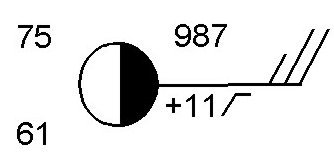
What is the temperature at this station
a)
75 degrees
b)
61 degrees
c)
987 degrees
d)
11 degrees
51.

What is the dew point at this station?
a)
75 degrees
b)
61 degrees
c)
987 degrees
d)
11 degrees
52.

What is the wind speed at this station
a)
3 knots
b)
15 knots
c)
25 knots
d)
30 knots
53.

What is the wind direction at this station?
a)
Wind is blowing from the north
b)
Wind is blowing to the East
c)
Wind is blowing from the East
d)
Wind is blowing to the North
54.

What is the cloud cover at this station?
a)
25%
b)
50%
c)
75%
d)
100%
55.
Temperature is measured in...
a)
degrees
b)
inches
c)
centimeters
d)
feet
56.

A thermometer measures ___.
a)
amount of rain
b)
temperature
c)
air pressure
d)
amount of snow
57.

A barometer measures ___.
a)
amount of rain
b)
temperature
c)
air pressure
d)
amount of snow
58.

Anemometer measures __.
a)
wind speed
b)
wind direction
c)
temperature
d)
air pressure
59.

Psychrometer and hygrometer measure ___.
a)
amount of rain
b)
temperature
c)
air pressure
d)
humidity
60.

Air masses are classified by which 2 characteristics?
a)
temperature and air pressure
b)
air pressure and wind speed
c)
air pressure and humidity
d)
temperature and humidity
61.
What type of of air mass is dry and cold?
a)
Maritime Polar (mP)
b)
Maritime Tropical (mT)
c)
Continental Tropical (cT)
d)
Continental Polar (cP)
62.
What type of air mass is wet and cold?
a)
Maritime Polar (mP)
b)
Maritime Tropical (mT)
c)
Continental Tropical (cT)
d)
Continental Polar (cP)
63.

Identify the type of front that is shown in the image.
a)
Occluded Front
b)
Cold Front
c)
Stationary Front
d)
Warm Front
64.

Identify the type of front that is shown in the image.
a)
Occluded Front
b)
Cold Front
c)
Stationary Front
d)
Warm Front
65.

Identify the type of front that is shown in the image.
a)
Occluded Front
b)
Cold Front
c)
Stationary Front
d)
Warm Front
66.

What type of storm front if this?
a)
Warm Front
b)
Cold Front
c)
Stationary Front
d)
Occluded Front
67.

What type of storm front is this?
a)
Warm Front
b)
Cold Front
c)
Occluded Front
d)
Stationary Front
68.
What type of of air mass is wet and warm?
a)
mP
b)
mT
c)
cT
d)
cP
69.
What type of of air mass is dry and warm?
a)
cP
b)
cT
c)
mP
d)
mT
100 %

