
 Worksheets
Geometry Review
Total questions: 117
Worksheet time: 4hrs 7mins
Name
Class
Date
1.
What is the slope in the equation: y=4x+3
a)
3
b)
4x
c)
4
d)
3x
2.
Slopes of parallel lines are...
a)
opposite reciprocals.
b)
opposites.
c)
identical.
d)
always 7.
3.
y = 3x +2
y = 3x - 3
These lines are...
y = 3x - 3
These lines are...
a)
Parallel
b)
Perpendicular
c)
Neither
d)
The same line
4.
A line is perpendicular to y = 2x - 7.
What is the slope of this line?
What is the slope of this line?
a)
-2
b)
1/2
c)
-1/2
d)
2
5.

Which of the following lines goes through the point (0, 4) and is parallel to y = 5x - 3?
a)
y = 1/5x - 3
b)
y= 5x - 7
c)
y = 5x + 4
d)
y = -5x - 3
6.
What slope is perpendicular to:
m = 5/8
m = 5/8
a)
-5/8
b)
5/8
c)
-8/5
d)
8/5
7.
What slope is parallel to:
m = 4
m = 4
a)
4
b)
-1/4
c)
-4
d)
1/4
8.
If two lines had slopes of -5 and 5 are they parallel, perpendicular, or neither?
a)
parallel
b)
perpendicular
c)
neither
9.

What is the relationship between angle 4 and angle 9?
a)
Vertical Angles
b)
Alternate Interior Angles
c)
Consecutive Interior Angles
d)
Linear Pair
10.

Which of the following terms best describes Angle d?
a)
Remote interior angle
b)
Corresponding angle
c)
Exterior angle
d)
Interior angle
11.

Which is a pair of corresponding angle?
a)
Angle 1 & Angle 4
b)
Angle 2 & Angle 7
c)
Angle 8 & Angle 6
d)
Angle 3 and Angle 5
12.

Which is a pair of Alternate Exterior Angles?
a)
Angle 2 & Angle 5
b)
Angle 1 & Angle 3
c)
Angle 7 & Angle 3
d)
Angle 8 & Angle 4
13.
What does SSS prove?
a)
Nothing
b)
Triangles similar
c)
Triangles congruent
d)
Triangle angle sum
14.

This is what kind of angle?
a)
obtuse
b)
right
c)
straight
d)
acute
15.
What does CPCTC stand for?
a)
Congruent parts of congruent triangles are congruent
b)
Corresponding parts of congruent triangles are congruent
c)
Corresponding parts of corresponding triangles are corresponding
d)
Corresponding parts of congruent triangles are Canadian.
16.
If one side of an equilateral triangle measures 4, what is the perimeter of the triangle?
a)
4
b)
8
c)
12
d)
16
17.

Name the postulate, if possible, that makes the triangles congruent.
a)
SAS
b)
ASA
c)
AAS
d)
Not Possible
18.

Name the postulate, if possible, that makes the triangles congruent.
a)
SSS
b)
SAS
c)
ASA
d)
Not Possible
19.
Which of the following is NOT a triangle congruence?
a)
Side-Side-Side
b)
Side-Angle-Side
c)
Angle-Angle-Side
d)
Angle-Side-Side
20.
The centriod is the point of concurrency of the ______________________ of a triangle.
a)
Medians
b)
Altitudes
c)
Perpendicular Bisectors
d)
Angle Bisectos
21.

If G is the centroid of triangle ABC and GF= 4. Find the length of GC.
a)
4
b)
8
c)
12
d)
Not Enough Information
22.

Name the angle vertical to <PQM
a)
<JQM
b)
<MQP
c)
<LQJ
d)
<LQN
23.

Angle 1 = 2x+9
Angle 2 = 3x-144
Find the measure of Angle 3.
Angle 2 = 3x-144
Find the measure of Angle 3.
a)
85o
b)
95o
c)
43o
d)
137o
24.
Given, "If I have a Siberian Husky, then I have a dog." Identify the converse.
a)
If I do not have a Siberian Husky, then I do not have a dog.
b)
If I have a dog, then I have a Siberian Husky.
c)
If I do not have a dog, then I do not have a Siberian Husky.
d)
If I do not have a Siberian Husky, then I have a dog.
25.

Find the missing angle.
a)
38°
b)
42°
c)
58°
d)
60°
26.

a)
congruent by side-side-side
b)
congruent by side-angle-side
c)
congruent by angle-side-angle
d)
similar but not congruent
27.

In the diagram, DC is the perpendicular bisector of AB and CE is the angle bisector of <ACD. Find the measure of <ACE
a)
90
b)
45
c)
30
d)
15
28.

Determine if the two triangles are congruent. If they are congruent, choose the best method for proving congruence.
a)
ASA
b)
Not Congruent
c)
SSS
d)
SAS
29.

Determine if the two triangles are congruent. If they are congruent, choose the best method for proving congruence.
a)
SAS
b)
SSS
c)
ASA
d)
AAS
30.

Describe the relationship between the marked lines
a)
They are congruent
b)
They are perpendicular
c)
They are parallel
d)
All of the above
31.

Name a pair of alternate exterior angles.
a)
∠AGE and ∠DHF
b)
∠AGH and ∠CHG
c)
∠GHC and ∠HGB
d)
∠CHF and ∠AGH
32.

Solve for the variable.
a)
133
b)
90
c)
47
d)
63
33.

Find the number of degrees in the third angle of the triangle
a)
155
b)
112
c)
74
d)
68
34.

Find the measure of angle A.
a)
44o
b)
96o
c)
-14o
d)
63o
35.

Is the inverse of this true?
a)
Its true. If two angles are not supplementary, then they do not add up to 180 degrees.
b)
Its false. If angles don't add up to 180, they can still be supplementary.
c)
Its false. Supplementary angles add up to 90 degrees.
d)
Its true. Supplementary angles can add up to less than 180 degrees.
36.

Is the converse to this true?
a)
Its false. Parallel lines intersect.
b)
True -- Parallel lines will not intersect if they are parallel.
c)
False.
d)
What are parallel lines?
37.

Find the measure of the indicated angle.
a)
26
b)
36
c)
85
d)
144
38.

Find HG.
a)
8
b)
9
c)
10
d)
11
39.

Find ST.
a)
11
b)
12
c)
13
d)
14
40.

a)
right angle
b)
acute angle
c)
obtuse angle
d)
little angle
41.
Supplementary angles have ___________ degrees.
a)
90
b)
180
c)
360
d)
45
42.
Complementary angles have ____________ degrees.
a)
90
b)
180
c)
360
d)
45
43.

What is the measure of angle CFD?
a)
90
b)
50
c)
40
d)
x
44.

What is the measure of angle AFE?
a)
Obtuse
b)
140
c)
50
d)
90
45.

a)
A
b)
B
c)
C
d)
D
46.

a)
A
b)
B
c)
C
d)
D
47.

a)
A
b)
B
c)
C
d)
D
48.

a)
A
b)
B
c)
C
d)
D
49.

a)
A
b)
B
c)
C
d)
D
50.

a)
A
b)
B
c)
C
d)
D
51.

a)
A
b)
B
c)
C
d)
D
52.

a)
A
b)
B
c)
C
d)
D
53.

a)
A
b)
B
c)
C
d)
D
54.

a)
A
b)
B
c)
C
d)
D
55.

a)
A
b)
B
c)
C
d)
D
56.
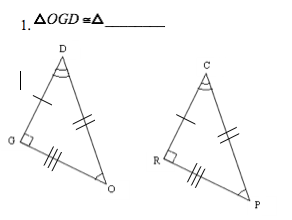
Complete the congruence statement.
a)
CRP
b)
PCR
c)
RPC
d)
PRC
57.
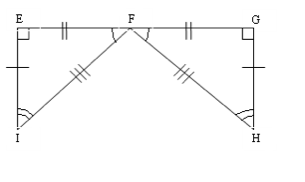
Which segment is congruent to EF?
a)
HG
b)
HF
c)
GF
d)
IE
58.
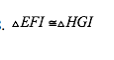
Use the congruency statement to answer the following:
<F = ___
<F = ___
a)
<H
b)
<I
c)
<G
d)
not congruent to another angle
59.

Are these triangles congruent? If so, state the rule which you used to determine congruence.
a)
Yes by ASA
b)
Yes by AAS
c)
Yes by SSA
d)
Not congruent
60.
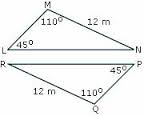
Are these triangles congruent? If so, state the rule which you used to determine congruence.
a)
AAA
b)
AAS
c)
ASA
d)
Not necessarily congruent
61.
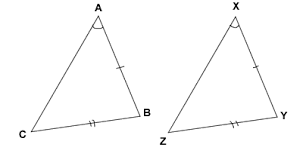
Are these triangles congruent? If so, state the rule which you used to determine congruence.
a)
SSA
b)
AAS
c)
ASA
d)
Not necessarily congruent
62.

Are these triangles congruent? If so, state the rule which you used to determine congruence.
a)
SAS
b)
SSS
c)
Both SSS and SAS
d)
Not necessarily congruent
63.
Draw a conclusion from the statement.
If you live in Orlando, then you live in Florida.
You live in Orlando.
If you live in Orlando, then you live in Florida.
You live in Orlando.
a)
You live in Disney Land
b)
You are an old person.
c)
You live in Florida
d)
You live in Orlando
64.

Find m∠ABC
a)
45o
b)
60o
c)
105o
d)
15o
65.
What is the converse of “If you saw the movie, then you know how it ends”?
a)
If you know how the movie ends, then you saw the movie.
b)
If you did not see the movie, then you do not know how it ends.
c)
If you do not know how the movie ends, then you did not see the movie.
d)
If you do not know how the movie ends, then you saw the movie.
66.
What is the inverse of “If you saw the movie, then you know how it ends”?
a)
If you know how the movie ends, then you saw the movie.
b)
If you did not see the movie, then you do not know how it ends.
c)
If you do not know how the movie ends, then you did not see the movie.
d)
If you do not know how the movie ends, then you saw the movie.
67.
What is the contrapositive of “If you saw the movie, then you know how it ends”?
a)
If you know how the movie ends, then you saw the movie.
b)
If you did not see the movie, then you do not know how it ends.
c)
If you do not know how the movie ends, then you did not see the movie.
d)
If you do not know how the movie ends, then you saw the movie.
68.
What is the contrapositive of “If you received a text message, then you have a cell phone”?
a)
If you have a cell phone, then you received a text message.
b)
If you do not have a cell phone, then you did not receive a text message.
c)
If you did not receive a text message, then you do not have a cell phone.
d)
If you received a text message, then you do not have a cell phone.
69.
What is the inverse of “If you received a text message, then you have a cell phone”?
a)
If you have a cell phone, then you received a text message.
b)
If you do not have a cell phone, then you did not receive a text message.
c)
If you did not receive a text message, then you do not have a cell phone.
d)
If you received a text message, then you do not have a cell phone.
70.
What is the converse of “If you received a text message, then you have a cell phone”?
a)
If you have a cell phone, then you received a text message.
b)
If you do not have a cell phone, then you did not receive a text message.
c)
If you did not receive a text message, then you do not have a cell phone.
d)
If you received a text message, then you do not have a cell phone.
71.

a)
59
b)
11
c)
35
d)
24
72.

a)
21
b)
9
c)
5
d)
16
73.
Part of a line. Has one endpoint and continues on forever in one direction.
a)
Line Segment
b)
Line
c)
Ray
d)
Point
74.
A line is named by...
a)
Any 2 points on the line, or a lowercase script letter.
b)
Any 3 points on the line.
c)
Any 1 point on the line.
d)
Any 3 points on the line, or a uppercase script letter.
75.
A plane is named by...
a)
Any 1 point on the plane.
b)
Any 3 collinear points on the plane or a lowercase script letter.
c)
Any 3 non-collinear points on the plane or an uppercase script letter.
d)
All points on the plane that aren't part of a line.
76.

Name 4 collinear points
a)
HMNO
b)
IKNO
c)
MJOL
d)
HNKI
77.

A plane containing point A.
a)
Plane DEA
b)
Plane k
c)
Plane CDF
d)
Plane F
78.
If ∆HEY ≅ ∆OMG, which of the following is true?
a)
∠H≅∠G
b)
HE ≅ MG
c)
HY ≅ OG
d)
∠E ≅ ∠O
79.

Find the distance.
a)
9.7
b)
10.7
c)
11.7
d)
12.7
80.
Find the distance between (-4, 5) and (7, 18).
a)
15.96
b)
16.08
c)
16.23
d)
17.03
81.
Find the distance between (-12, 1) and (12, -1).
a)
24.05
b)
24.06
c)
24.07
d)
24.08
82.
Which is NOT a test to prove triangles congruent?
a)
SAA
b)
SSS
c)
SSA
d)
SAS
83.
Draw a conclusion from the statement.
If a parasite lives in or on a host organism, then it harms its host.
A virus is a parasite.
If a parasite lives in or on a host organism, then it harms its host.
A virus is a parasite.
a)
It will harm the host.
b)
I have a cold.
c)
It lives in or on a host
d)
Invalid
84.
Draw a conclusion from the statement.
If Jack goes to school, then it is Monday.
Jack doesn't go to school.
If Jack goes to school, then it is Monday.
Jack doesn't go to school.
a)
Jack skipped school.
b)
It isn't Monday.
c)
It's Saturday.
d)
Invalid
85.
Using the Law of Syllogism, which of the following completes the statement to form a valid conclusion?
If it is snowing heavily, then school will be canceled.
If school is canceled, the big test will not be given today.
It is snowing heavily, therefore
If it is snowing heavily, then school will be canceled.
If school is canceled, the big test will not be given today.
It is snowing heavily, therefore
a)
look out for the snowplows while driving to school.
b)
the big test will not be given today.
c)
the roads will be hard to drive on.
d)
you should call the school to see if school is canceled.
86.
If the binding of the book is broken, then the student will have to pay for a new one. Michael has to pay for a new book, so he concludes the binding on his book is broken. Is he correct?
a)
Yes
b)
No
87.
For the converse we _________ the hypothesis and conclusion
a)
switch
b)
negate
c)
switch and negate
88.
Given, "If I have a Siberian Husky, then I have a dog." Identify the converse.
a)
If I do not have a Siberian Husky, then I do not have a dog.
b)
If I have a dog, then I have a Siberian Husky.
c)
If I do not have a dog, then I do not have a Siberian Husky.
d)
If I do not have a Siberian Husky, then I have a dog.
89.
Given, "If I have a Siberian Husky, then I have a dog." Identify the inverse.
a)
If I do not have a Siberian Husky, then I do not have a dog.
b)
If I have a dog, then I have a Siberian Husky.
c)
If I do not have a dog, then I do not have a Siberian Husky.
d)
If I do not have a Siberian Husky, then I have a dog.
90.
Given, "If I have a Siberian Husky, then I have a dog." Identify the contrapositive.
a)
If I do not have a Siberian Husky, then I do not have a dog.
b)
If I have a dog, then I have a Siberian Husky.
c)
If I do not have a dog, then I do not have a Siberian Husky.
d)
If I do not have a Siberian Husky, then I have a dog.
91.

Is the inverse of the following statement true? "If an angle measures 30 degrees, then it is acute."
a)
Yes
b)
No
92.
(1) If a figure is a square, then it is a polygon.
(2) Figure A is a polygon.
(3) ???????
What belongs in line 3?
(2) Figure A is a polygon.
(3) ???????
What belongs in line 3?
a)
Figure A is a polygon.
b)
Figure A is a circle.
c)
Figure A is a square.
d)
invalid; nothing belongs in line 3
93.
If an angle is 40⁰, then it is acute.
∠A is 40⁰.
Using the Law of Detachment, what is the logical statement to conclude?
∠A is 40⁰.
Using the Law of Detachment, what is the logical statement to conclude?
a)
∠A is complementary to ∠B
b)
∠A is acute.
c)
∠A is obtuse.
d)
∠A is 40⁰
94.
Find the distance between (3, 24) and (7, 56).
a)
32.1
b)
32.2
c)
32.3
d)
32.4
95.
Find the supplement of a 81° angle.
a)
9°
b)
99°
c)
101°
d)
180°
96.

∠2 & ∠4 are...
a)
Supplementary angles
b)
Vertical angles
c)
Corresponding angles
d)
Alternate interior angles
97.

∠6 & ∠7 are...
a)
Supplementary angles
b)
Vertical angles
c)
Corresponding angles
d)
Alternate interior angles
98.

∠2 & ∠6 are...
a)
Supplementary angles
b)
Vertical angles
c)
Corresponding angles
d)
Alternate interior angles
99.

∠3 & ∠6 are...
a)
Supplementary angles
b)
Vertical angles
c)
Corresponding angles
d)
Alternate interior angles
100.

a)
∠B=82°
b)
∠B=98°
c)
∠B=180°
d)
∠B=8°
101.

a)
∠C=116°
b)
∠C=64°
c)
∠C=180°
d)
∠C=26°
102.

a)
∠D=116°
b)
∠D=64°
c)
∠D=180°
d)
∠D=26°
103.

a)
∠J=105°
b)
∠J=75°
c)
∠J=15°
d)
∠J=90°
104.

a)
∠L=51°
b)
∠L=129°
c)
∠L=180°
d)
∠L=39°
105.

a)
∠M=47°
b)
∠M=133°
c)
∠M=180°
d)
∠M=33°
106.
a)
∠L=51°
b)
∠L=129°
c)
∠L=180°
d)
∠L=39°
107.
a)
∠M=47°
b)
∠M=133°
c)
∠M=180°
d)
∠M=33°
108.

a)
∠A=77°
b)
∠A=103°
c)
∠A=180°
d)
∠A=13°
109.

a)
∠B=77°
b)
∠B=103°
c)
∠B=180°
d)
∠B=13°
110.

a)
∠C=96°
b)
∠C=84°
c)
∠C=180°
d)
∠C=6°
111.

a)
∠D=96°
b)
∠D=84°
c)
∠D=180°
d)
∠D=6°
112.

a)
∠F=61°
b)
∠F=119°
c)
∠F=180°
d)
∠F=29°
113.

a)
A
b)
C
c)
D
114.

a)
3 inches
b)
5 inches
c)
90 inches
d)
4 inches
115.

Use the congruence statement and figure to find the missing part of the statement
a)
FS
b)
SR
c)
RF
d)
DF
116.

PICK THE CORRECT CONGRUENCE STATEMENT
a)
∆TUV ≅ ∆EUV
b)
∆VUT ≅ ∆UVE
c)
∆TUV ≅ ∆UEV
d)
∆UTV ≅ ∆EUV
117.
1. Given the congruent polygons
DFGH ≅ QRST, If FG =12, DH = 15 and
m ∠ T = 110° then find the following…
QT = ___________ RS = ___________ and m∠ H = _______________
DFGH ≅ QRST, If FG =12, DH = 15 and
m ∠ T = 110° then find the following…
QT = ___________ RS = ___________ and m∠ H = _______________
a)
QT = 15 RS = 12 and m∠ H =110°
b)
QT = 12 RS = 15 and m∠ H =110°
c)
QT = 15 RS = 12 and m∠ H =70°
d)
QT = 12 RS = 15 and m∠ H =70°
100 %

