wayground logo

Free Printable Worksheets

NEW

Font size

S
M
L
XL
Worksheets

ISPSCH1ScienceSkills

Total questions: 42

Worksheet time: 2hrs 31mins

Name
Class
Date
1.
There are two types of data. Which type of data involves numbers that are obtained by counting or measuring?
a)
quantitative
b)
qualitative
2.
The summary at the end of an experiment that explains the results. 
a)
conclusion
b)
procedures
c)
materials
d)
responding variable
3.
A series of steps used by scientists to solve a problem or answer a question. 
a)
scientific method
b)
recipe
c)
data collection
d)
metric system
4.
A list of the steps anyone could follow to conduct an experiment. 
a)
obervations
b)
question/problem
c)
materials
d)
procedures
5.
A student is planning an experiment to find out how the height from which he drops a ball affects how high the ball bounces. The dependent variable is the _____.
a)
Diameter of the ball
b)
Force acting on the ball
c)
Height that the ball bounces
d)
Height from which the ball is dropped
6.
When experimenting with the growth of a plant, a scientist uses three (of the same type of) plants, two different fertilizers, equal light, and equal water. What type of variable is the fertilizer?
a)
Dependent
b)
Independent
c)
Control
d)
Compound
7.
An experiment is performed on plants to see how different liquids affect plant growth. Each plant in the experiment is given a different liquid; water, apple juice, or milk. Each plant has the same amount of soil, sunlight, and listens to the same music. In this investigation, what is the dependent variable?
a)
Type of plant
b)
Water, apple juice, milk
c)
Plant growth
d)
Color of the plant's leaves
8.
What is a hypothesis?
a)
A hypothesis is the right answer to an experiment.
b)
A hypothesis is the wrong answer to an experiment.
c)

A testable if then statement that is a possible answer to the question.

d)

A testable statement that makes sense but could be wrong.

9.
Should experiments be repeated over and over to see if the results are the same each time?
a)
yes
b)
no
10.
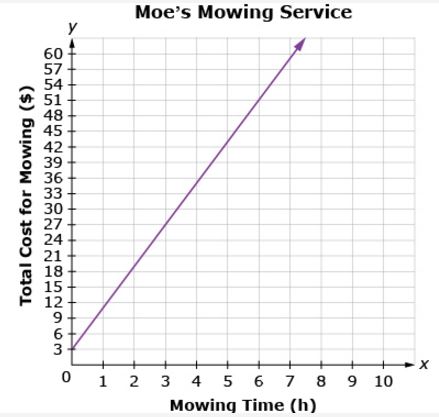
What is the independent variable?
a)
cost of mowing
b)
Moe's Mowing Service
c)
$18
d)
Mowing Time
11.
The Independent/Manipulated Variable goes on the ___ axis
a)
x
b)
y
12.
The Dependent/Responding Variable goes on the ___ axis
a)
x
b)
y
13.
Which would go on the y-axis?
a)
Time
b)
# of Bacteria 
14.
What pressure will produce a volume of 30 mL? 
a)
9.5 atm
b)
19.5 atm
c)
 30 atm
d)
 40 atm
15.
In a controlled experiment, how many independent variables can be worked with at a time? 
a)
one
b)
none
c)
two or more
d)
how ever many makes sense.
16.
If I study for my scientific method quiz, then I will have a better test score. What is the dependent variable?
a)
Scientific Method
b)
Studying
c)
Independent variable
d)
Test score
17.
Which of these contains steps in the right order?
a)
Ask a question, state your hypothesis, research, experiment, analyze, make a conclusion
b)
State your hypothesis, ask a question, research, experiment, analyze, make a conclusion
c)
Ask a question, research, state your hypothesis, experiment, analyze, make a conclusion
d)
State your hypothesis, ask a question, research, make a conclusion, experiment, analyze
18.
There are two types of data. Which type of data involves descriptions/photographs/illustrations that cannot be counted or measured?
a)
qualitative
b)
quantitative
19.
Which statement is an inference about this picture?
a)
The van is tan.
b)
The  van ran into KFC. 
c)
The driver was hungry. 
d)
Red and white are part of the KFC building. 
20.
Which axis does the independent variable go on?
a)
X-axis
b)
Y-axis
c)
Both the X-axis and Y-axis
d)
neither the X-axis or Y-axis
21.
Should experiments be repeated over and over to see if the results are the same each time?
a)
yes
b)
no
22.

What is the term for the variable that is kept constant throughout an experiment?

a)

Dependent variable

b)

Independent variable

c)

Control variable

d)

Compound variable

23.

In an experiment, the height of a plant is measured over a period of time. What type of data is this?

a)

Qualitative

b)

Quantitative

24.

What is the first step in the scientific method?

a)

Form a hypothesis

b)

Conduct an experiment

c)

Analyze the data

d)

Ask a question

25.

7,000 g = ____ kg

a)

70

b)

700

c)

7

d)

0.07

26.

648 g = ____ mg

a)

6,480

b)

64,800

c)

648,000

d)

64.8

27.

240 cm = ___________ m

a)

2400

b)

24

c)

2.4

d)

0.24

28.

68 cm = ___________ mm

a)

0.68

b)

6.8

c)

68

d)

680

29.

Using the conversion chart, as the units move to the left, the decimal place moves to the ____________.

a)

Right

b)

Sometimes to the right, sometimes to the left

c)

Left

d)

The decimal place doesn't change between units

30.
What are the three base units?
a)
mass,length,grams
b)
meters,length,grams
c)
measuring,liters,games
d)
meters,liters,grams
31.

In a density column, is the substance with the highest density on the bottom or the top?

a)

Bottom

b)

Top

32.

Which object has the highest density in this picture?

a)

A

b)

B

c)

C

33.

Which of the following is an example of an object with a high density?

a)

Pillow

b)

Bowling Ball

c)

Beach Ball

34.

You calculated the density of an unknown substance to be 7.8g/cm3. According to the chart, which of the substances doe you most likely have?

a)

Zinc

b)

Copper

c)

Tin

d)

Iron

35.

Which substance is the most dense in this picture?

a)

Vegetable Oil

b)

Dish Soap

c)

Honey

d)

Corn Syrup

36.

Which of the following substances would float in water? (Hint: water has a density of 1g/cm3)

a)

gold

b)

rubber

c)

water

d)

cork

37.

Which table represents the data in the graph?

a)
b)
c)
d)
38.

What is the general trend of this line graph?

a)

The more you mow, the less money you make.

b)

You make the same amount of money regardless of how long you mow.

c)

The more you mow, the more money you make.

d)

Mowing is dangerous.

39.

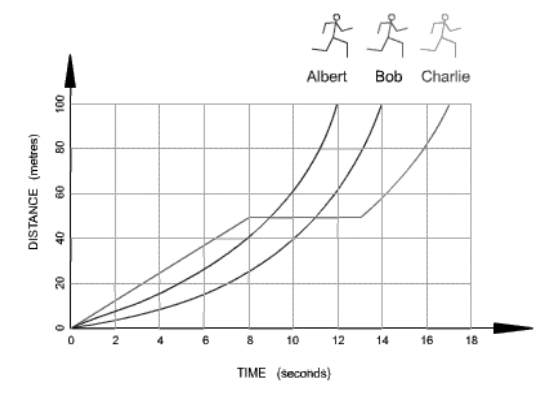
Which runner stopped for a rest?

a)

Albert

b)

Bob

c)

Charlie

40.

What is the measurement using the correct number shown?

a)

8.5mL

b)

8.50mL

c)

8.40mL

d)

8.4m

41.

Which best describes an Inverse (Indirect) Graph As one variable increases the other________

a)

Increases

b)

Decreases

c)

Remains the same

42.
What is an observation for this picture?
a)
The man is scared
b)
The man is going to get eaten
c)
There is a man in a kayak
d)
The man is paddling fast