
 Worksheets
chemistry review
Total questions: 43
Worksheet time: 33mins
Name
Class
Date
1.
What is the little number after an element in a chemical equation called.
Example: H2
Example: H2
a)
Coefficient
b)
Subscript
c)
Atom
d)
Equation
2.
At the end of chemical reactions, what is the total mass of the reactants compared to the total mass of the products?
a)
the product is doubled
b)
the product is half the mass of the reactants
c)
the mass is the same
d)
the mass changes depending on the reaction
3.
When balancing equations a ____ can be placed to the left of a formula of a substance to make the equations balanced
a)
charge
b)
subscript
c)
random number
d)
coefficient
4.
Balance this equation:
2Li + Cl2 -> LiCl
2Li + Cl2 -> LiCl
a)
2Li + Cl2 -> 4LiCl2
b)
2Li + Cl2 -> LiCl2
c)
2Li + Cl2 -> 2LiCl
5.
What does the Law of Conservation of Mass state?
a)
Matter cannot be gained or lost in a chemical reaction.
b)
Matter can only be lost in a chemical reaction.
c)
Matter can only be gained in a chemical reaction.
d)
Matter can be gained and lost in a chemical reaction.
6.
How many F atoms are in this compound?
6MgF2
6MgF2
a)
2
b)
6
c)
8
d)
12
7.
How many atoms are there TOTAL in:
H2SO4
H2SO4
a)
6
b)
5
c)
7
d)
3
8.
Which of the following is evidence of a chemical reaction?
a)
fizzing
b)
water changing to ice
c)
saltwater
d)
paper being cut in half
9.
Why must we balance chemical equations?
a)
Our teacher said so
b)
to abide by the law of conservation of energy
c)
to abide by the law of conservation of mass
10.
Which one is a compound?
a)
Co
b)
Br
c)
Fe
d)
CO
11.
How many elements are found in the following molecule? Mg(ClO3)2
a)
1
b)
4
c)
3
d)
5
12.
Can an element be broken down into a simpler substance
a)
yes
b)
No
13.
Is salt (NaCI) a compound or a element
a)
Compound
b)
element
14.
Mixtures are separated through ___________changes.
a)
mixture
b)
compound
c)
physical
15.

This picture represents which of the following?
a)
element
b)
compound
c)
mixture
16.

This picture represents which of the following?
a)
element
b)
compound
c)
mixture
17.
The horizontal rows on the periodic table are known as
a)
periods.
b)
atoms.
c)
groups or families.
d)
valence electrons.
18.
The separation technique that involves heating a solution until the liquid changes into a gaseous state, leaving behind a solid is known as
a)
decanting
b)
evaporation
c)
loading
d)
chromatography
19.
Which one of the following methods is used to separate the colours in food dyes?
a)
winnowing
b)
Threshing
c)
Crystallization
d)
chromatography
20.
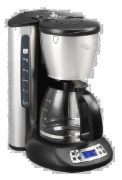
In a coffee machine, the ground coffee is separated from the coffee solution by using..
a)
sand paper
b)
filter paper
c)
toilet paper
d)
tissue paper
21.
Which one of the following would you use to separate sand from iron filings?
a)
a bar magnet
b)
filter paper
c)
chromatography paper
d)
alum
22.
Iron fillings can be separated from iron and Sulphur mixture by
a)
sedementation
b)
heating
c)
magnetic attraction
d)
seiving
23.
Lucky Charms
a)
Heterogeneous
b)
Homogeneous
c)
A compound
24.
Water
a)
Heterogeneous
b)
Homogeneous
c)
A compound
25.
Coffee
a)
Heterogeneous
b)
Homogeneous
c)
A compound
26.
Air
a)
Heterogeneous
b)
Homogeneous
c)
A compound
27.
A combination of 2 or more substances that can be easily separated is called-
a)
a mixture
b)
a solution
c)
a solute
d)
a solvent
28.
Water and Kool-Aid are mixed together. Hot water, coffee and sugar are mixed together. Which substance is the solvent in both?
a)
Water
b)
Coffee
c)
Kool-aid
d)
Sugar
29.
A mixture made of parts that separate upon standing is what type of mixture?
a)
suspension
b)
solution
c)
alloy
d)
colloid
30.
Milk
a)
A. SOLUTION
b)
B. SUSPENSION
c)
C. COLLOID
31.
The positive particles of an atom are
a)
electrons
b)
positrons
c)
neutrons
d)
protons
32.
A particle that moves around the nucleus is a(n)...
a)
Proton
b)
Neutron
c)
Electron
d)
Quark
33.
In the modern periodic table elements are arranged by:
a)
atomic mass
b)
atomic number
c)
valence electrons
d)
number of isotopes
34.

What does the 1.00794 stand for?
a)
Hydrogen
b)
atomic number
c)
atomic mass
d)
atomic explosion
35.
A state of matter that has a definite volume and shape.
a)
solid
b)
liquid
c)
gas
d)
matter
36.
The amount of space something takes up
a)
density
b)
volume
c)
mass
d)
matter
37.
You can measure ______ with grams.
a)
mass
b)
volume
c)
conductivity
d)
melting point
38.
The ability of a metal to allow heat or electricity to pass through it.
a)
conductivity
b)
insulator
c)
mass
d)
density
39.
Which particle is equal to the Atomic Number
a)
# of electrons
b)
# of neutrons
c)
# of protons
40.
Ionic Bonding involves...
a)
The transfer of protons
b)
The transfer of nuetrons
c)
The transfer of electrons
d)
None Of the above
41.
Covalent compounds
a)
Share electrons
b)
transfer electrons
c)
contain a sea of electrons
d)
conduct electricity
42.
What happens when an atom loses an electron?
a)
Neutral (no charge)
b)
Positive charge
c)
Negative charge
43.
What is the number of valence electrons for Oxygen?
a)
8
b)
6
c)
2
d)
1
100 %

