
 Worksheets
1st Semester Review
Total questions: 51
Worksheet time: 40mins
Name
Class
Date
1.
Temperature, light, air, water, and soil are all _____ parts of the environment
a)
alive
b)
biotic
c)
abiotic
d)
living
2.
Is sunlight an abiotic or biotic factor?
a)
abiotic
b)
biotic
3.
A living or once-living organisms in an ecosystem is a
a)
population
b)
biotic factor
c)
abiotic factor
d)
community
4.
Which of the following is not an abiotic factor?
a)
sun
b)
temperature
c)
soil
d)
grass
5.

A system made up of organisms interacting with one another
a)
biology
b)
abiotic
c)
biotic
d)
ecosystem
6.
Which of the following is NOT a level of organization in ecosystems?
a)
community
b)
species
c)
population
d)
organism
7.
What are the ecological levels of organization from smallest to the largest?
a)
organism, population, community, ecosystem, biome, biosphere
b)
organism, community, population, ecosystem, biome, biosphere
c)
organism, population, community, biome, ecosystem, ecosphere.
d)
organism, community, population, biome, ecosystem, ecosphere
8.
Identify the examples as: a organism, population, community, or ecosystem.
Chicken, Cow, Grass, Buffalo, and Mouse living on farmland.
Chicken, Cow, Grass, Buffalo, and Mouse living on farmland.
a)
Organism
b)
Community
c)
Population
d)
Ecosystem
9.
Any ONE living thing.
a)
Organism
b)
Population
c)
Community
d)
Ecosystem
10.
The largest level of ecological organization which includes all biotic and abiotic factors.
a)
Ecosystem
b)
Organism
c)
Population
d)
Community
11.
Identify the examples as: a organism, population, community, or ecosystem.
Water, Fish, Turtles, Oxygen, Rocks and Moss interacting in a river system.
Water, Fish, Turtles, Oxygen, Rocks and Moss interacting in a river system.
a)
Organism
b)
Population
c)
Community
d)
Ecosystem
12.
The role or function or job of a species in a community.
a)
habitat
b)
diet
c)
niche
d)
ecosystem
13.
A place where an organism lives.
a)
Terrain
b)
Habitat
c)
Community
d)
Population
14.
All the members of one species that live within an area of an ecosystem
a)
population
b)
community
c)
niche
15.
What would most likely happen if an ecosystem no longer received sunlight?
a)
The number of herbivores would increase
b)
The number of plants would increase
c)
all organisms would adapt
d)
All living organisms would eventually die
16.
The thinnest layer of the Earth is?
a)
Mantle
b)
Lithosphere
c)
Athenosphere
d)
Crust
17.
The lithosphere combines what two layers?
a)
Athenosphere & Crust
b)
Crust & Upper Mantel
c)
Mantel & Athenosphere
18.
This layer of Earth is solid Iron and Nickel
a)
Outer Core
b)
Mantle
c)
Inner Core
d)
Crust
19.
This layer of Earth is the thickest part
a)
crust
b)
outer core
c)
mantle
d)
inner core
20.
What are the two types of crust
a)
continental and oceanic
b)
ocean and upper
c)
lower and upper
d)
pizza and subway
21.
What is the correct order (starting from the surface) of Earth's layers?
a)
crust, outer core, inner core, mantle
b)
mantle, outer core, inner core, crust
c)
crust, mantle, outer core, inner core
d)
outer core, inner core, crust, mantle
22.
Heat transfer within a fluid takes place by...
a)
convection currents
b)
radiation
c)
conduction
d)
density
23.

Name the boundary
a)
convergent boundary
b)
divergent boundary
c)
transform boundary
d)
sergent boundary
24.

Name the boundary
a)
convergent boundary
b)
divergent boundary
c)
transform boundary
d)
sergent boundary
25.

Name the boundary
a)
convergent boundary
b)
divergent boundary
c)
transform boundary
d)
sergent boundary
26.
What does the theory of continental drift state?
a)
The continents were once joined in a super-continent and have moved over time
b)
Continents are stationary and do not move
c)
The Earth is broken into lithospheric plates that move due to convection currents
d)
none of the above
27.
Which of the following occurs because of convection currents?
a)
Tectonic plates on the crust move.
b)
The mantle increases in size.
c)
Pressure in the crust increases.
d)
Pressure in the crust decreases.
28.
Volcanoes are most often formed at this boundary.
a)
Divergent
b)
Convergent
c)
Normal
d)
Transform
29.
The Mid-Atlantic Ridge is formed at this boundary.
a)
Divergent
b)
Convergent
c)
Normal
d)
Transform
30.
The tectonic plates float on the
a)
lithosphere
b)
lower mantle
c)
outer core
d)
asthenosphere
31.
A force of attraction between any two objects is called _____________.
a)
static electricity
b)
rotation
c)
gravity
d)
orbit
32.
Complete the sentence: the _____the mass, the larger the gravitational pull between two objects.
a)
smaller
b)
larger
33.
Where is the asteroid belt found?
a)
between earth and mars
b)
Between Uranus and Neptune
c)
Between Mercury and Venus
d)
Between Mars and Jupiter
34.
Associated with transform boundaries.
a)
Volcanoes
b)
mountains
c)
trenches
d)
earthquakes
35.
Gravity is responsible for the . . .
a)
sun rotating around the planets
b)
sun revolving around the planets
c)
planets revolving around the sun
d)
planets rotating of a planet around the sun
36.
The ___________ the planet is from the sun, the ____________ it takes to go around the sun.
a)
closer, shorter
b)
farther, shorter
c)
farther, longer
d)
closer, longer
37.
Gravitational force depends on
a)
mass and density
b)
weight and distance
c)
distance and mass
d)
weight and density
38.
The asthenosphere makes up the?
a)
Upper portion of the mantel
b)
The lower portion of the crust
c)
Just the Athenosphere
39.
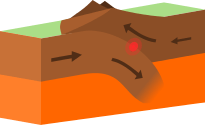
What type of plate boundary is this?
a)
Plate
b)
Divergent
c)
Convergent
d)
Transform
40.
A divergent boundary occurs when plates ....
a)
Pull apart
b)
Come together
c)
Slide past each other
d)
subducting
41.
A mid-ocean ridge occurs at a ________ plate boundary.
a)
transform
b)
convergent
c)
divergent
42.
Softest mineral on the Mohs hardness scale
a)
quartz
b)
talc
c)
apatite
d)
gypsum
43.
Shiny, metallic and pearly are terms used to describe _____
a)
streak
b)
luster
c)
color
d)
density
44.

The asteroid belt is between which planets?
a)
Earth and Mars
b)
Saturn and Uranus
c)
Jupiter and Saturn
d)
Mars and Jupiter
45.
Our Sun in our Solar System is considered a/an?
a)
Inner Planet
b)
Outer Planet
c)
Star
d)
Asteroid
46.
__________holds all of the planets in orbit around the sun.
a)
Force
b)
Motion
c)
Weight
d)
Gravity
47.
Two ways to describe types of igneous rocks are _____
a)
Extrusive and Intrusive
b)
Foliated and Non-Foliated
c)
Clastic and Biochemical
d)
Black and Gray
48.
If two planets moved three times further apart, their force of attraction would
a)
increase
b)
decrease
c)
stay the same
49.
The asthenosphere makes up the?
a)
Upper portion of the mantel
b)
The lower portion of the crust
c)
Just the Athenosphere
50.
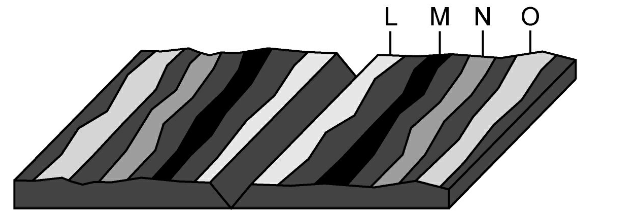
Where would the oldest rock be found?
a)
L
b)
M
c)
N
d)
O
51.
What is the Ring of Fire and where is it located?
a)
A ring of volcanoes around the Atlantic Ocean
b)
A ring of volcanoes around the Indian Ocean
c)
A ring of Volcanoes around the Pacific Ocean
d)
A ring of volcanoes around the entire globe
100 %

