
 Worksheets
Physical Science Final Review
Total questions: 37
Worksheet time: 23mins
Name
Class
Date
1.
The law of ________________states that mass is neither created or destroyed in a chemical reaction.
a)
Evolution
b)
Conservation of mass
c)
Destruction
d)
The land
2.
You can balance a chemical equation by using ______________, the numbers that appear before the formulas.
a)
Subscripts
b)
Superscripts
c)
Covalent bonds
d)
Coefficients
3.
In order to show that mass is conserved in a chemical reaction, a chemical equation must be _________________
a)
Balanced
b)
Unbalanced
c)
Rewritten
d)
Sorted
4.
A ______________ reaction is a reaction on which a compound breaks down into two or more simple substances.
a)
Synthesis
b)
Single replacement
c)
Combustion
d)
Decomposition
5.
A __________________reaction is a reaction in which one element takes the place of another element in a compound.
a)
Single replacement
b)
Double replacement
c)
Combustion
d)
Synthesis
6.
A ________________reaction is a reaction in which two different compounds exchange positive ions and form two new compounds.
a)
Single replacement
b)
Double replacement
c)
Combustion
d)
Synthesis
7.
Factors that affect reaction rates include
a)
today, tonight, tomorrow, this way, that way
b)
temperature, weather, population, waves, time of day
c)
location, time, weight, heat, color
d)
temperature, surface area, concentration, stirring, and catalysts.
8.
A chemical reaction that releases energy to its surroundings is called an .
a)
Endothermic reaction
b)
Easy reaction
c)
Flowing
d)
Exothermic reaction
9.

Based on the diagram above, which statement is correct?
a)
All isotopes of hydrogen have different numbers of electrons in them.
b)
All isotopes of hydrogen have one neutron in the nucleus.
c)
All isotopes of hydrogen have one proton in the nucleus.
d)
There are the same number of protons and neutrons in every isotope of hydrogen.
10.
Elements of the same group possess ___.
a)
the same number of valance electrons
b)
the same number of total electrons
c)
the same number of protons
d)
different physical and chemical properties
11.
Which of the following is not a sign that a chemical reaction took place?
a)
production of gas
b)
phase change
c)
color change
d)
production of odor
12.
Which of the following is a negatively charged subatomic particle?
a)
Electron
b)
Proton
c)
Neutron
d)
Quark
13.
Which of the following includes all of the subatomic particles found in the nucleus of an atom?
a)
Electrons and protons
b)
Electrons, protons, and neutrons
c)
Neutrons and electrons
d)
Neutrons and protons
14.

1. Based on the periodic table entry below, how many protons are in one helium atom.
a)
A. 1
b)
B. 2
c)
C. 4
d)
D. 6
15.
What state of matter has a definite shape and a definite volume?
a)
solid
b)
liquid
c)
gas
16.
Which state of matter has neither a definite shape nor a definite volume?
a)
solid
b)
liquid
c)
gas
17.
Which state of matter has a definite volume but no real shape of its own?
a)
solid
b)
liquid
c)
gas
18.
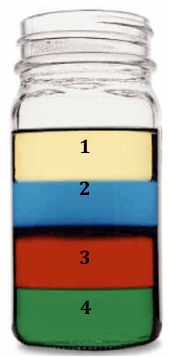
Put the liquids in order from most dense to least dense?
a)
4, 3, 2, 1
b)
1, 2, 3, 4
c)
3, 4, 2, 1,
d)
4, 3, 1, 2
19.
Why do some substances float on water?
a)
they are warmer than water
b)
they are cooler than water
c)
they are more dense than water
d)
they are less dense than water
20.

What is the volume of the fish?
a)
18.0 cm3
b)
6.0 cm3
c)
38.0 cm3
21.
Which lab tool might you use to measure the volume of a liquid?
a)
electric scale
b)
bunsen burner
c)
test tube
d)
graduated cylinder
22.

Which of these is the best measure of how much space an object or substance takes up?
a)
mass
b)
length
c)
volume
d)
density
23.
The burning of wood is a physical change
a)
true
b)
false
24.
What is the volume of 150 grams of lead if it has a density of 11.3 g/cm3?
a)
13.3 g
b)
13.3 cm3
c)
.075 g
d)
1695 cm3
25.
An empty beaker has a mass of 60 grams. When mercury is added to the beaker, it has a mass of 200 grams. What is the mass of the mercury?
a)
140 grams
b)
200 grams
c)
140 mL
d)
260 g
26.
Which will float in water (density= 1 g/mL)?
Corn syrup 1.37 g/mL
Vegetable oil 0.91 g/mL
Honey 1.42 g/mL
Lamp oil 0.81 g/mL
Corn syrup 1.37 g/mL
Vegetable oil 0.91 g/mL
Honey 1.42 g/mL
Lamp oil 0.81 g/mL
a)
Corn syrup and Honey
b)
Vegetable oil and Lamp oil
c)
Corn syrup and vegetable oil
d)
Honey and Lamp oil
27.
Which units of measurement are used for volume?
a)
grams
b)
centimeters
c)
grams/milliliter
d)
milliliter
28.

What is the volume of Object X?
a)
10.0 cm3
b)
15.0 cm3
c)
20.0 cm3
d)
25.0 cm3
29.
Frank has an eraser. It has a mass of 4g, and a volume of 2cm3. What is its density?
a)
8 g/cm3
b)
2 g/cm3
c)
1/2 g/cm3
d)
24 g/cm3
30.
When water freezes, it undergoes a
a)
chemical change
b)
physical change
c)
vaporization
d)
evaporation
31.
Bromine has an atomic number of 35. From this information, you know that bromine has...
a)
35 protons and 35 electrons
b)
35 protons and 35 neutrons
c)
35 neutrons and 35 electrons
d)
35 protons and 37 neutrons
32.
The center of an atom is called its
a)
core
b)
nucleus
c)
middle
d)
center
33.
A vapor changing to a liquid is called...
a)
vaporization
b)
freezing
c)
condensation
d)
evaporation
34.
A(n) ____________ reaction is one that takes in or absorbs heat.
a)
endothermic
b)
exothermic
c)
chemical
d)
physical
35.

This lab safety symbol means
a)
Wear a lab apron to protect your clothes
b)
Wash your hands after the lab is over
c)
There may be sharp objects present
d)
Wear safety goggles
36.
Which of these is NOT a lab safety rule?
a)
Follow directions
b)
Eat and drink
c)
No horseplay
d)
Be safe
37.
A prediction you make about the answer to the problem statement
a)
Hypothesis
b)
Problem statement
c)
Procedures
d)
Materials
100 %

