
 Worksheets
Fall Semester Exam REVIEW
Total questions: 56
Worksheet time: 3580secs
Name
Class
Date
1.
Which of the following DID NOT cause the Dust Bowl?
a)
overproduction
b)
windstorms
c)
drought
d)
tornadoes
2.
Which of the following was NOT a cause of the Great Depression?
a)
Hawley-Smoot Tariff
b)
Easy Credit
c)
Mistakes of the Federal Reserve
d)
high farm prices
3.
What territory did the United States NOT acquire as a result of the Spanish-American War?
a)
Cuba
b)
Puerto Rico
c)
Philippines
d)
Guam
4.
Henry Ford’s main contribution to the US industry was the idea of the assembly line and __________.
a)
automobile
b)
mass production
c)
sports car
d)
transportation
5.
An important feature of the Harlem Renaissance of the 1920's can best be summed up by which of the following?
a)
African Americans expressed themselves through songs and dance
b)
African Americans supported Prohibition
c)
African Americans moved into cities in order to find jobs
d)
African Americans called for equality and civil rights
6.

What is a good title for this list?
a)
Culture of the 1920s
b)
The Great Migration
c)
Impact of the Great Depression
d)
Features of the New Deal
7.
During The Great Migration, many southerners moved to big cities for what reason?
a)
to find more food
b)
because they didn't like growing cotton
c)
to find better jobs
d)
to get bigger homes
8.
It was hard for black people to find jobs in the south because of __________, which made segregation legal.
a)
Jim Crow laws
b)
Slave laws
c)
Segregational Act of 1900
d)
Civil Rights
9.
America works to build an empire, focusing on Asia and Latin America.
a)
Imperialism
b)
Gilded Age
c)
Westward Expansion
d)
Cold War
10.
Aiming to solve the economic problems facing America the President was willing to "try something" using his 3 R's (Relief, Recover, Reform).
a)
New Deal
b)
Great Depression
c)
Globalization
d)
Civil Rights
11.
A military draft is known as what?
a)
Conscription
b)
Appeasement
c)
Reparation
d)
Absolutism
12.
Which development most contributed to the increasing social independence of Americans in the early twentieth century?
a)
Rise of the Populist movement
b)
Emergence of Victorian ideals
c)
Improved telecommunications
d)
Greater access to automobiles
13.
Which invention allowed news and entertainment to reach large audiences in a very short amount of time in the 1920's?
a)
the newspaper
b)
the radio
c)
the television
d)
the mail
14.

What type of music was popular in speakeasies during the 1920’s?
a)
Rock and Roll
b)
Jazz
c)
Rap
d)
Country
15.
This period during the 1870s to 1900 is known for it's rise of railroads, big business, industrialization and social problems in the United States.
a)
World War I
b)
Progressive Era
c)
Gilded age
d)
Roaring Twenties
16.
During the Gilded age, workers came together to work for better pay, working conditions, and less hours. Leaders such as Samuel Gompers help led many of this workers in....
a)
Philanthropy
b)
Labor Unions
c)
Political Bosses
d)
Credit Unions
17.
The Pendleton Act of United States in 1883 decided that government jobs should be awarded on the basis of merit (test) instead of political affiliation.
a)
direct voting
b)
civil service reform
c)
political machines
d)
civil labor unions
18.
What was a city government marked by corruption, bribery, and Kickbacks (common during the Gilded Age) called?
a)
credit mobilier
b)
political machine
c)
corrected democracy
d)
electoral politics
19.
Fact most significant in development of labor unions during nineteenth century?
a)
Working conditions
b)
Racial segregation
c)
Class discrimination
d)
Growing prosperity
20.
Why did Americans in Hawaii want to be annexed by the United States?
a)
Queen Liluokalani was persecuting American sugar growers.
b)
Annexation had trade advantages for the American sugar growers in Hawaii.
c)
Laws forced Americans to return land to the Hawaiian government.
d)
All are true.
21.
The Jungle--by muckraker Upton Sinclair--exposed the unsanitary conditions in the meatpacking industry and led to this law
a)
Sherman Anti-Trust Act
b)
Meat Inspection Act
c)
Food Cleanliness Act
d)
Clayton Anti-Meat Act
22.
Secret telegram from Germany to Mexico asking Mexico to attack the US & then they would be rewarded by gaining back their lands from the US after the war.
a)
Zimmerman Telegram
b)
Secret Message #2
c)
Treaty of Versailles
d)
Treaty of Paris
23.
It was Wilson’s plan to reunite Europe after WWI.
a)
Fourteen Points
b)
Treaty of Versailles
c)
System of Alliances
d)
United Nations
24.
The final peace settlement of WWI. It blamed Germany for the entire war, made them pay huge reparations, and was directly responsible for leading to WWII.
a)
Treaty of Paris
b)
Treaty of Versailles
c)
Fourteen Points
d)
Roosevelt Corollary
25.
Which was NOT a LONG-TERM cause of the Great Depression?
a)
Buying stock on margin
b)
Stock market crash (Black Tuesday)
c)
too much production and consumer spending
d)
Laisezz-faire economic policies
26.
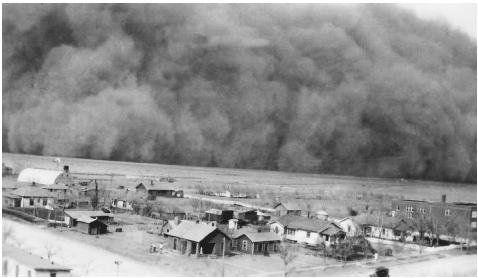
What effect did the Dust Bowl storms have on the Great Depression?
a)
Many farmers were forced to leave the Great Plains.
b)
Unemployment decreased gradually.
c)
Many homes long the Mississippi River were flooded.
d)
Hoover was re-elected as president.
27.
What was the name of Wilson's proposed international peace keeping body?
a)
United Nations
b)
North Atlantic Treaty Organization
c)
League of Nations
d)
Warsaw Pact
28.

-USS Maine sinks
-Rough Riders aid the U.S. military in achieving victory
-United States acquires Puerto Rico, Guam, and the Philippines
The events above are related to which of the following?
-Rough Riders aid the U.S. military in achieving victory
-United States acquires Puerto Rico, Guam, and the Philippines
The events above are related to which of the following?
a)
War of 1812
b)
Spanish American War
c)
Mexican American War
d)
World War I
29.
In The Jungle, Upton Sinclair exposed
a)
Dangers faced by coal miners
b)
Corrupt business practices of the Standard Oil Company
c)
Unsanitary conditions in the meat-packing industry
d)
Illegal deals between special interests and the government
30.
Who did not want Americans to control Hawaii and was overthrown?
a)
Woodrow Wilson
b)
Queen Liliuokolani "Lili"
c)
Theodore Roosevelt
d)
William Seward
31.
What was the reason for building the Panama Canal?
a)
To help ships travel from the Atlantic to the Pacific ocean faster
b)
To allow soldiers to travel by sea
c)
To create an easier way for the USS Maine to reach Cuba
d)
To help immigrants get to America
32.
What was the name given to President Roosevelt's plan to alter the Supreme Court to increase his power in having his New Deal legislation passed instead of having it struck down on constitutional grounds?
a)
The New Deal
b)
The Great Depression
c)
Court Packing
d)
Second New Deal
33.
This was created to protect the money people had deposited in the bank
a)
Federal Deposit Insurance Corporation
b)
Securities and Exchange Committee
c)
Tennessee Valley Authority
d)
National Recovery Administration
34.
What term describes building an empire by conquering other nations?
a)
Isolationism
b)
Repubicanism
c)
Militarism
d)
Imperialism
35.
What was the United States warship called that exploded killing over 200 American sailors?
a)
U S Maine
b)
USS Maine
c)
USS Maybe
d)
US Maritime
36.

Assembly lines are used to mass-produce goods. What is mass production?
a)
The production of high-quality goods
b)
The production of cheap goods
c)
The production of a small number of goods
d)
The production of a large number of goods.
37.
THIS SCANDAL BY ONE OF HARDING'S CABINET ADVISERS, ALBERT FALL, RESULTED IN HIS REMOVAL AND ARREST
a)
WATERGATE SCANDAL
b)
TEAPOT DOME SCANDAL
c)
THE V.A. SCANDAL
d)
THE XYZ AFFAIR
38.
How did President Roosevelt help to make the United States a world power?
a)
He strengthened and asserted U.S. military power.
b)
He sent troops to China to demand access to trade markets.
c)
He peacefully negotiated the construction of the Panama Canal.
d)
He improved U.S. education in order to pursue peaceful diplomacy.
39.
What was the Red Scare
a)
A time when people were afraid of anarchism, communism, and socialism
b)
When people were afraid of the color red
c)
Sacco and Vanzetti
d)
a red ghost
40.
What was the Harlem Renaissance of the 1920s?
a)
a program of urban renewal among various ethnic groups begun in New York City
b)
a period of musical, artistic, and literary productivity among African Americans in New York City
c)
the integration of African Americans into colleges and universities throughout the nation
d)
a set of political reforms and social programs supported by African American politicians in New York City
41.
"Global War" caused by MAIN, joined by America, and intensified because of new technology. Called the War to End All Wars, ended by an imperfect peace.
a)
World War I
b)
World War II
c)
Spanish-American War
d)
Vietnam War
42.
At first thought of as a "Return to Normalcy" after global upheaval, this decade saw traditional norms challenged by new social views and science.
a)
Roaring 20s
b)
Civil Rights
c)
End of Cold War
d)
Great Depression
43.
Period of economic distress (blamed on Herbert Hoover) caused by over speculation, reliance on credit, and bad banking practices.
a)
New Deal
b)
Great Depression
c)
Roaring 20s
d)
Jazz Age
44.
Which constitutional amendment outlawed the manufacture and sale of Alcohol?
a)
17
b)
18
c)
19
d)
21
45.
founded the NAACP
a)
W.E.B. DuBois
b)
Booker T. Washington
c)
Stephen Douglas
d)
Harriet Beecher Stoew
46.
Which group believed in survival of the fittest and people were naturally selected to succeed?
a)
social darwinist
b)
political bosses
c)
nativist
d)
political machines
47.
Which law gave farmland to citizens in order to move to the Great Plains?
a)
Sherman Antitrust Act
b)
Stamp Act
c)
Great Plains Act
d)
Homestead Act
48.
Which of the following was a result of Prohibition during the 1920's?
a)
Growth of organized crime
b)
More jobs on farms
c)
Less unemployment in cities
d)
Fall of the stock market
49.
The group most credited with pushing prohibition was
a)
The KKK
b)
African Americans
c)
Women
d)
Business Owners
50.
To cause inflation and increase prices, the Populists wanted
a)
bimettalism
b)
the gold standard
c)
the silver standard
d)
the federal reserve
51.
What was the purpose of free coinage of silver?
a)
To help farmers pay off debt
b)
To increase the flow of money to help the poor people in the inner city
c)
To stabalize our economy
52.
Which was not a cause of the Dust Bowl?
a)
Drought
b)
Poor Farming techniques
c)
Unemployment
d)
High Winds
53.
What was the focus of Progressives when it came to voting?
a)
Create a direct democracy
b)
Restrict voting to just the wealthy
c)
Get rid of the electoral college
d)
A direct election of senators
54.
How did the government help people settle the Great Plains?
a)
By providing free equipment and materials for building a home
b)
Through the Federal Reserve Act making loans available to settlers
c)
Through the Homestead Act providing free federal land grants
d)
Building railroad stations in each town
55.
This movement, originally lead primarily by middle class women, looked to correct the abuses of the rich against the urban poor.
a)
Progressive Movment
b)
Populist Movement
c)
Americanization Movement
d)
Prohibition Movement
56.
A bill that originates from the people rather than legislators is known as what? Example of these is like the bills on the White House website:
a)
A Recall
b)
An Initiative
c)
A Referendum
d)
An Amendment
100 %

