
 Worksheets
ECE Learning Set 3 Review
Total questions: 74
Worksheet time: 1hrs 1mins
Name
Class
Date
1.
_________________ are seismic waves that move both up and down and side to side.
a)
P waves
b)
S waves
c)
Surface waves
d)
faults
2.
Magnitude tells geologists...
a)
how much energy was released
b)
a number that geologists assign based on an earthquakes size
c)
how much damage occurred
d)
all of the options
3.
Geologists use _____________________ to locate an earthquakes epicinter.
a)
Surface Waves
b)
seismic waves
c)
focus
d)
the Mercalli scale
4.
Scientists need data from at least ___ seismographs to find and earthquake's epicenter.
a)
5
b)
2
c)
4
d)
3
5.
Scientists need data from at least ___ seismographs to find and earthquake's epicenter.
a)
5
b)
2
c)
4
d)
3
6.
The point on the surface directly above the focus is called the _________________.
a)
epicenter
b)
seismograph
c)
home
d)
fault
7.
Which body wave compresses and stretches rock materials as it passes through the Earth's interior?
a)
Body Waves
b)
P- Waves
c)
S- Waves
d)
Surface Waves
8.
Which body waves cause particles of rock material to move at right angles to the direction in which the waves are traveling?
a)
Body Waves
b)
P- Waves
c)
S- Waves
d)
Surface Waves
9.
What is the name of the instrument that measures movements in the ground during an earthquake and creates electric signals that can be read to determine an earthquake's magnitude?
a)
Seismometer
b)
Seismic Station
c)
Seismogram
d)
Seismograph
10.
What is the measure of the amount of energy released in an earthquake?
a)
Intensity
b)
Epicenter
c)
Magnitude
d)
Seismogram
11.
Which scale rates earthquakes based on the amount of damage done?
a)
Mercalli Scale
b)
Richter Scale
c)
Seismogram Scale
d)
Bernoulli Scale
12.
What is the shaking of the Earth’s crust caused by a sudden release of energy?
a)
Earthquake
b)
Epicenter
c)
Fault
d)
Plate
13.
The Richter scale measures...
a)
the amount of radon gas released during an earthquake.
b)
the movement of tectonic plates over a year.
c)
the strength of an earthquake.
d)
the intensity of an earthquake.
14.
The Modified Mercalli scale considers earthquake intensity and the amount of damage cause by an earthquake.
a)
true
b)
false
15.
Which waves travel fastest, always being the first pulse of waves detected by seismic stations?
a)
P- waves
b)
S- waves
16.
What do S- (secondary) waves do during an earthquake?
a)
Shake the ground in a shearing motion.
b)
Cause eruptions.
c)
Open cracks in the earth's surface.
d)
Cause buildings to move up and down.
17.
A written record of earthquake motion is called a ___________________.
a)
seismograph
b)
seismogram
c)
seismologist
d)
seismometer
18.
How much stronger is a magnitude 8.0 earthquake compared to magnitude 7.0 one on the Richter Scale?
a)
7/8 as strong
b)
10 times stronger
c)
56 times stronger
d)
twice as strong
19.
Which wave can travel through solids, liquids, and gases?
a)
P
b)
S
c)
Surface
d)
Seismic
20.
True or False
Primary Waves travel the fastest and cause the most damage
Primary Waves travel the fastest and cause the most damage
a)
True
b)
False
21.
True or False
The mantle is divided into plates
The mantle is divided into plates
a)
True
b)
False
22.
If two continental plates PUSH together- what is most likely to occur?
a)
Volcanoe
b)
Mountains
c)
Oceanic rift
d)
Tornado
23.
Secondary Waves can pass through ______ only
a)
gas
b)
water
c)
solids
d)
the defense of the Panthers
24.
A ________ is a break in rock along which the ground has shifted from side to side.
a)
sinkhole
b)
crater
c)
meteorite
d)
fault
25.
What are seismic waves?
a)
Energy released by an earthquake in waves or vibrations
b)
The point beneath Earth’s surface at which rock under stress breaks and triggers an earthquake
c)
The point on the surface directly above the point at which an earthquake occurs
d)
The strength of an earthquake
26.
In what order do the three types of seismic waves arrive at a seismograph?
a)
S wave, P wave, Surface wave
b)
Surface wave, P wave and S wave
c)
P wave, S wave and Surface wave
d)
P wave, Surface wave and S wave
27.
Which type of seismic wave produces the most severe ground movement?
a)
P wave
b)
S wave
c)
Surface wave
d)
None of the above
28.
Describe the moment magnitude scale, and explain why it is useful in measuring earthquakes.
a)
It measures nearby earthquakes.
b)
It measures earthquakes total energy of earthquakes near or far
c)
It tells us how dangerous an earthquake was
d)
It measures the size of the largest wave.
29.
How do geologists locate the epicenter of an earthquake?
a)
They measure the difference between seismic waves on three or more seismographs. The epicenter is where the circles intercept.
b)
They measure the difference between seismic waves on the first seismograph to receive the wave.
c)
They measure the largest surface wave to hit the surface.
d)
They add the total damage of the p wave, s wave and surface wave.
30.
_____________ records ground movements caused by seismic waves as they
move through Earth
move through Earth
a)
Focus
b)
Epicenter
c)
Surface Waves
d)
Seismograph
31.
________ are the slowest seismic waves.
a)
P waves
b)
S waves
c)
Surface waves
d)
Epicenter
32.
___________ is the point beneath Earth’s surface at which rock under stress breaks and triggers an earthquake.
a)
Focus
b)
Epicenter
c)
Surface waves
d)
Seismograph
33.
True or False? The shaking and trembling that results from movement of rock beneath Earth’s surface is called an earthquake.
a)
True
b)
False, magma
34.
True or False? The epicenter of an earthquake is below the focus.
a)
True
b)
False, above
35.
True or False? P waves can become surface waves when they reach Earth’s
surface.
surface.
a)
True
b)
False, no waves
36.

This image is an example of a __.
a)
seismograph
b)
seismogram
c)
telegram
d)
triangulation
37.

This image is a ___.
a)
seismogram
b)
seismograph
c)
teleprompter
d)
spirograph
38.

Which statement is true about seismic waves?
a)
P waves travel faster than secondary and surface waves.
b)
Secondary waves travel faster than surface and primary waves.
c)
Surface waves are the fastest.
d)
All seismic waves travel at the same speed.
39.

When an underwater earthquake causes a giant wave to come ashore, that wave is known as a __
a)
tsunami
b)
seismic wave
c)
shearing
d)
focus wave
40.

This famous transform fault is located in the western United States creates significant earthquake activity for California
a)
New Madrid
b)
Denali Fault
c)
Ramapo Seismic Zone
d)
San Andreas
41.

Earthquakes happen every day. Most are too small for humans to notice.
a)
True
b)
False
42.

These are the first waves released during an earthquake
a)
S waves
b)
Surface Waves
c)
P waves
43.

What is a tsunami?
a)
Huge wave
b)
small wave
c)
A pet for your tummy
d)
wind and tides
44.

What starts a Tsunami?
a)
COOKIE CAT
b)
when rock underground suddenly breaks along a fault.
c)
An underwater Earthquake
d)
Dante
45.

Letter C is pointing to which Earth layer?
a)
Mantle
b)
Crust
c)
Outer Core
d)
Inner Core
46.

The Asthenosphere is located in which Earth layer?
a)
A - Inner Core
b)
B - Outer Core
c)
C - Mantle
d)
D - Crust
47.

The huge pieces of the earth's crust are called ____________________________.
a)
crust
b)
plates
c)
directions
d)
seismos
48.
Which travels fastest, always being the first detected by seismic stations?
a)
P waves
b)
S waves
49.
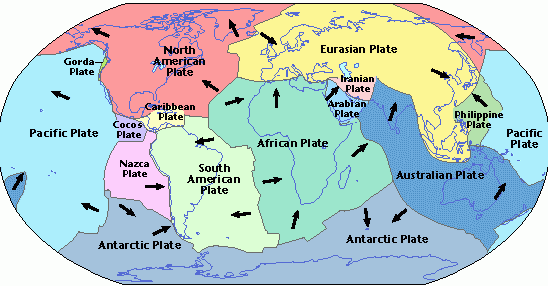
Many earthquakes happen along the borders of...
a)
Countries
b)
Tectonic Plates
c)
Climate Zones
d)
None of the above.
50.
What type of mountain is formed by tension?
a)
fault block mountain
b)
folded mountain
c)
volcanic mountain
51.
Which statement best explains the difference between longitudinal and transverse waves?
a)
Longitudinal waves have troughs, while transverse waves have crests.
b)
Longitudinal waves produce energy, while transverse waves consume energy.
c)
Particles in longitudinal waves travel towards a force, while particles in transverse wave travel away from a force.
d)
Particles in longitudinal waves travel in the direction of the wave, while particles in transverse waves travel perpendicular to the wave.
52.
The most destructive type of wave is a
a)
P-wave
b)
S-wave
c)
Surface wave
d)
transverse wave
53.
An instrument that detects and measures earthquakes is a
a)
seismogram
b)
focus seismic map
c)
focus
d)
seismograph
54.
What is a tracing of an earthquake's motion that is created by a seismograph?
a)
Seismograph
b)
Seismogram
c)
Seismologist
d)
Elastic Rebound
55.
An instrument that records vibrations in the ground and determines the location and strength of an earthquake.
a)
Seismograph
b)
Shakeograph
c)
Seismogram
d)
Epicenter
56.
The point on Earth's surface directly above an earthquake's starting point or focus.
a)
Hot spot
b)
Focus
c)
Moho point
d)
Epicenter
57.
The point along a fault at which the first motion of an earthquake occurs.
a)
Starting point
b)
Epicenter
c)
Focus
d)
Moho point
58.
A seismic wave that causes particles of rock to move in a side-to-side direction.
a)
S - Waves
b)
Side Waves
c)
Surface Waves
d)
P - Waves
59.
Which type of seismic waves are the slowest?
a)
S-waves
b)
P-waves
c)
Surface waves
d)
Primary waves
60.

Where is the epicenter located?
a)
A
b)
B
c)
C
d)
There is no epicenter
61.

Where is the focus located?
a)
A
b)
B
c)
C
d)
There is no focus
62.
___ waves are the first and fastest seismic waves.
a)
Surface waves
b)
S waves
c)
P waves
63.
Earthquakes are caused by the release of stored energy along a fault.
a)
True
b)
False
64.
What is the name of the waves given off by an earthquake?
a)
Seismic waves
b)
Radiation waves
c)
Sound waves
d)
Compaction waves
65.
Which of the statements best describes the relationship between lag time and distance from epicenter?
a)
The longer the lag time, the closer the distance.
b)
The longer the lag time, the farther the distance.
c)
The shorter the lag time, the farther the distance.
d)
There is no relationship.
66.

Where is the epicenter for this earthquake located based on triangulation?
a)
A
b)
B
c)
C
d)
D
67.
What would you be most likely to find at a transform boundary?
a)
Earthquakes
b)
Volcanoes
c)
Mountains
d)
Rift
68.
What would you be most likely to find at a convergent boundary between two pieces of continental crust?
a)
Volcano
b)
Mountain
c)
Rift
d)
Island Arc
69.
The area where two or more plates meet is called a __________________.
a)
fault
b)
plate boundary
c)
plate edge
d)
ring of fire
70.
A deep crack in the Earth's crust is called a _______________.
a)
canyon
b)
trench
c)
fault
d)
plate
71.
Earthquakes typically occur _________________.
a)
In the middle of tectonic plates
b)
only in California
c)
only in the middle of the ocean
d)
along plate boundaries
72.

What is happening at this boundary?
a)
A rift valley forms
b)
Mountains are building
c)
The ocean is sinking
d)
Volcanoes form
73.

What is happening at this boundary?
a)
Plates are subducting
b)
Mountains are building
c)
Earthquakes
d)
Volcanoes form
74.
The Tetons, Rockies, and Appalachian mountain ranges in the United States were formed by which of the following forces?
a)
Glacial drift
b)
Volcanic eruption
c)
Physical weathering
d)
Crustal plate movement
100 %

