
 Worksheets
Plate Tectonics, Continental Drift, Earth's Layers Test Review
Total questions: 79
Worksheet time: 55mins
Name
Class
Date
1.

Name this plate boundary.
a)
divergent
b)
convergent
c)
transform
d)
allegiant
2.

Name this plate boundary.
a)
divergent
b)
convergent
c)
transform
d)
transformers
3.

Name this plate boundary.
a)
divergent
b)
convergent
c)
transform
d)
insurgent
4.
What are the deepest places on Earth formed by pushing oceanic crust under continental crust?
a)
mid-ocean ridges
b)
rift valleys
c)
trenches
d)
mountain ranges
5.
What forms when denser oceanic crust is pushed under less dense oceanic crust?
a)
mountains
b)
volcanic islands
c)
rift valleys
d)
mid-ocean ridges
6.
This theory states that Earth's plates move on top of the mantle at a slow and constant rate due to convection currents
a)
plate tectonics
b)
continental drift
c)
seafloor spreading
d)
pangaea
7.
Large pieces of Earth's lithosphere that move around are called?
a)
sections
b)
plates
c)
land masses
d)
faults
8.
Which piece of evidence was not used by Wegener to support his theory of continental drift?
a)
South America and Africa coastlines
b)
coal beds in Antarctica
c)
plant and reptile fossils
d)
earthquake patterns
9.
What forms when two oceanic plates diverge?
a)
moutains
b)
rift valley
c)
mid-ocean ridge
d)
deep-ocean trench
10.
What is associated with transform boundaries?
a)
mountains
b)
volcanoes
c)
earthquakes
d)
islands
11.
What occurs when two plates come together and the denser one is forced under back into the mantle?
a)
reduction
b)
conduction
c)
subduction
d)
convection
12.
A break or crack in the Earth's crust is called a...
a)
plate
b)
fault
c)
fold
d)
crack
13.
Which type of plate boundary would cause folded mountains to form?
a)
transform
b)
convergent
c)
divergent
d)
subduction
14.
What are the two types of crust?
a)
continental and oceanic
b)
ocean and basin
c)
lower and upper
d)
thick and thin
15.
What drives tectonic plate movement?
a)
gravity
b)
coriolis effect
c)
convection currents
d)
the earth's magnetic core
16.
Earthquakes and volcanoes are most likely found in which locations?
a)
at plate boundaries
b)
in oceans
c)
in the middle of continents
d)
in the middle of plates
17.
When an oceanic plate and a continental plate collide, which one will subduct?
a)
oceanic
b)
continental
c)
neither
d)
both
18.
According to Wegener's hypothesis of continental drift,
a)
Earth's surface is made up of seven major landmasses
b)
the continents DO NOT move
c)
Earth is slowly cooling and shrinking
d)
the continents were once joined together in a single landmass
19.
Most geologists rejected Alfred Wegener's idea of continental drift because...
a)
it did not agree with their current theory
b)
Wegener was interested in what Earth was like millions of years ago
c)
Wegener used several different types of evidence to support his hypothesis
d)
Wegener could not identify the force that moved the continents
20.
The youngest rocks on the seafloor are most likely found...
a)
closest to a mid-ocean ridge
b)
farthest from a mid-ocean ridge
c)
near the coastlines
d)
closest to a deep sea trench
21.
The Andes Mountains are a volcanic mountain range located on the western coast of South America. The plate boundary located in this region is most likely an area of-
a)
subduction because the plates are colliding
b)
folded mountains because the plates are colliding
c)
mid-ocean ridges because the plates are pulling apart
d)
ocean-floor spreading because the plates are spreading apart
22.
The San Andreas Fault is a crack in the Earth's crust that runs the length of California. What plate boundary feature caused this?
a)
an inactive convergent boundary
b)
an active convergent boundary
c)
an active transform boundary
d)
a volcanic eruption
23.
What geologic feature is most likely to form at a divergent boundary?
a)
delta
b)
rift valley
c)
trench
d)
plateau
24.
Rising magma that results from subduction may produce...
a)
fossil layers
b)
volcanic island arcs
c)
deep-sea sediment
d)
seafloor spreading
25.
What do volcanic island arcs indicate about the plate tectonics in the region?
a)
a converging plate boundary
b)
a diverging plate boundary
c)
a transform plate boundary
d)
new seafloor being created
26.
What geologic process formed the Himalayas?
a)
two continental plates converging
b)
an earthquake in a subduction zone
c)
a tectonic plate moving over a hot spot
d)
movement at a transform fault boundary
27.
The type of plate boundary where two plates come together is a .....
a)
Convergent Boundary
b)
Divergent Boundary
c)
Transform Boundary
d)
Plate Boundary
28.
Which of the following causes Earth's tectonic plates to move?
a)
Energy from the Sun
b)
Magnetic Pole Reversal
c)
Convection currents in the mantle
d)
Faults in Mountain Ranges
29.
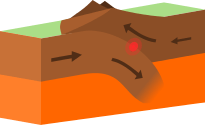
What type of plate boundary is this?
a)
Plate
b)
Divergent
c)
Convergent
d)
Transform
30.

What type of event will occur at this boundary?
a)
Earthquake
b)
Volcano Eruption
c)
Tornado
d)
Mountain Building
31.
A divergent boundary occurs when plates ....
a)
Pull apart
b)
Come together
c)
Slide past each other
d)
subducting
32.
Which of the following is the name of the ancient supercontinent formed 28 Million Years ago.
a)
Pangea
b)
Gondwanda
c)
Laurasia
d)
Neverland
33.
Which of the following is NOT evidence to support the theory of plate tectonics?
a)
Fossils
b)
Mountains
c)
Glaciers
d)
Sand Erosion
34.
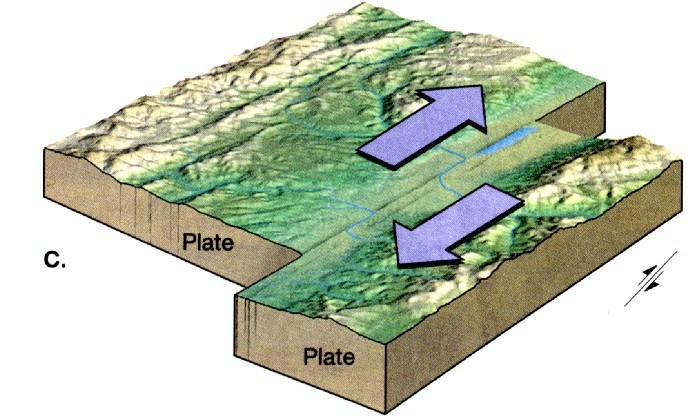
What type of plate boundary is this?
a)
Transform
b)
Convergent
c)
Divergent
d)
Plate
35.
The theory that says Earth's continents once made up an ancient supercontinent, and have been drifting apart ever since, is called the theory of...
a)
Pangea
b)
Plate Tectonics
c)
Natural Selection
d)
Gravity
36.
Oceanic Trenches are formed by _______ plate boundaries
a)
Convergent
b)
Transform
c)
Plate
d)
Divergent
37.
A fault is formed by the movement of a __________ plate boundary
a)
Transform
b)
Convergent
c)
Divergent
38.
Islands can from from magma which is pushed up at a __________ plate boundary
a)
Divergent
b)
Convergent
c)
Transform
39.
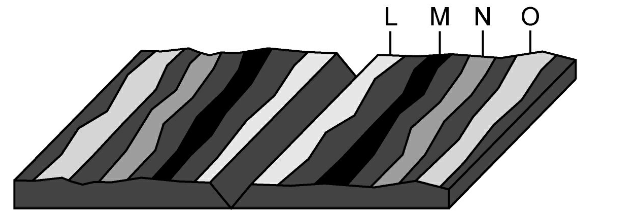
Where would the oldest rock be found?
a)
L
b)
M
c)
N
d)
O
40.
How is it possible for new crust to be formed without increasing the surface area of the Earth?
a)
Crust is destroyed at the same time it is created
b)
New crust is underwater where it sinks
c)
New crust breaks more easily than old crust
41.
Mountains are created when....
a)
Two continental plates collide
b)
Two oceanic plates pull apart
c)
An Oceanic plate subducts under a Continental Plate
d)
Two continental plates pull apart
42.

The youngest material of the ocean floor is found at mid-ocean _________.
a)
ridges
b)
trenches
c)
basins
d)
rifts
43.

The presence of the same ________ on several continents supports the idea of continental drift.
a)
rocks
b)
fossils
c)
both fossils and rocks
d)
neither fossils nor rocks
44.

A lack of evidence for continental drift prevented many scientists from believing a single supercontinent called _________ existed.
a)
Glossopteris
b)
Pangaea
c)
Gondwanaland
d)
Mesosaurus
45.

The theory of _______ states that Earth’s crust and upper mantle are broken into sections that are in constant, slow motion.
a)
plate tectonics
b)
continental drift
c)
seafloor spreading
d)
divergent boundaries
46.

Matching ________ on different continents are evidence for continental drift.
a)
weather systems
b)
river systems
c)
rock structures
d)
wind systems
47.

Many scientists think hot plastic-like rock in the mantle is forced upward toward the surface, cools, and sinks. This process is called a(n) _________.
a)
earthquake
b)
convergent boundary
c)
volcano
d)
convection current
48.

The _________ is the thinnest layer of Earth.
a)
outer core
b)
inner core
c)
mantle
d)
crust
49.

_______ are formed when two continental plates collide.
a)
Mountain ranges
b)
Transform faults
c)
Rift valleys
d)
Volcanoes
50.

The theory of continental drift was first proposed by __________.
a)
Thomas Edison
b)
Alfred Wegener
c)
Benjamin Franklin
d)
Harry Hess
51.

The theory of seafloor spreading was first proposed by __________.
a)
Thomas Edison
b)
Harry Hess
c)
Benjamin Franklin
d)
Alfred Wegener
52.

What is the correct order (starting from the surface) of Earth’s layers?
a)
mantle, outer core, inner core, crust
b)
crust, mantle, outer core, inner core
c)
outer core, inner core, crust, mantle
d)
crust, outer core, inner core, mantle
53.

Which layer of Earth is made up partly of crust and partly of mantle material?
a)
lithosphere
b)
mantle
c)
asthenosphere
d)
crust
54.

The layer of caramel-like consistency that flows and moves the plates of the Earth is called the ________.
a)
mantle
b)
lithosphere
c)
crust
d)
asthenosphere
55.

The _______ is the thickest layer of the Earth at 1800 miles thick. This layer contains most of the mass of the Earth.
a)
crust
b)
mantle
c)
outer core
d)
inner core
56.

The _________ is so hot that the metals in it are all in the liquid state.
a)
crust
b)
mantle
c)
outer core
d)
inner core
57.

_________ currents carry heat from the hot inner core to the cooler outer mantle and back again.
a)
River
b)
Radiation
c)
Convection
d)
Conduction
58.

Plates move apart at _________ boundaries.
a)
volcanic
b)
divergent
c)
convergent
d)
transform
59.

The San Andreas Fault in California is an example of a ________.
a)
divergent boundary
b)
convergent boundary
c)
transform fault
d)
subduction zone
60.

Which type of plate boundary occurs at B?
a)
convergent
b)
divergent
c)
transform
d)
country
61.

The feature labeled C represents some of the deepest spots on the ocean floor. These areas are called ___.
a)
mid-ocean ridge
b)
trenches
c)
deep-sea vent
d)
abyssal plain
62.

The feature labeled D is part of the continuous underwater mountain range that circles Earth. It is called ___.
a)
mid-ocean ridge
b)
trenches
c)
deep-sea vent
d)
abyssal plain
63.

Which type of plate boundary is shown at A?
a)
transform boundary
b)
convergent boundary
c)
divergent boundary
d)
fractured boundary
64.

When plates slide past one another, _________ occur.
a)
divergent boundaries
b)
convection currents
c)
subduction zones
d)
transform faults
65.

Which layer of Earth is located above the outer core?
a)
crust
b)
inner core
c)
mantle
d)
lithosphere
66.
Which of these two layers is a solid?
a)
innercore
b)
Outercore
67.
What is the top layer of the Earth's surface called?
a)
Mantle
b)
Innercore
c)
Outercore
d)
Crust
68.
A dense ball of solid iron and nickel.
a)
crust
b)
inner core
c)
mantle
d)
outer core
69.
Which best describes the asthenosphere?
a)
molten metal
b)
dense, solid metal ball
c)
solid that flows
d)
dry land and ocean floor
70.
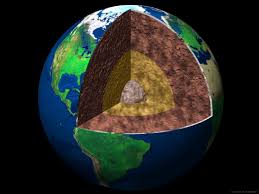
Which layer of Earth is located above the outer core?
a)
crust
b)
inner core
c)
mantle
d)
lithosphere
71.
Which layer of the earth is rock made mostly of iron?
a)
Lithosphere
b)
Core
c)
Asthenosphere
d)
Mantle
72.
What part of the earth is a layer of rock that comprises 67% of Earth’s mass?
a)
mesosphere
b)
mantle
c)
asthenosphere
d)
lithosphere
73.
What is the rigid layer of the Earth's surface made up of the crust and upper mantle called?
a)
asthenosphere
b)
lithosphere
c)
mesosphere
d)
continental crust
74.
How many layers of the Earth's CORE are there?
a)
one
b)
two
c)
three
d)
four
75.
Is the outer core a liquid or solid?
a)
liquid
b)
solid
76.
Temperature _____________________ as you go deeper into the earth.
a)
increases
b)
decreases
c)
goes up and down depending on the layer
d)
stays the same
77.
Pressure ______________________ as you go deeper into the Earth
a)
increases
b)
decreases
c)
goes up or down depending on the layer
d)
stays the same
78.
How have scientists been able to study Earth's mantle?
a)
In some places, Earth's crust thins enough to see mantle.
b)
Earth's surface heat warms the crust turning it into mantle.
c)
Cooling crust material becomes mantle over time.
d)
In some places, mantle rock pushes to Earth's surface.
79.
Which layer of Earth is characterized by rock that is plastic, or soft enough to flow?
a)
asthenosphere
b)
crust
c)
lithosphere
d)
inner core
100 %

