
 Worksheets
Plate Tectonics and Volcanism
Total questions: 25
Worksheet time: 13mins
Name
Class
Date
1.

What was the main reason Wegener's continental drift hypothesis was rejected?
a)
He could not explain HOW the continents moved
b)
His explanations were illogical
c)
He was not liked by other scientists
d)
His evidence was incorrect
2.

Which of the following was NOT used to support the continental drift hypothesis?
a)
Fossil evidence
b)
Puzzle-like fit of South America and Africa
c)
Ancient climate
d)
Paleomagnetism
3.
Scientists today believes that there are several supercontinents like Pangaea.
a)
YAH!
b)
Neigh
c)
There is only ONE supercontinent
d)
Maybe. IDK.
4.

The outermost rigid layer of Earth that includes the crust and the upper mantle is called the _____.
a)
Lithosphere
b)
Asthenosphere
c)
Crust
d)
Mantle
5.

In the theory of plate tectonics, a plate can be made up of _____.
a)
Continental Lithosphere
b)
Oceanic Lithosphere
c)
Both continental and oceanic lithosphere
d)
Both continental and oceanic asthenosphere
6.

Which type of crust is more dense?
a)
Antarctic
b)
Arctic
c)
Oceanic
d)
Continental
7.
Which ocean is expanding due to a mid-ocean ridge (divergent boundary)?
a)
Indian
b)
Dead Sea
c)
Atlantic
d)
Artic
8.
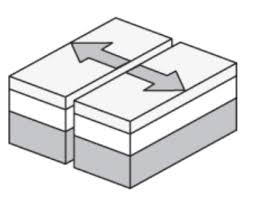
Name the boundary
a)
convergent boundary
b)
divergent boundary
c)
transform boundary
d)
sergent boundary
9.

Name the boundary
a)
convergent boundary
b)
divergent boundary
c)
transform boundary
d)
sergent boundary
10.
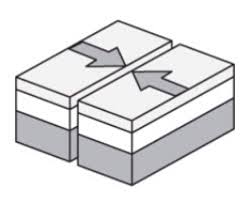
Name the boundary
a)
convergent boundary
b)
divergent boundary
c)
transform boundary
d)
sergent boundary
11.
Continental-Continental, Oceanic-Oceanic, and Continental-Oceanic are what type of plate boundaries?
a)
Divergent
b)
Convergent
c)
Transform
d)
Sergent
12.

Choose the best definition for subduction
a)
Where 2 plates meet each other.
b)
A plate interaction that creates volcanoes.
c)
Where a plate sinks into the mantle under another plate.
d)
Where plates grind against each other and form mountains.
13.

Scientists think that convection currents that move the plates flow in Earth's
a)
Continental crust
b)
Oceanic crust
c)
Asthenosphere
d)
Lithosphere
14.

Magma's viscosity is directly related to its _____.
a)
Depth
b)
Age
c)
Color
d)
Silica Content
15.

When lava cools into jagged chunks, it is called _____.
a)
aa
b)
ribbon lava
c)
pillow lava
d)
pahoehoe
16.

When lava cools into ribbons, it is called ____.
a)
aa
b)
ribbon lava
c)
pillow lava
d)
pahoehoe
17.

The super-heated, dense cloud shown here is called _____.
a)
vortex
b)
dust cloud
c)
pyroclastic flow
d)
thermal cloud
18.

This forms when hot lava is thrown from a volcano and hardens as it spins.
a)
volcanic bombs
b)
volcanic blocks
c)
lapilli
d)
pahoehoe
19.

What is the most abundant gas associated with volcanic activity?
a)
Chlorine
b)
Sulfur Oxide
c)
Carbon Dioxide
d)
Water Vapor
20.
Volcanoes can be found...
a)
on land
b)
under water
c)
on islands
d)
all of the above
21.

Which is the largest, more broad volcanoes that formed Hawaii?
a)
Shield Volcano
b)
Dome Volcano
c)
Cinder Cone Volcano
d)
Composite Cone Volcano
22.

Which is a steep-sided, relatively small and explosive volcano?
a)
Shield Volcano
b)
Dome Volcano
c)
Cinder Cone Volcano
d)
Composite Cone Volcano
23.

What do you call the steep-walled depression around the opening of a volcano?
a)
Volcanic Pipe
b)
Vent
c)
Crater
d)
Sinkhole
24.

The laccolith, batholith an dike are types of __________ ___________. These are magma that has pushed into existing layers of rock and cooled there.
a)
extrusive sediments
b)
igneous intrusions
c)
metamorphic layers
d)
hot spots
25.

What do you call the lens-shaped intrusive igneous mass near the Earth's surface?
a)
Laccolith
b)
Dike
c)
Batholith
d)
Sill
100 %

