
 Worksheets
Plate Tectonics, Earthquakes and Volcanoes
Total questions: 45
Worksheet time: 21mins
Name
Class
Date
1.
The type of plate boundary where two plates come together is a .....
a)
Convergent Boundary
b)
Divergent Boundary
c)
Transform Boundary
d)
Plate Boundary
2.
Which of the following causes Earth's tectonic plates to move?
a)
Energy from the Sun
b)
Magnetic Pole Reversal
c)
Convection currents in the mantle
d)
Faults in Mountain Ranges
3.
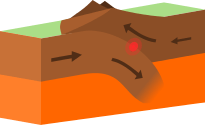
What type of plate boundary is this?
a)
Plate
b)
Divergent
c)
Convergent
d)
Transform
4.

What type of event will occur at this boundary?
a)
Earthquake
b)
Volcano Eruption
c)
Tornado
d)
Mountain Building
5.
A divergent boundary occurs when plates ....
a)
Pull apart
b)
Come together
c)
Slide past each other
d)
subducting
6.
Which of the following is NOT evidence to support the theory of plate tectonics?
a)
Fossils
b)
Mountains
c)
Glaciers
d)
Sand Erosion
7.
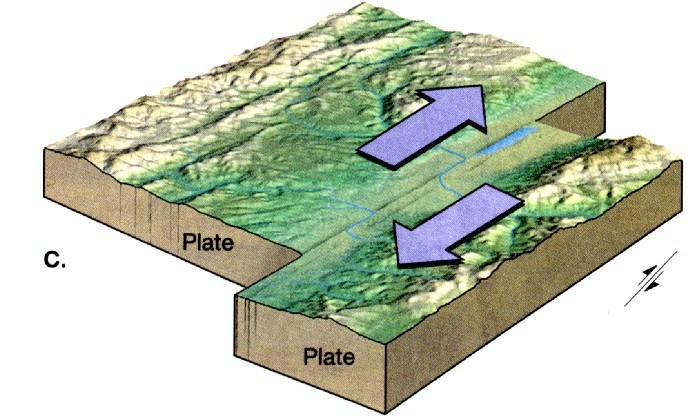
What type of plate boundary is this?
a)
Transform
b)
Convergent
c)
Divergent
d)
Plate
8.
The theory that says Earth's continents once made up an ancient supercontinent, and have been drifting apart ever since, is called the theory of...
a)
Pangea
b)
Plate Tectonics
c)
Natural Selection
d)
Gravity
9.
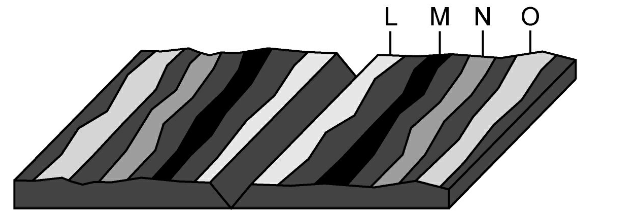
Where would the oldest rock be found?
a)
L
b)
M
c)
N
d)
O
10.
How is it possible for new crust to be formed without increasing the surface area of the Earth?
a)
Crust is destroyed at the same time it is created
b)
New crust is underwater where it sinks
c)
New crust breaks more easily than old crust
11.
Mountains are created when....
a)
Two continental plates collide
b)
Two oceanic plates pull apart
c)
An Oceanic plate subducts under a Continental Plate
d)
Two continental plates pull apart
12.

Scientists think that convection currents that move the plates flow in Earth's
a)
Continental crust
b)
Oceanic crust
c)
Asthenosphere
d)
Lithosphere
13.

The outside layer of the earth is called ______________________.
a)
core
b)
crust
c)
mantle
d)
outer core
14.

The huge pieces of the earth's crust are called ____________________________.
a)
crust
b)
plates
c)
directions
d)
seismos
15.

This famous transform fault is located in the western United States creates significant earthquake activity for California
a)
New Madrid
b)
Denali Fault
c)
Ramapo Seismic Zone
d)
San Andreas
16.

What is a break in the Earth's crust?
a)
Fault
b)
Focus
c)
Fold
d)
Mineral
17.

Which kind of plate boundary is this?
a)
divergent boundary
b)
transform boundary
c)
convergent boundary (ocean to continent)
d)
convergent boundary (continent to continent)
18.
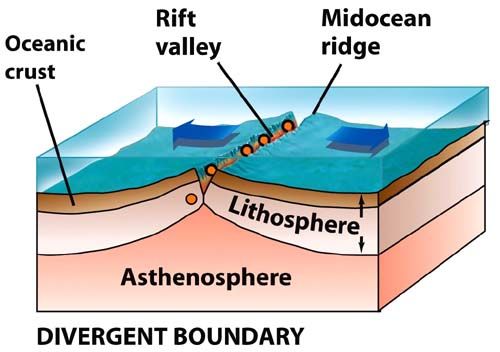
What kind of plate boundary is shown here?
a)
divergent
b)
convergent
c)
transform
d)
strike slip
19.
200-300 million years ago, the continents were joined in a single land mass called...
a)
Pan America
b)
Pangaea
c)
Pan Acean
d)
'Murica
20.
Who is known as the "Father of Continental Drift"?
a)
Harry Hess
b)
Abraham Ortelius
c)
Alfred Wegner
d)
John Tuzo Wilson
21.
What are the deepest places on Earth formed by pushing oceanic crust under continental crust?
a)
mid-ocean ridges
b)
rift valleys
c)
trenches
d)
mountain ranges
22.
What forms when two oceanic plates diverge?
a)
moutains
b)
rift valley
c)
mid-ocean ridge
d)
deep-ocean trench
23.
What occurs when two plates come together and the denser one is forced under back into the mantle?
a)
reduction
b)
conduction
c)
subduction
d)
convection
24.
Which type of plate boundary would cause folded mountains to form?
a)
transform
b)
convergent
c)
divergent
d)
subduction
25.
What are the two types of crust?
a)
continental and oceanic
b)
ocean and basin
c)
lower and upper
d)
thick and thin
26.
Earthquakes and volcanoes are most likely found in which locations?
a)
at plate boundaries
b)
in oceans
c)
in the middle of continents
d)
in the middle of plates
27.
When an oceanic plate and a continental plate collide, which one will subduct?
a)
oceanic
b)
continental
c)
neither
d)
both
28.
According to Wegener's hypothesis of continental drift,
a)
Earth's surface is made up of seven major landmasses
b)
the continents DO NOT move
c)
Earth is slowly cooling and shrinking
d)
the continents were once joined together in a single landmass
29.
Most geologists rejected Alfred Wegener's idea of continental drift because...
a)
it did not agree with their current theory
b)
Wegener was interested in what Earth was like millions of years ago
c)
Wegener used several different types of evidence to support his hypothesis
d)
Wegener could not identify the force that moved the continents
30.
What were magnetic stripes on the ocean floor used to show?
a)
the seafloor was spreading outward from the mid-Atlantic ridge
b)
the seafloor was spreading inward toward the mid-Atlantic ridge
c)
the seafloor was effectively stationary
d)
natural magnetic rocks always form in the mantle of the Earth
31.
The youngest rocks on the seafloor are most likely found...
a)
closest to a mid-ocean ridge
b)
farthest from a mid-ocean ridge
c)
near the coastlines
d)
closest to a deep sea trench
32.
What geologic process formed the Himalayas?
a)
two continental plates converging
b)
an earthquake in a subduction zone
c)
a tectonic plate moving over a hot spot
d)
movement at a transform fault boundary
33.
What is a magnetic field reversal?
a)
when Earth's magnetic field suddenly disappears for short periods of time
b)
when Earth's magnetic field is flipped so that the positions of magnetic north and magnetic south are interchanged
c)
when Earth's magnetic field suddenly runs east/west instead of south/north
d)
none of these
34.

The center point on the surface of an earthquake represented by letter R is called what?
a)
Center point
b)
Focus
c)
Epicenter
d)
Seismic waves
35.

Where is the point at which the first movement occurs during an earthquake? Reperesented by letter S
a)
Epicenter
b)
Focus
c)
Fault
d)
Plate
36.
Which scale measures the intensity of the ground movement?
a)
Mercalli Scale
b)
Richter Scale
c)
Seismogram Scale
d)
Bernoulli Scale
37.

In this image we have magma rising to the surface and exiting in small amounts. A volcanic mountain has not yet formed. What do we call this?
a)
Hot Spot
b)
Volcano
c)
Fault-Block
38.

When a rock is under stress and changes shape. What do we call this?
a)
Deformation
b)
Mutation
c)
Compression
39.
What is subduction?
a)
one plate collides with another
b)
one plate destroys another
c)
one plate goes beneath another
d)
one plate divides another
40.

What types of waves are released from an earthquake?
a)
Energy Waves
b)
Sonic Waves
c)
Seismic Waves
41.

What do you call melted rock once it hardens on the Earth's surface?
a)
focus
b)
magma
c)
lava
d)
seismic waves
42.

What is the name of the instrument used to measure the waves of an earthquake?
a)
Richter Scale
b)
Octograph
c)
Seismograph
d)
Fault detecor
43.

What is the violent shaking of Earth's crust as built-up energy is released.
a)
earthquake
b)
epicenter
c)
fault
d)
focus
44.

Where do many earthquakes and volcanoes occur along the Pacific Ocean?
a)
along the Mid-Atlantic Ridge
b)
along the Nazca Plate
c)
along the Ring of Fire
d)
near India
45.

Which earthquake wave is the most destructive?
a)
P waves
b)
S waves
c)
surface waves
d)
tsunami waves
100 %

