
 Worksheets
Unit 5 The Universe
Total questions: 41
Worksheet time: 21mins
Name
Class
Date
1.

Small rocky body orbiting the Sun; many located in asteroid belt between Mars & Jupiter
a)
Asteroid
b)
Comet
c)
Meteor
d)
None of These
2.

A celestial object consisting of a nucleus of ice & dust; when near the Sun, a ‘tail’ of particles points away from the Sun.
a)
Comet
b)
Meteor
c)
Asteroid
d)
All of These
3.

Grouping things by similar properties or characteristics
a)
Classification
b)
Dichotomous Key
c)
HR Diagram
d)
None of These
4.

Group of stars, gas, and dust held together by gravity
a)
Galaxy
b)
Solar System
c)
Asteroid Belt
d)
All of These
5.

A small body of matter from space that enters the Earth’s atmosphere; friction with the air causes it heat up and appear as a streak of light
a)
Meteor
b)
Comet
c)
Asteroid
d)
All of These
6.

A natural satellite of a planet; small body that orbits a larger body
a)
Moon
b)
Comet
c)
Meteor
d)
None of These
7.

The curved path of an natural or manmade object around a star, planet
a)
Orbit
b)
Rotation
c)
Revolution
d)
None of These
8.

Body in space moving in an elliptical orbit around a star
a)
Planet
b)
Moon
c)
Comet
d)
None of These
9.
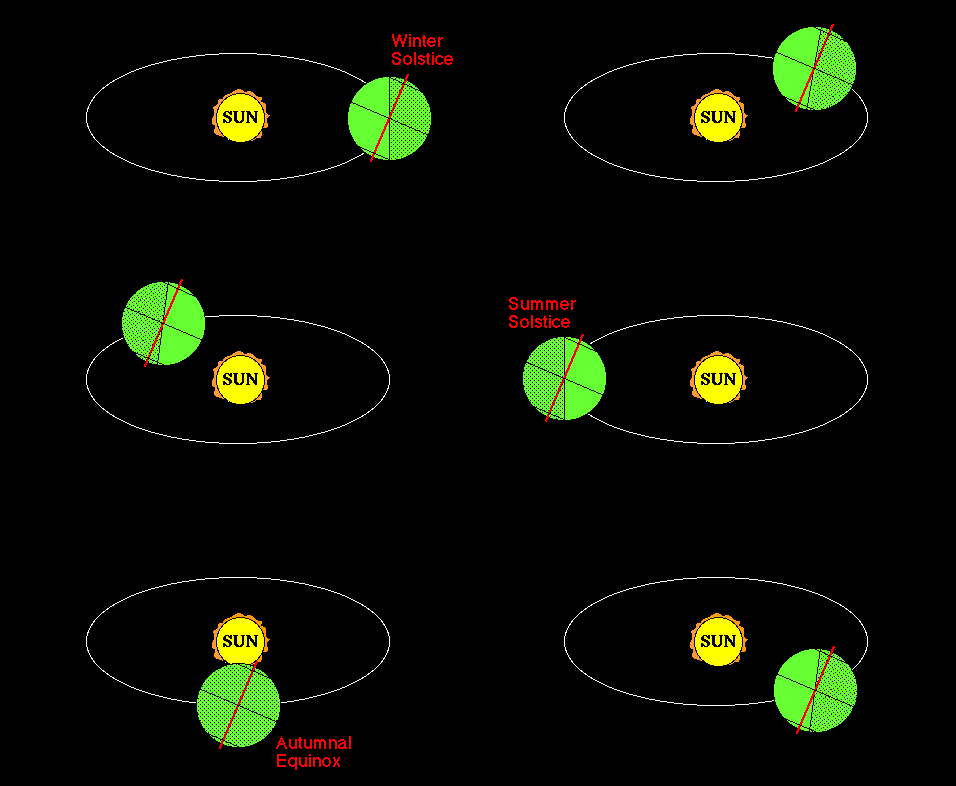
The orbiting of one object around another
a)
Revolution
b)
Rotation
c)
Exploration
d)
All of These
10.

The spinning of a an object on its axis
a)
Rotation
b)
Revolution
c)
Orbit
d)
All of These
11.

An object in space that produces its own heat and light
a)
Star
b)
Comet
c)
Meteor
d)
Asteroid
12.

The actual, measured brightness of a star
a)
Absolute Magnitude
b)
Apparent Magnitude
c)
Black Hole
d)
All of These
13.
The perceived brightness of a star as seen from Earth (affected by star size, temperature, & distance from Earth)
a)
Apparent Magnitude
b)
Absolute Magnitude
c)
White Dwarf
d)
All of These
14.

The idea that explains the origin of the universe
a)
The Big Bang Theory
b)
The Geocentric Theory
c)
The Heliocentric Theory
d)
All of These
15.

A region of space having a gravitational field so intense that no matter or light can escape
a)
Black Hole
b)
White Dwarf
c)
Red Giant
d)
Eliptical Galaxy
16.

A small, dead star that is so hot it is still giving off light
a)
Dwarf Star
b)
Black Hole
c)
Red Giant
d)
All of These
17.

All of the frequency or wavelengths of EM radiation; travel in waves through space
a)
Electromagnetic Spectrum
b)
Microwaves
c)
Radio Waves
d)
Ultraviolet Waves
18.

A type of galaxy shaped like an ellipse; not flat and no arms (football-shaped)
a)
Elliptical Galaxy
b)
Spiral Galaxy
c)
Irregular Galaxy
d)
All of These
19.

The rate at which something occurs per unit time
a)
Frequency
b)
Wavelength
c)
Electromagnetic Spectrum
d)
None of These
20.

The stage after main sequence in which an older star gets many times larger
a)
Giant Star
b)
Black Hole
c)
Dwarf Star
d)
None of These
21.

A scatter graph of stars showing the relationship between luminosity (brightness) and temperature
a)
Hertzsprung-Russell Diagram
b)
Electromagnetic Spectrum
c)
Life Cycle of Stars
d)
All of These
22.

A galaxy with no specific shape
a)
Irregular Galaxy
b)
Spiral Galaxy
c)
Elliptical Galaxy
d)
None of These
23.

The stages a star goes through from birth to death depending on its mass
a)
Life Cycle of a Star
b)
Light Year
c)
Luminosity
d)
All of These
24.

The visible spectrum of colors that vary in wavelength
a)
Light wave
b)
Frequency
c)
Light Year
d)
All of These
25.

A unit of measure equal to the distance light travels in one year; used to measure huge distances between objects in space.
a)
Light Waves
b)
Light Year
c)
Luminosity
d)
All of These
26.

The brightness of a star
a)
Luminosity
b)
Light Year
c)
Light Wave
d)
None of These
27.

The measure of the brightness of a star
a)
Magnitude
b)
Nebula
c)
Light-Year
d)
None of These
28.

A cloud of dust and gas in space; usual birthplace of stars
a)
Nebula
b)
Luminosity
c)
Irregular Galaxy
d)
All of These
29.

The part of the electromagnetic spectrum with low frequencies & longer wavelengths; used to communicate through space & observe stars
a)
Radio Wave
b)
Ultraviolet
c)
Microwaves
d)
Gamma
30.

The lengthening of the wavelength of light causing a shift towards the red end of the spectrum due to the star/galaxy moving away from Earth
a)
Red Shift
b)
Blue Shift
c)
Speed of Light
d)
All of These
31.

The distance light can travel in a unit of time through space; 300,000 km/s
a)
Speed of Light
b)
Red Shift
c)
Light Year
d)
All of These
32.

A flat, disc-shaped galaxy arms of stars spiraling out from the core
a)
Spiral Galaxy
b)
Irregular Galaxy
c)
Elliptical Galaxy
d)
None of These
33.

A very large star, bigger than a giant that is very bright
a)
Supergiant Star
b)
Black Hole
c)
White Dwarf
d)
Red Giant
34.

All of the matter and space as a whole including nebula, stars, planets and moons
a)
Universe
b)
Galaxy
c)
Solar System
d)
All of These
35.

The back-and-forth motion that travels from one place to another
a)
Wave
b)
Amplitude
c)
Frequency
d)
All of These
36.
The distance between two adjacent crests or two adjacent troughs
a)
Wavelength
b)
Amplitude
c)
Light Year
d)
All of These
37.

The measure of the amount of energy in a wave; distance above or below the rest position
a)
Amplitude
b)
Wavelength
c)
Magnitude
d)
All of These
38.

The average distance between the Earth and Sun
a)
Astronomical Unit
b)
Light Year
c)
Wavelength
d)
All of These
39.

The change in the apparent frequency of a wave due to the sources motion towards or away from the viewer
a)
Doppler Effect
b)
Wavelength
c)
Amplitude
d)
None of These
40.

This theory stated that the Earth was the center of the universe
a)
Geocentric
b)
Heliocentric
c)
Big Bang
d)
All of These
41.

This theory stated that the Sun was the center of the universe
a)
Heliocentric
b)
Geocentric
c)
Big Bang
d)
None of These
100 %

