
 Worksheets
Unit 3 Review for midterm
Total questions: 20
Worksheet time: 17mins
Name
Class
Date
1.

Which atom has the largest atomic radius?
a)
potassium (K)
b)
rubidium (Rb)
c)
francium (Fr)
2.
As you move down the periodic table atoms get bigger. This is because ____________.
a)
The atoms have more mass.
b)
The atoms have more protons.
c)
The atoms have more energy levels
d)
The atoms have more nuetrons
3.
Atoms that have a high electronegativity, _______________.
a)
give up their electrons more easily.
b)
hold on to their electrons more tightly.
c)
have more electron shells.
4.

Which of the following will have a higher electronegativity than arsenic (As)?
a)
Carbon (C)
b)
Neon (Ne)
c)
Antimony (Sb)
d)
Germanium (Ge)
5.
Ionization energy is...
a)
the energy required to add an electron to a specific atom
b)
how much energy it takes to remove an electron from an atom
c)
the energy required to shield the outer electrons from the nucleus
d)
a measure of the ability of an atom to attract electrons
6.

Which of the following will have a lower ionization energy than Scandium (Sc)?
a)
Helium (He)
b)
Titanium (Ti)
c)
Calcium (Ca)
d)
Magnesium (Mg)
7.
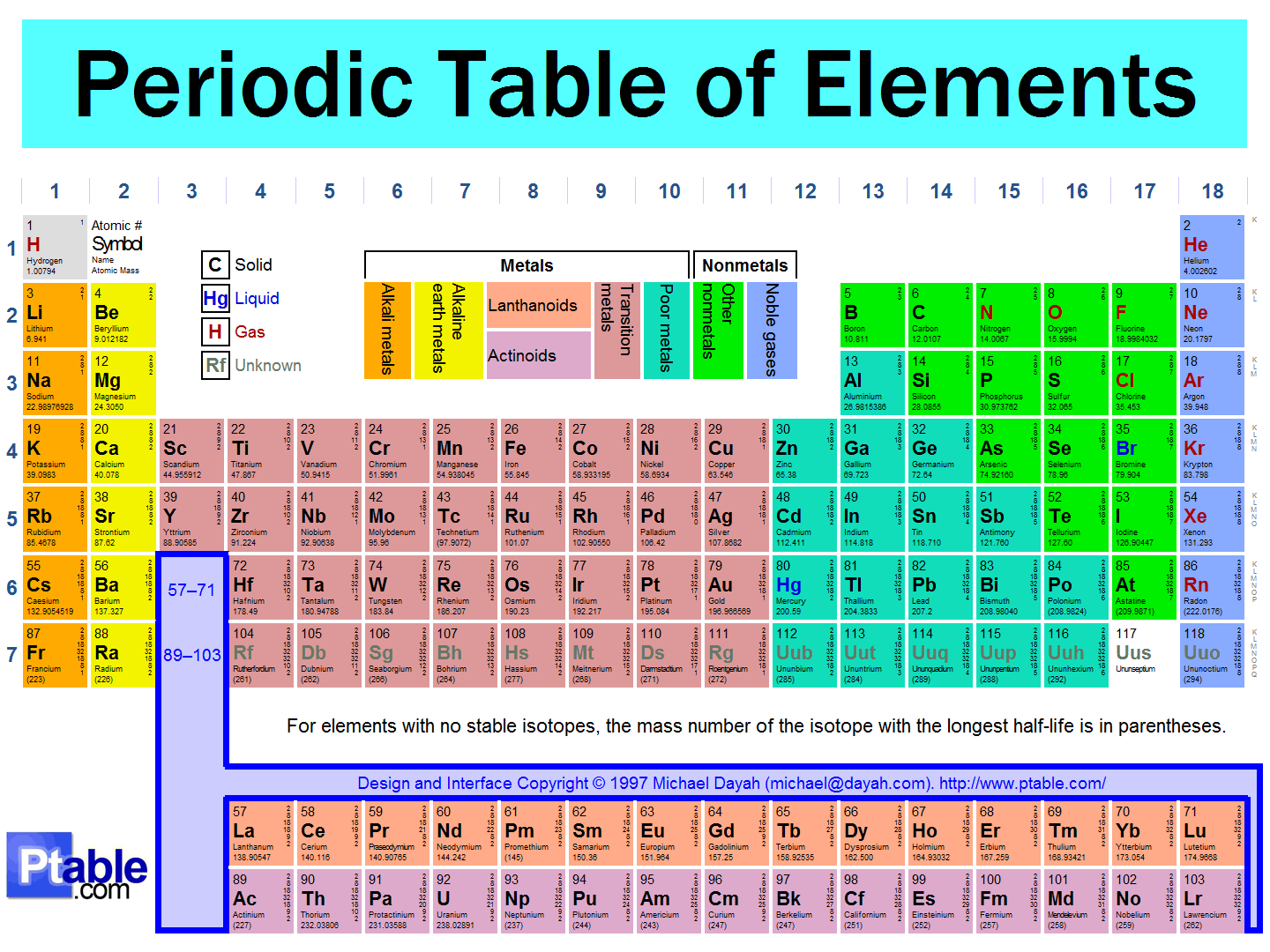
The horizontal row on the periodic table is called a
a)
group
b)
family
c)
period
d)
atomic number
8.

A vertical column is called...
a)
group
b)
tower
c)
period
d)
crew
9.

The yellow atoms are called
a)
metals
b)
nonmetals
c)
metalloids
d)
noble gases
10.
Elements in the same ________ are more chemically similar.
a)
group
b)
period
c)
club
d)
table
11.
How many valence electrons are elements trying to reach in their outer shells?
a)
1
b)
2
c)
5
d)
8
12.
What determines the reactivity of an element?
a)
Size of its nucleus
b)
Number of total electrons
c)
Number of valence electrons
d)
Number of shells
13.
How do you determine the number of valence electrons an element has?
a)
Look at its period
b)
Look at its group
c)
Look at its atomic number
d)
Look at its atomic mass
14.

How many electrons does Calcium (Ca) need to lose to become stable?
a)
1
b)
2
c)
3
d)
4
15.

How many electrons does oxygen (O) need to gain to become stable?
a)
1
b)
2
c)
3
d)
4
16.

The atoms along the staircase are called
a)
metals
b)
nonmetals
c)
metalloids
d)
noble gases
17.
Elements on the left side of the periodic table are
a)
metals
b)
nonmetals
c)
metalloids
d)
noble gases
18.
Which of the following is not a property of metals?
a)
brittle
b)
malleable
c)
lustrous
d)
conductive
19.
The noble gases have how many valence electrons?
a)
1
b)
2
c)
7
d)
8
20.
How many Valance electrons does Iodine Have?
a)
6
b)
16
c)
7
d)
17
100 %

