
 Worksheets
Regents Chemistry Midterm Review #1
Total questions: 105
Worksheet time: 2hrs 2mins
Name
Class
Date
1.
The temperature of a sample of matter is a measure of the
a)
average potential energy of the particles of the sample
b)
average kinetic energy of the particles of the sample
c)
total nuclear energy of the sample
d)
total thermal energy of the sample
2.

The mass of a proton is approximately equal to...
a)
1 atomic mass unit.
b)
12 atomic mass units.
c)
the mass of 1 mole of carbon atoms.
d)
the mass of 12 moles of electron.
3.

Which term refers to how strongly an atom of an element attracts electrons in a chemical bond with an atom of a different element?
a)
entropy
b)
electronegativity
c)
activation energy
d)
first ionization energy
4.

A substance composed of two or more elements that are chemically combined in a fixed proportion is called...
a)
a mixture
b)
a solution
c)
an isotope
d)
a compound
5.
The nucleus of an atom is ____.
a)
the central core and is composed of protons and neutrons
b)
positively charged and has more protons than neutrons
c)
negatively charged and has a high density
d)
negatively charged and has a low density
6.
The atomic number of an element is the total number of which particles in the nucleus?
a)
protons
b)
electrons
c)
neutrons
d)
quarks
7.
The sum of the protons and neutrons in an atom equals the ____.
a)
mass number
b)
atomic number
c)
average atomic number
d)
a very large number
8.

The atoms along the staircase are called
a)
metals
b)
nonmetals
c)
metalloids
d)
noble gases
9.
Which group of the periodic table is composed of inert (not reactive) gases?
a)
alkali metals
b)
alkaline earth metals
c)
halogens
d)
noble gases
10.
As atoms of elements in group 16 are considered in order from top to bottom, the electronegativity of each successive element....
a)
decreases
b)
increases
c)
remains the same
d)
none of the above
11.
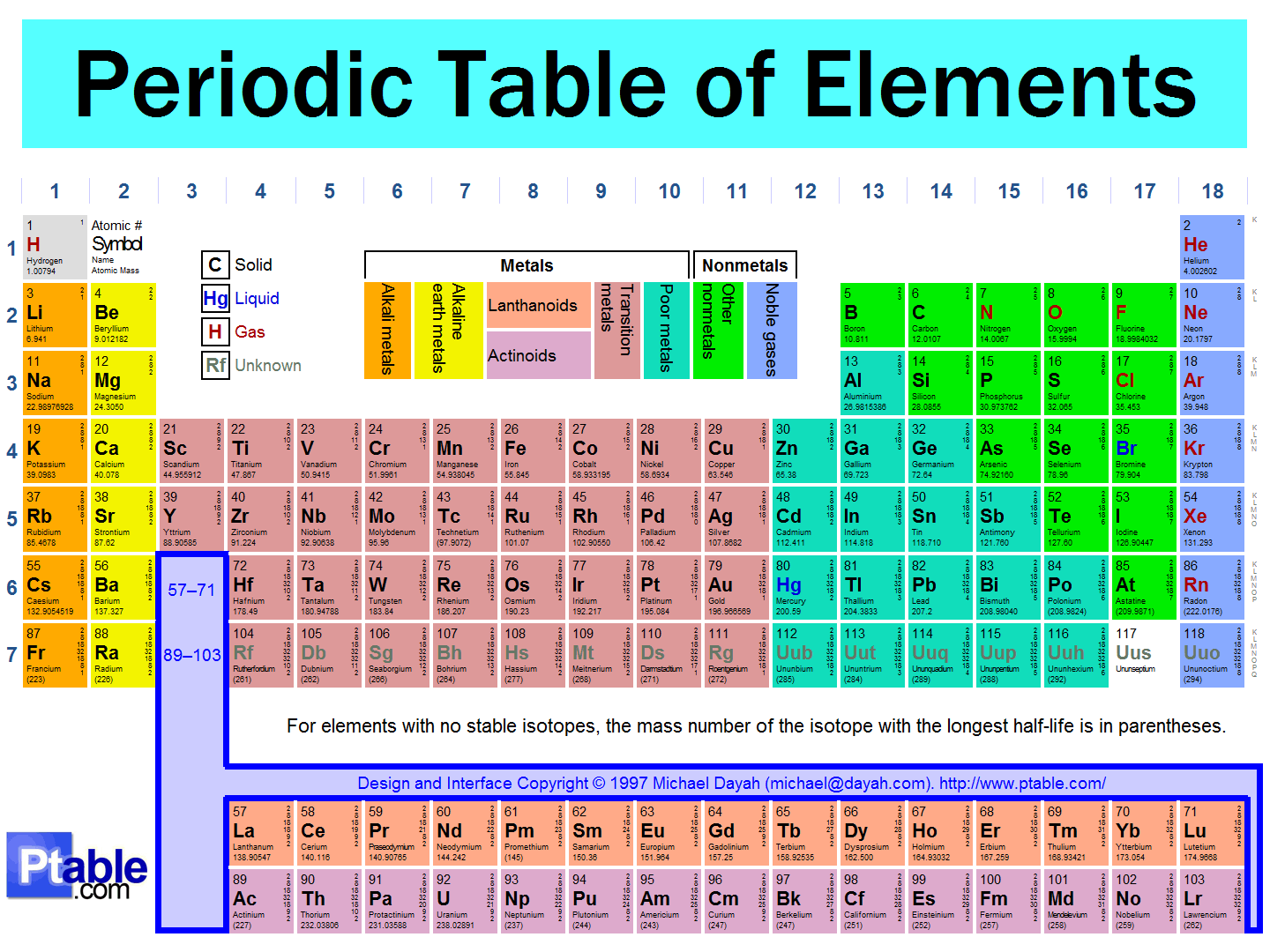
A vertical column is called...
a)
group
b)
tower
c)
period
d)
crew
12.
The atomic number tells you what?
a)
number of electrons
b)
number of protons
c)
number of neutrons
d)
both electrons and protons in an atom.
13.
How many neutrons does an atom of argon-41 contain? (elemental symbol: Ar)
a)
18
b)
41
c)
23
d)
39
14.
Who discovered the electron?
a)
J.J. Thomson
b)
Ernest Rutherford
c)
John Dalton
d)
Niels Bohr
15.
How many protons does an atom of Barium (Ba) contain?
a)
56
b)
65
c)
5
d)
137
16.
Who was the first person to support is atomic theory with scientific evidence?
a)
J.J. Thomson
b)
Ernest Rutherford
c)
John Dalton
d)
Democritus
17.
What is the best explanation of how light is emitted from an atom
a)
Electrons emitted from the nucleus in an atom
b)
Gamma rays from radioactive atoms
c)
Electrons falling from a higher to a lower energy level in an atom
d)
Electrons being excited from a lower to a higher energy level in an atom
18.
If a substance is ________ , it can be pounded into shapes. This is a property of a metal.
a)
ductile
b)
malleable
c)
magnetic
d)
reactive
19.
Which has a charge of +1?
a)
proton
b)
neutron
c)
electron
d)
atom
20.
Choose a physical property
a)
The element is flammable
b)
The element explodes when exposed to air
c)
The element is shiny
d)
The elements reacts with HCl
21.
Which group has the most reactive nonmetals?
a)
halogen
b)
noble gases
c)
alkali metals
d)
alkaline earth metals
22.

Which scientist developed the model of the atom shown?
a)
Rutherford
b)
Bohr
c)
Chadwick
d)
Dalton
23.
What is the answer (in sig figs) to the following:
3.0+4.15
3.0+4.15
a)
7.15
b)
7.2
c)
7.1
d)
7
24.
According to the wave-mechanical model of the atom, an orbital is a region of the most probable location of
a)
an alpha particle
b)
a gamma ray
c)
an electron
d)
a proton
25.
Which particles have approximately the same mass?
a)
an electron and an alpha particle
b)
an electron and a proton
c)
a neutron and an alpha particle
d)
a neutron and a proton
26.
During a flame test, a lithium salt produces a characteristic red flame. This red color is produced when electrons in excited lithium atoms
a)
are lost by the atoms
b)
are gained by the atoms
c)
return to lower energy states within the atoms
d)
move to higher energy states within the atoms
27.
Compared to the energy and charge of the electrons in the first shell of a Be atom, the electrons in the second shell of this atom have
a)
less energy and the same charge
b)
less energy and a different charge
c)
more energy and the same charge
d)
more energy and a different charge
28.
Which quantity can vary among atoms of the same element?
a)
mass number
b)
atomic number
c)
number of protons
d)
number of electrons
29.
Which substances have atoms of the same element but different molecular structures?
a)
He(g) and Ne(g)
b)
O2(g) and O3(g
c)
K(s) and Na(s)
d)
P4(s) and S8(s)
30.
An atom that has 13 protons and 15 neutrons is an isotope of the element
a)
nickel
b)
silicon
c)
aluminum
d)
phosphorus
31.
Which elements have the most similar chemical properties?
a)
Si, As, and Te
b)
N2, O2, and F2
c)
Mg, Sr, and Ba
d)
Ca, Cs, and Cu
32.
Compared to the charge of a proton, the charge of an electon has
a)
a greater magnitude and the same sign
b)
a greater magnitude and the opposite sign
c)
the same magnitude and the same sign
d)
the same magnitude and the opposite sign
33.
Which atom has the largest atomic radius?
a)
potassium
b)
rubidium
c)
francium
d)
cesium
34.
When an excited electron in an atom moves to the ground state, the electron
a)
absorbs energy as it moves to a higher energy state
b)
absorbs energy as it moves to a lower energy state
c)
emits energy as it moves to a higher energy state
d)
emits energy as it moves to a lower energy state
35.
The atomic mass of magnesium is the weighted average of the atomic mass of
a)
all of the artificially produced isotopes of Mg
b)
all of the naturally occuring isotopes of Mg
c)
the two most abundant artificially produced isotopes of Mg
d)
the two most abundant naturally occuring isotopes of Mg
36.
Which element has atoms with the strongest attraction for electrons in a chemical bond?
a)
chlorine
b)
nitrogen
c)
fluorine
d)
oxygen
37.
Which sample of copper has atoms with the lowest average kinetic energy?
a)
10. g at 45 degrees C
b)
20. g at 35 degrees C
c)
30. g at 25 degrees C
d)
40. g at 15 degrees C
38.
Which change results in the formation of different substances?
a)
burning of propane
b)
melting of NaCl(s)
c)
deposition of CO2(g)
d)
solidification of water
39.
Which substance can not be broken down by a chemical change?
a)
ammonia
b)
ethanol
c)
propanal
d)
zirconium
40.
Which element is a liquid at STP?
a)
bromine
b)
cesium
c)
francium
d)
iodine
41.
The accepted value for the percent by mass of water in a hydrate is 36.0%. In a laboratory activity, a student determined the percent by mass of water in the hydrate to be 37.8%. What is the percent error for the student's measured value?
a)
5.00%
b)
4.80%
c)
1.80%
d)
0.05%
42.

Which line segment of the graph represents boiling?
a)
line AB
b)
line BC
c)
line CD
d)
Line DE
43.
At standard pressure, the total amount of heat required to completely vaporize a 100-gram sample of water at its boiling points is
a)
2.26 x 10 J
b)
2.26 x 10² J
c)
2.26 x 10³ J
d)
2.26 x 10⁵J
44.
A sample of helium gas is in a sealed, rigid container. What occurs as the temperature of the sample is increased?
a)
the mass of the sample decreases
b)
the number of moles of gas increases
c)
the volume of each atom decreases
d)
the frequency of collisions between atoms increases
45.
One beneficial use of radioisotopes is
a)
detection of disease
b)
neutralization of an acid spill
c)
decreasing the dissolved O2(g) level in seawater
d)
increasing the concentration of CO2(g) in the atmosphere
46.

Which diagram represents a mixture of two different molecular forms of the same element?
a)
1
b)
2
c)
3
d)
4
47.
Which list of elements consists of a metal, a metalloid, and a nonmetal?
a)
Li, Na, Rb
b)
Cr, Mo, W
c)
Sn, Si, C
d)
O, S, Te
48.
The mass of a proton is approximately equal to the mass of
a)
an alpha particle
b)
a beta particle
c)
a neutron
d)
a positron
49.
What quantities must be conserved in all chemical reactions?
a)
mass, charge, density
b)
mass, charge, energy
c)
charge, volume, density
d)
charge, volume, energy
50.

Which equation represents natural transmutation?
a)
1
b)
2
c)
3
d)
4
51.

During which time interval is the average kinetic energy of the particles of the substance constant while the potential energy of the particle increases?
a)
AC
b)
BC
c)
CD
d)
DF
52.
A substance is classified as either an element or a
a)
compound
b)
solution
c)
heterogeneous mixture
d)
homogeneous mixture
53.
Which phrase describes an atom?
a)
a negatively charged nucleus surrounded by positively charged protons
b)
a negatively charged nucleus surrounded by positively charged electrons
c)
a positively charged nucleus surrounded by negatively charged protons
d)
a positively charged nucleus surrounded by negatively charged electrons
54.
Which general trend is found in Period 3 as the elements are considered in order of increasing atomic number?
a)
increasing atomic radius
b)
increasing electronegativity
c)
decreasing atomic mass
d)
decreasing first ionization energy
55.
A bromine atom in an excited state could have an electron configuration of
a)
2-8-18-6
b)
2-8-18-7
c)
2-8-17-7
d)
2-8-17-8
56.
At STP, which physical property of aluminum always remains the same from sample to sample?
a)
mass
b)
density
c)
length
d)
volume
57.
Which unit is used to express the pressure of a gas?
a)
mole
b)
joule
c)
kelvin
d)
pascal
58.
The elements in Group 2 have similar chemical properties because each atom of these elements has the same
a)
atomic number
b)
mass number
c)
number of electron shells
d)
number of valence electrons
59.

Which numerical setup can be used to determine the atomic mass of lithium?
a)
(0.075)(6.02 u) + (0.925)(7.02 u)
b)
(0.925)(6.02 u) + (0.075)(7.02 u)
c)
(7.5)(6.02 u) + (92.5)(7.02 u)
d)
(92.5)(6.02 u) + (7.5)(7.02 u)
60.
Which substance can not be broken down by a chemical change?
a)
ammonia
b)
arsenic
c)
ethane
d)
propanal
61.
You are heating a substance in a test tube. Always point the open end of the tube
a)
toward yourself.
b)
toward your lab partner.
c)
toward another lab station.
d)
away from all people.
62.
The state of matter that takes the shape of its container is....
a)
Gas
b)
Solid
c)
Liquid
d)
None of these
63.
Which conclusion was drawn from the results of the gold foil experiment?
(1) An atom is electrically neutral.
(2) An atom is mostly empty space.
(3) The nucleus of an atom is negatively charged.
(4) The electrons in an atom are located in specific shells.
(1) An atom is electrically neutral.
(2) An atom is mostly empty space.
(3) The nucleus of an atom is negatively charged.
(4) The electrons in an atom are located in specific shells.
a)
1
b)
2
c)
3
d)
4
64.
Which group on the Periodic Table has at least one element in each of the three phases of matter at STP?
a)
1
b)
2
c)
17
d)
18
65.

Given the diagram, an arrow representing the path of an emitted beta particle in the electric field between two oppositely charged metal plates would bend
a)
up
b)
down
c)
left
d)
right
66.

A sample of a substance is a liquid at 65°C. The sample is heated uniformly to 125°C. The heating curve for the sample at standard pressure is shown below.
Determine the boiling point of the sample at standard pressure
Determine the boiling point of the sample at standard pressure
a)
95°C
b)
125°C
c)
100°C
d)
65°C
67.
Which net change occurs in a nuclear fusion reaction?
a)
Ionic bonds are broken.
b)
Ionic bonds are formed.
c)
Energy is converted to mass.
d)
Mass is converted to energy.
68.
The ratio of chromium to iron to carbon varies among the different types of stainless steel. Therefore, stainless steel is classified as
a)
a compound
b)
a mixture
c)
an element
d)
a substance
69.
Based on Table S, an atom of which element has the weakest attraction for electrons in a chemical bond?
a)
polonium
b)
selenium
c)
sulfur
d)
tellurium
70.
Which units of measurement are used for volume?
a)
grams
b)
centimeters
c)
grams/milliliter
d)
milliliter
71.

The density of this material is 2 g/cm3.
There are 24 cm3 Find the total mass.
There are 24 cm3 Find the total mass.
a)
12 grams
b)
48 grams
c)
12 g/cm3
d)
48 g/cm3
72.

Why is coffee a homogeneous mixture?
a)
It has the same composition and appearance throughout the mixture
b)
There are visible differences within the mixture
c)
There are some differences and similarities
d)
It is mixed once stirred
73.
How many significant figures does the following number have: 0.002040
a)
6
b)
4
c)
3
d)
2
74.
Round 1047.78 to three sig figs
a)
104
b)
105
c)
1050
d)
1050.00
75.
How many sig figs are there?
4000.
4000.
a)
1
b)
3
c)
4
76.
Determine the number of Significant Figures in 10-L.
a)
4
b)
3
c)
2
d)
1
77.
Determine the number of Significant Figures in 10.0-g
a)
5
b)
4
c)
3
d)
2
78.
Which measurement is the most precise?
a)
23
b)
23.5
c)
23.59
d)
23.590
79.
Calculate 7.987 m - 0.54 m and give your answer with the correct number of significant figures.
a)
7.45 m
b)
7.447 m
c)
7.4 m
d)
7.5 m
80.
Calculate 1.23 m x 0.89 m and give your answer with the correct number of significant figures.
a)
1.0 m2
b)
1.1 m2
c)
1.0947 m2
d)
1.095 m2
81.
Calculate 923 g ÷ 20312 cm3 and give your answer with the correct number of significant figures.
a)
0.04 g/cm3
b)
0.045 g/cm3
c)
0.0454 g/cm3
d)
0.05 g/cm3
82.

What is a valence electron?
a)
electrons in the second energy level
b)
electrons in the outermost energy level
c)
the atomic number
d)
electrons in the first level
83.

the formula of this atom when it becomes an ion would be
a)
N-2
b)
N+3
c)
N-3
d)
N+2
84.
THE NUMBER OF ELECTRONS IN THIS PARTICLE WOULD BE
17Cl-1
17Cl-1
a)
17
b)
19
c)
16
d)
18
85.

the electron configuration of calcium ion is
a)
2,8,8,2
b)
2,8,8
c)
2,2,8
d)
2,8
86.
Atoms that gain electrons become...
a)
negatively charged (anions)
b)
positively charged (cations)
c)
remain neutrally charged
d)
21
87.
METALS are more likely to LOSE electrons, so they tend to form ...
a)
anions
b)
cations
c)
neutral atoms
d)
negative ions
88.
Nonmetals form ____ by ____ electrons.
a)
Cations, gaining
b)
Cations, losing
c)
Anions, gaining
d)
Anions, losing
89.
Ionization Energy is defined as.....
a)
The smallest amount of energy possible to excite an electron to a higher energy level
b)
The amount of energy given off when an electron returns to a ground state
c)
The amount of energy in one photon
d)
The energy required to remove one electron from a neutral atom
90.
Most elements will gain or lose electrons so that they end up with _______ valence electrons.
a)
2
b)
6
c)
8
d)
10
91.

This could be the dot diagram of
a)
P
b)
Ar
c)
Na
d)
B
92.
Electronegativity is...
a)
how good an atom is at attracting electrons
b)
the ability of an atom to lose electrons
c)
the energy required to remove an electron from a specific atom
d)
how easy it is to make friends.
93.
How many electrons should Oxygen have around its Lewis dot model?
a)
5
b)
6
c)
7
d)
8
94.
Whose law states that as pressure goes up, volume goes down?
a)
Charles
b)
Boyle
c)
Aglow
d)
Mazias
95.
Charles's Law states that
a)
As Pressure goes up volume goes down
b)
As Pressure goes up temperature goes up
c)
As Volume goes up temperature goes up
d)
As Pressure goes down volume goes down
96.
What will happen to the volume of a gas under constant temperature if the pressure increases?
a)
Increase
b)
Decrease
c)
Nothing
d)
Explosion!
97.
You have a gas that has a pressure of 2.0 atm and a volume of 10.0L. What would be the new volume if the pressure was changed to 1.0 atm?
a)
5.0 L
b)
20.0 L
c)
It would stay at 10L
d)
1.0 L
98.
A helium balloon with a volume of 1.8L at 1.0 atm and 293K is released into the air. As it rises, the pressure drops to 0.7atm and the temperature drops to 263K
a)
2.31 L
b)
0.43 L
c)
1.50 L
d)
2.57 L
99.
If the half-life of uranium-232 is 70 years, how many half-lives will it take for 10 g of it to be reduced to 1.25 g?
a)
1 half-life
b)
2 half-lives
c)
3 half-lives
d)
4 half-lives
100.
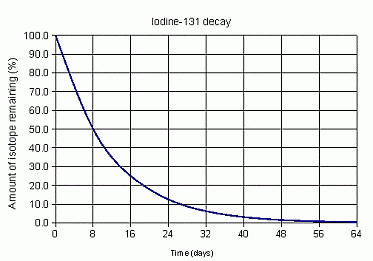
What is the half-life of iodine-131?
a)
32 days
b)
8 days
c)
16 days
d)
24 days
101.
Put these in order of most penetrating to least penetrating.
a)
beta, alpha, gamma
b)
gamma, alpha, beta
c)
gamma, beta, alpha
d)
alpha, beta, gamma
102.
Unstable isotopes undergo radioactive decay. What occurs during radioactive decay?
a)
Unstable isotopes collapse in on themselves.
b)
The electrons in unstable isotopes constantly move to higher energy levels within the electron cloud.
c)
Unstable isotopes release charged particles.
d)
Unstable isotopes capture charged particles from other atoms
103.
For the following nuclear reaction, what was the beginning radionuclide (X)?
X → 86Rn222 + 2He4
X → 86Rn222 + 2He4
a)
Radium-222
b)
Radon-222
c)
Radon-226
d)
Radium-226
104.
Balance the following reaction and choose the type of decay.
54Xe118 → X + 55Cs118
54Xe118 → X + 55Cs118
a)
alpha emission
b)
neutron activation
c)
beta emission
d)
gamma emission
105.
Which of the following types of nuclear decay produces particles that are identical to the helium nucleus.
a)
Beta
b)
Delta
c)
Gamma
d)
Alpha
100 %

