
NEW
Font size
S
M
L
XL
 Worksheets
Space Objects and Tools
Total questions: 66
Worksheet time: 53mins
Name
Class
Date
1.

Which planets are closest to the sun?
a)
Dwarf planets.
b)
Gas planets.
c)
Terrestrial planets.
2.

What lies between Mars and Jupiter?
a)
Asteroid Belt
b)
Kuiper Belt
c)
Oort Cloud
3.

Why do planets and other space object orbit the sun?
a)
Greatest distance, greatest gravitational force
b)
Greatest mass, greatest gravitational force
c)
Only star, only object with gravitational force
4.

What do we call space debris that burns up in Earth's atmosphere, creating a streak of light (shooting star)?
a)
Meteorites
b)
Meteors
c)
Meteoroids
5.
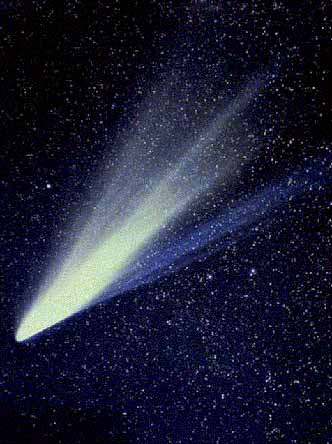
What does the image show?
a)
Asteroid
b)
Comet
c)
Meteor
6.

The outer most planets, jovial planets, are sometimes called __________.
a)
Dwarf
b)
Gas planets (or giants)
c)
Terrestrial planets
7.

What do we call small space rocks that successfully enters Earth's atmosphere and reach the ground?
a)
Meteorites
b)
Meteoroids
c)
Meteors
8.
What do we call small space rocks that burn up in Earth's atmosphere, creating a streak of light (shooting star)?
a)
Meteorites
b)
Meteors
c)
Meteoroids
9.

A small object that enters Earth's atmosphere from space and burns due to friction, emitting light.
a)
meteor
b)
comet
c)
asteroid
d)
star
10.

The__________ belt falls between Mars and Jupiter.
a)
Asteroid
b)
Meteor
c)
Comet
11.

What do comets orbit
a)
The Stars
b)
The Planets
c)
The Sun
12.
A chunk of rock or dust in space is called a __.
a)
meteroite
b)
asteroid
c)
comet
d)
meteoroid
13.
What object is made of ice?
a)
meteor
b)
comet
c)
asteroid
d)
meteorite
14.
Which one travels in an elongated, elliptical orbit around the sun?
a)
asteroid
b)
comet
c)
meteor
d)
meteorite
15.

A shooting star is actually a...
a)
Comet
b)
Meteoroid
c)
Meteorite
d)
Meteor
16.
The__________ belt falls between Mars and Jupiter.
a)
Asteroid
b)
Meteor
c)
Comet
17.

What instrument would you use to look at the stars?
a)
Microscope
b)
Telescope
c)
Magnifying Glass
d)
Binoculars
18.

What is located at the center of our Solar System?
a)
Earth
b)
Our Moon
c)
The Sun
d)
The Asteroid Belt
19.

The curved path of an object around another object or a point in space.
a)
circle
b)
elipse
c)
orbit
d)
trapizoid
20.

A celestial body that revolves around a planet.
a)
moon
b)
star
c)
comet
d)
meteor
21.
Which space object is larger?
a)
Asteroid
b)
Meteoroid
22.

Where do meteoroids NOT occur?
a)
Throughout the solar system
b)
In the asteroid belt
c)
On Earth
23.
Sometimes called "dirty snowballs".
a)
asteoids
b)
meteoroids
c)
comets
d)
meteors
24.
What are the jovial (outer) planets composed of ?
a)
rock
b)
gas
c)
dust
25.
The order of the planets is:
a)
Mars,Venus,Earth,
Mercury,Saturn
Jupiter, Uranus, Neptune
Mercury,Saturn
Jupiter, Uranus, Neptune
b)
Earth,Venus,Mars
Jupiter, Neptune,
Mercury,Saturn,
Uranus
Jupiter, Neptune,
Mercury,Saturn,
Uranus
c)
Mercury,Venus,Earth
Mars,Jupiter,
Saturn,Uranus
Neptune
Mars,Jupiter,
Saturn,Uranus
Neptune
26.
What is NOT a common characteristic of the outer planets?
a)
Gaseous
b)
Giant
c)
Rings
d)
Smaller than Earth
27.
What is in between the inner planets and the outer planets?
a)
Asteroid belt
b)
Kuiper belt
c)
Sun
d)
Moon
28.
The spinning of the Earth on its axis that causes night and day.
a)
Rotate
b)
Revolve
29.
It takes Earth _________ to make one complete rotation on its axis.
a)
24 hours
b)
365 days
c)
28 days
d)
24 days
30.
It takes Earth _____________ to make one revolution or orbit around the Sun.
a)
365 days
b)
365 hours
c)
28 days
d)
24 hours
31.
There are thousands of these orbiting the Earth. They send information to the Earth about the universe, weather, and cell phones.
a)
space probes
b)
space shuttle
c)
space station
d)
satellite
32.
This type of telescope can see light that is not visible.
a)
blind telescope
b)
radio telescope
c)
invisible telescope
d)
shuttle telescope
33.
These can carry cameras and other equipment far out into the solar system.
a)
satellite
b)
rover
c)
space shuttle
d)
space probe
34.
This is a place where astronauts can stay in space while they are gathering information.
a)
satellite
b)
lander
c)
space station
d)
Hubble Telescope
35.

The best thing about radio telescopes is:
a)
They can receive data any time of day and in any weather
b)
They can receive very high frequency signals
c)
They receive gamma rays
d)
They can intercept signals between planets
36.

Spectrascopes use bands of color to identify:
a)
Mass of star
b)
The elements in the star
c)
The weight of the star
d)
The sounds the star makes
37.

The space instrument that travels beyond our solar system are:
a)
Space probes
b)
Satellites
c)
Observatories
d)
Telescopes
38.

Unmanned space probes are used to explore outer space because:
a)
They are inexpensive
b)
They are extremely large
c)
It's too dangerous for humans
d)
It's too hard to see things far away
39.

A refracting telescope uses:
a)
Lens
b)
Mirrors
c)
Lens and mirrors
d)
Transmitters
40.

Which is NOT a space tool?
a)
Refracting telescope
b)
Reflecting telescope
c)
Spectrascopes
d)
Prisms
41.

What are the two types of optical telescopes?
a)
Reflecting/Rarefaction
b)
Compressional/Longitudinal
c)
Reflecting/Longitudinal
d)
Refracting/Reflecting
42.

What space tool leaves a planets orbit and travels to places too dangerous for man.
a)
solar probe
b)
space probe
c)
spectroscope
43.
What object is launched into orbit and designed to send and receive information?
a)
rover
b)
satellite
c)
space shuttle
44.
Both reflecting and refracting telescopes are designed to
a)
break visible light into colors of the spectrum.
b)
separate visible light from ultraviolet and radio waves.
c)
gather and focus visible light.
d)
work better with short-wavelength radiation.
45.
Reflecting telescopes differ from refracting telescopes in having
a)
no eyepiece lens.
b)
two large objective lenses.
c)
a mirror instead of an objective lens.
d)
one large objective lens.
46.
A ______ telescope uses a mirror to focus light onto a small area.
a)
reflecting
b)
refracting
c)
radio
d)
spectrum
47.
About how many days does it take to moon to go through a complete cycle?
a)
7 days
b)
365 days
c)
29 days
d)
20 days
48.

When the Earth is between the moon and sun, it is most likely a:
a)
new moon
b)
full moon
c)
waxing crescent
d)
waxing gibbous
49.

How long does it take the moon to complete an orbit around Earth?
a)
23 days
b)
29 days (1 month)
c)
2 weeks (half a month)
d)
365 days (a year)
50.

The Moon orbits Earth in a ________________ direction
a)
clockwise
b)
counterclockwise
c)
upwards
d)
downwards
51.

Name the moon phase
a)
Waxing Gibbous
b)
Waxing Crescent
c)
Waning Crescent
d)
Waning Gibbous
52.

Name the moon phase
a)
Waning Crescent
b)
Waxing Crescent
c)
Waning Gibbous
d)
Waxing Gibbous
53.
The 1st Quarter moon is lit on the:
a)
Left Side
b)
Right Side
54.

Which season is taking place in the Northern Hemisphere in Position 3?
a)
Winter
b)
Spring
c)
Summer
d)
Fall
55.

Which season is taking place in the Northern Hemisphere in Position 3?
a)
Winter
b)
Spring
c)
Summer
d)
Fall
56.

Which season is taking place in the Northern Hemisphere in Position 4?
a)
Winter
b)
Spring
c)
Summer
d)
Fall
57.
The Earth's axis is tilted _____ degrees.
a)
23.5
b)
25.3
c)
30.2
d)
24
58.

At position A, which hemisphere would have summer?
a)
Northern hemisphere
b)
Southern hemisphere
59.
What do June 21 and December 21 have in common?
a)
equinox dates
b)
the moon is full
c)
solstice dates
d)
the cold fronts blow in
60.
The term equinox means....
a)
equal amount of day light and equal amount of night
b)
Equal amount of winter and summer
c)
Equal amounts of hot dogs for everyone
d)
The longest day of the year
61.
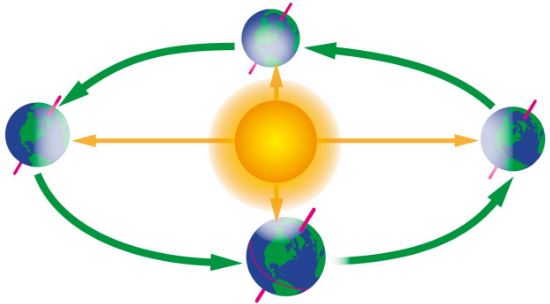
In spring/summer, the axis of the earth is pointed away or toward the sun?
a)
towards
b)
Neither away or toward
c)
away
62.
During a lunar eclipse, what color does the moon appear?
a)
Black
b)
Red-orange
c)
Yellow-green
d)
White
63.
A solar eclipse only happens during a ________ moon.
a)
New
b)
Cresent
c)
Gibbous
d)
Full
64.
A lunar eclipse only happens during a ________ moon.
a)
New
b)
Cresent
c)
Gibbous
d)
Full
65.
Where must you be to see a total solar eclipse?
a)
a corona
b)
an orbit
c)
the moon's shadow
d)
the earth's shadow
66.
Why is a lunar eclipse very rare?
a)
Because it happens every new moon
b)
Because the moon's orbit is tilted, so the sun, moon and earth rarely line up
c)
because the moon isn't close enough to the earth
d)
because the earth isn't close enough to the sun
Reset

