
 Worksheets
Mid Term Review 23
Total questions: 70
Worksheet time: 41mins
aphelion
perihelion

What does heliocentric mean?
Earth centered
Helium centered
Sun centered
Proof of the Big Bang
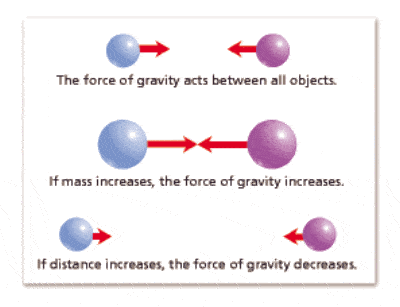


What two things determine the gravity of an object?
mass & weight
mass & distance
density & mass
volume & distance
When will the forces of gravity between two objects be the GREATEST?
when the masses of both objects are small and the objects are far apart
when the masses of both objects are large and the objects are close together
when the masses of both objects are small and the objects are close together
when the masses of both objects are large and the objects are far apart
If a planet's eccentricity is closer to zero it more like a(n)
circle
highly eccentric ellipse
Which statement correctly describes when the earth is closest to the sun
It is called aphelion and it occurs on January 3rd
It is called perihelion and it occurs on July 3rd
It is called aphelion and it occurs on July 3rd
It is called perihelion and it occurs on January 3rd
Earth will travel fastest in its orbit when
the earth is closest to the sun (January 3rd)
the earth is farthest from the sun (July 3rd)
The earth is closest to the sun (July 3rd)
The earth is farthest from the sun (January 3rd)
What is it called when earth reaches the point in orbit when it is farthest from the sun?
Perihelion
Aphelion
How can the position of the sun in earth's orbit be described?
The sun is at the very center of a perfectly circular orbit
The sun is at one of the two focal points of a slightly eccentric ellipse
The sun is at one of the two focal points of a highly eccentric ellipse
The farther a planet is from the sun, the
less time it will take to revolve around the sun
more time it will take to revolve around the sun
distance does not play a role
The size of the gravitational force between two objects depends on their ____.
Frictional Forces
inertia
masses and the distance between them
speed and direction
Why does an astronaut weigh less on the moon than on Earth?
The astronaut has less mass on the moon.
The astronaut is farther from Earth’s center when he or she is on the moon.
The gravitational field strength is less on the moon’s surface than on Earth’s surface.
The astronaut is continually in free fall because the moon orbits Earth.
Which of the following statements applies to the motion of a ball rising and then falling in free fall?
I. The ball has constant acceleration as it moves upward.
II. The ball has zero acceleration at the very top of its path.
III. The ball has constant acceleration as it moves downward.
I only
III only
I and III
I, II, and III
Kepler’s second law states that a line connecting a planet to the sun
is longest in the winter and shortest in the summer.
is longest in the winter and shortest in the summer.
sweeps out the same amount of area in any two equal periods of time.
sweeps out the same amount of area regardless of the planet.
Kepler’s first law states that
the sun is the center of the solar system.
planets orbit the sun in elliptical orbits, with the sun located at one focus.
planets orbit the sun in circular orbits, with the sun located at the center.
gravity provides the force that holds the planets in orbit about the sun.
What two factors cause planets to move in elliptical orbits?
centripetal force and rotational capacity
inertia and gravity
mass and distance
mass and gravity
Kepler’s third law states that the ratio of
the orbital period to the orbital radius is the same for all planets.
the orbital periods of any two planets equals the ratio of the orbital radii.
all planets would orbit with the same orbital period.
the period squared to the radius cubed is the same ratio for all planets.
Which of the following statements is correct about weight and mass?
Mass and weight both vary with location.
Mass varies with location, but weight does not.
Weight varies with location, but mass does not.
Neither mass nor weight varies with location.
Planets travel at _______________distances and speeds as they orbit the sun.
the same
different, faster when closer, slower when farther away
different, slower when closer, faster when farther away
the same distance but different speeds
When the earth is closest to the sun, it is ____________ and when it is farthest from the sun it is____________.
winter (January), summer (July)
summer (July), winter (December)
fall (September), spring (March)
spring (April), summer (June)
In a heliocentric system, Earth revolves around
Mars
The moon
Stars
The sun
The fact that each planet’s orbit is an ellipse was discovered by
Copernicus
Kepler
Galileo
Brahe
Copernicus explained that
the sun is at the center of the system of planets.
the sun and the planets revolve around Earth.
the geocentric system is correct.
there are only six planets.

A theory that says the universe began as a small point that expanded rapidly about 13.7 billion years ago.
Big Bang Theory
Singularity Theory
Galaxy Theory

The change in wavelength that allows us to determine if an object if moving toward us or away from us
Whiteshift and Blueshift
Redshift and Greenshift
Redshift and Blueshift
Which description is considered most accurate regarding what actually happened during the Big Bang?
Two galaxies collided causing an immense explosion as stars crashed into one another
All of what would become the universe was concentrated in a single small point, or singularity, which rapidly expanded into what is now stars, planets, galaxies, matter, and energy.
All matter emerged from a massive black hole at the center of the universe.
Parts of the sun were ripped off by massive internal explosions and were thrown into space where they cooled to become other things, like plants, comets, and other galaxies.
Observations of space indicate that most matter in the universe is ___.
hydrogen, helium, and dark matter
gold and plutonium
oxygen and water vapor
carbon

Galaxies that are REDSHIFTED are:
actually BLUE
really NEAR earth
invisible or not visible
moving AWAY from us.

If something that makes light is moving AWAY from you, it spreads the wavelengths of light out. This application of the Doppler effect is known as ___.
blue shift
green shift
red shift
black shift

Most distant galaxies show a RED SHIFT. This is considered EVIDENCE that the universe is ___.
getting cooler
expanding
condensing into a small point
swirling around

A galaxy showing BLUE SHIFT is ___.
very cold
moving TOWARDS OR TO us
dying
about to supernova

The CMB (Cosmic Background Radiation) is:
the remaining energy from the big bang.
incredibly cool.
a cloud of light
only located in certain places in the universe.
What are two important pieces of evidence we have for the Big Bang?
Ptolemy’s work on epicycles and Hubble’s law (the expansion of the Universe)
Hubble’s law (the expansion of the Universe) and cosmic background radiation
The fact that we have multiple Universes to compare and study and cosmic background radiation (CBR)
The abundance of hydrogen, helium, and lithium found in the Universe and Ptolemy’s work on epicycles

How do main sequence stars like the sun make their energy?
fusion of hydrogen into helium
fission of hydrogen into helium
fusion of helium into hydrogen
fission of helium into hydrogen
Stars are born in
the big bang
black holes
protoplanetary disks
nebulae
A nebula is...
cosmic microwave background
planets that are in the process of forming
a cloud of dust and gas in space
the same thing as a singularity
Heavier elements like carbon, oxygen, silicon and iron were formed....
inside giants and supergiants
during the big bang
inside main sequence stars
on Earth

Compared to a yellow star, a blue star is always ________
hotter
colder
bigger
smaller

In general, as the radius of a star increases....
the temperature increases
the temperature decreases
the luminosity increases
the luminosity decreases

After a small star has used up all of it's hydrogen, it will become a......
white dwarf
red giant
interstellar cloud
supernova
When a supergiant runs out of fuel for fusion it will collapse in on itself and explode in a ....
big bang
black hole
nebula
supernova
After a supernova explosion, if the core leftover is very massive it will become a ...
black hole
white dwarf
neutron star
supergiant
A star will remain on the main sequence as long as it can balance the inward force of _________ with the outward force of _____________.
gravity, luminosity
gravity, nuclear fusion
nuclear fusion, gravity
nuclear fusion, temperature


sort of cool, dim (not too much light), and red?


