
 Worksheets
4th Grade Milestone Review SCIENCE
Total questions: 68
Worksheet time: 40mins
Name
Class
Date
1.
How are sound waves created?
a)
an object vibrates and makes air particles move around
b)
an ear has to detect the waves
c)
Air particles move very fast from one object to another.
d)
A dust particle moves around and upsets the still air.
2.
Which of the following materials would a sound wave move through the fastest?
a)
A wall.
b)
A glass of water.
c)
A yardstick.
d)
An empty gymnasium.
3.
After a summer rainstorm, a rainbow appeared in the sky. What produces a rainbow when light travels through the water droplets?
a)
The light is separated into a spectrum.
b)
The light is absorbed into air particles.
4.
Which of the following in an opaque material?
a)
a clear glass
b)
brick wall
c)
waxed paper
d)
a clear shower curtain
5.
What happens when light hits a mirror?
a)
The light is absorbed.
b)
The light is reflected.
6.
A lens that is thicker on the ends and thinner in the middle is called ...
a)
convex lens
b)
concave lens
7.
The objects in the night sky seem to slowly move across the sky because Earth
a)
revolves around the sun
b)
rotates on its axis
c)
is tilted on its axis
8.
Day and night occur on different parts of Earth because
a)
Earth revolves around the sun
b)
Earth rotates on its axis
c)
The Sun revolves around the galaxy
9.
Seasons are caused by
a)
the position of the moon
b)
the tilt of Earth as it moves around the Sun
c)
the Sun getting warmer and colder
10.
An example of water condensing is...
a)
A puddle disappearing on a hot summer afternoon.
b)
Sweat forming on your forehead after you play PE.
c)
Ice cubes melting when you put them out in the sun.
d)
Dew forming on plants during a cold night.
11.
To find out which way the wind is blowing, use this tool...
a)
wind vane
b)
thermometer
c)
barometer
d)
anemometer
12.
When an ice cube is melting, it is changing from
a)
a solid to a gas
b)
a liquid to a solid
c)
a solid to a liquid
d)
a liquid to a gas
13.
A mushroom is a type of a decomposer. What does it do for a food chain?
a)
produce their own food
b)
eat both plants and animals
c)
eat only old leaves that have fallen off the tree
d)
break down dead materials and return nutrients to the soil
14.
A consumer that eats only other consumers is called...
a)
an herbivore
b)
a carnivore
c)
an omnivore
d)
a decomposer
15.
The tilt of the Earth on its axis as it moves around the sun MOST affects the—
a)
timing of the tides
b)
length of the month
c)
the cycle of the four seasons
d)
phases of the moon
16.

Earth would not have seasons if—
a)
it did not rotate
b)
it was slightly closer to the sun
c)
it was no tilted on its axis
d)
it had more than one moon
17.
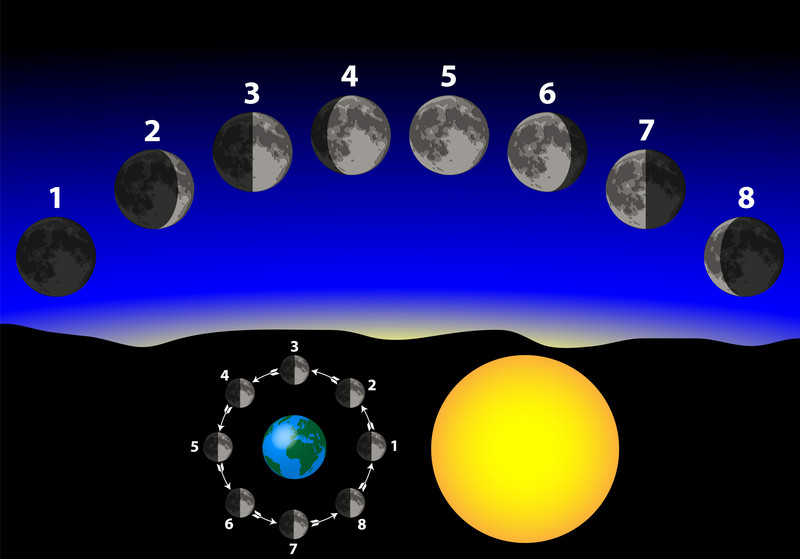
What causes the phases of the moon?
A The Earth orbiting the moon
B The sun reflecting the moon
C The moon rotating on its axis
D The moon orbiting the Earth
A The Earth orbiting the moon
B The sun reflecting the moon
C The moon rotating on its axis
D The moon orbiting the Earth
a)
The Earth orbiting the moon
b)
The sun reflecting the moon
c)
The moon rotating on its axis
d)
The moon orbiting the Earth
18.
Seasons result from the Earth’s—
A rotation on its axis while orbiting the sun
B tilt on its axis as it orbits the sun
C distance from the sun during its orbit
D atmosphere changing during its orbit
A rotation on its axis while orbiting the sun
B tilt on its axis as it orbits the sun
C distance from the sun during its orbit
D atmosphere changing during its orbit
a)
rotation on its axis while orbiting the sun
b)
tilt on its axis as it orbits the sun
c)
distance from the sun during its orbit
d)
atmosphere changing during its orbits
19.
The sun is a _____________.
a)
planet
b)
star
c)
galaxy
d)
comet
20.
What do we use to look at things that are far away in the sky?
a)
telescope
b)
microscope
c)
telegram
d)
telegraph
21.
Why do we have seasons on Earth.
a)
Due to the tilt and rotation of the Earth on its axis.
b)
Due to the Gravitational pull
c)
Due to the Rotation of the sun
d)
Due to the Revolution of the Sun
22.
One rotation of the Earth on its axis is..........
a)
24 hours= 1 day
b)
365 days= 1 year
c)
12 Hours= Half a day
d)
300 hours
23.
How long does it take the Earth to revolve around the sun?
a)
365 days=1 year
b)
24 hours=1 day
c)
1 month
d)
6 months
24.
What does waxing mean?
a)
growing
b)
shrinking
25.
What does waning mean?
a)
shrinking
b)
growing
26.
What are the 4 types of Precipitation?
a)
Rain, Snow, Sleet, Hail
b)
Precipitation, Condensation, Evaporation, Transpiration
c)
Ground Water, Snow, Precipitation, Evaporation
d)
Sleet, Ground Water, Condensation, Rain
27.
What is the average weather in a place over a time called?
a)
Weather
b)
Climate
c)
Temperature
d)
Cloud Formation
28.
A glass of cold lemonade was taken from the refrigerator and set on the table. Soon there were little drops of water on the outside of the glass. Where did the water come from?
a)
The water came from the air
b)
the water came through the glass
c)
Ice in the glass melted and the lemonade in the class overflowed.
d)
Nobody knows where the water came from.
29.
What type of weather can we expect when there is a high pressure system over Georgia?
a)
Clear skies
b)
Rain
c)
Cloudy with a chance of Storms
d)
A tornado
30.
What is it called when a liquid changes to a gas?
a)
Evaporation
b)
Condensation
c)
Precipitation
d)
Transpiration
31.
What is it called when a gas turns into a liquid?
a)
Condensation
b)
Precipitation
c)
Transpiration
d)
Evaporations
32.
_________________ measures wind speed.
a)
anemometer
b)
barometer
c)
rain gauge
d)
thermometer
33.
______________ measures the directions of the wind.
a)
wind vane
b)
barometer
c)
rain gauge
d)
thermometer
34.
_________________ measures the amount of pressure in the air.
a)
thermometer
b)
rain gauge
c)
barometer
d)
anemometer
35.
______________ measures how much it rained.
a)
thermometer
b)
rain gauge
c)
barometer
d)
wind vane
36.
________________ measures temperature.
a)
thermometer
b)
barometer
c)
anemometer
d)
rain gauge
37.
____________ is when all light can pass through it (glass)
a)
transparent
b)
translucent
c)
opaque
d)
reflection
38.
_________________ is when some light can pass through an object. (Plastic)
a)
translucent
b)
transparent
c)
opaque
d)
refraction
39.
____________ is when no light can pass through (wood).
a)
opaque
b)
translucent
c)
transparents
d)
prism
40.
The bending of light is called ___________
a)
Refraction
b)
Reflection
c)
Prism
d)
Concave Lens
41.
The bouncing off of light is called ____________________.
a)
Reflection
b)
Refraction
c)
Prism
d)
Translucent
42.
Lens that is thicker in the middle than on the edges and magnifies.
a)
Convex Lens
b)
Concave Lens
c)
Transparent
d)
Translucent
43.
Lens that is thicker at the edges than in the middle and does NOT magnify.
a)
Concave Lens
b)
Convex Lens
c)
Translucent
d)
Transparent
44.
Sound travels the fastest through _____________________.
a)
solids
b)
liquids
c)
gases
d)
plasmas
45.
All sounds start with a ___________________.
a)
Explosion
b)
Pitch
c)
Vibration
d)
Crash
46.

This is a picture of a ________________.
a)
inclined plane
b)
pulley
c)
wedge
d)
screw
47.

This is a picture of a ________________.
a)
Lever
b)
Pulley
c)
Wheel and Axle
d)
Screw
48.

This is a picture of a ________________.
a)
Pulley
b)
Screw
c)
Wheel and Axle
d)
Inclined Plane
49.

This is a picture of a ________________.
a)
Screw
b)
Pulley
c)
Inclined plane
d)
Wheel and Axle
50.

This is a picture of a ________________.
a)
Wedge
b)
Pulley
c)
Inclined Plane
d)
Screw
51.

This is a picture of a ________________.
a)
Wheel and Axle
b)
Pulley
c)
Screw
d)
Lever
52.
When you drop a pencil from your desk, what causes the pencil to go toward the floor instead of the ceiling?
a)
gravity
b)
inertia
c)
force
53.
When you start to speed up, you are ______________.
a)
Accelerating
b)
Deccelerating
c)
Velocity
54.
A push or a pull on an object is called:
a)
Force
b)
Gravity
c)
Acceleration
d)
Inertia
55.
A _____________ eats only plants.
a)
Herbivore
b)
Omnivore
c)
Carnivore
d)
Producer
56.
An animal that kills another animal for food is called
a)
prey
b)
predator
c)
producer
d)
herbivore
57.
The death of all the members of a certain group of organisms
a)
extinction
b)
migration
c)
hibernation
d)
instinct
58.
The movement of animals from on place to another and back.
a)
hibernation
b)
extinction
c)
migration
d)
adaptation
59.
A body part of behavior that helps an organism survive.
a)
Adaptations
b)
Physical
c)
Behavioral
d)
Instinct
60.
A color or shape that helps an animal hide.
a)
camouflage
b)
adaptation
c)
Physical
d)
Behavorial
61.
Which is a huge ball of hot gases that gives off its own light?
a)
A planet
b)
A star
c)
A comet
d)
A moon
62.
A huge system of gas, dust, and stars is a
a)
galaxy
b)
comet
c)
moon
d)
star
63.
What planet can support life?
a)
Earth
b)
Mars
c)
Saturn
d)
Pluto
64.
In a forest, owls hunt at night. Mice are the main food of the owls. Which change will most likely happen if there are fewer mice in the forest?
a)
A. The owls will hunt during the day.
b)
B. The owls will have more babies.
c)
C. The number of owls will decrease.
d)
D. The owls will become extinct.
65.

Look at this food chain. What would MOST LIKELY happen if the rabbit population suddenly becomes much larger?
a)
A. The clover population would decrease and the coyote population would increase.
b)
B. The clover population would decrease and the coyote population would decrease.
c)
C. The clover population would increase and the coyote population would decrease.
d)
D. he clover population would increase and the coyote population would increase.
66.

__________ is the average weather over a period of time.
a)
abiotic
b)
climate
c)
biotic
d)
adaptation
67.

Which Moon phase comes before a Waxing Gibbous?
a)
Waning Crescent
b)
First Quarter
c)
Waxing Crescent
d)
Full Moon
68.

When the Northern Hemisphere of Earth is Leaning away from the Sun, What season is the Southern Hemisphere experiencing?
a)
Summer
b)
Winter
c)
Spring
d)
Fall
100 %

