
 Worksheets
Gravity and Inertia
Total questions: 90
Worksheet time: 2hrs 31mins
Name
Class
Date
1.

An object at rest will stay at rest and an object in motion will stay in motion with a constant speed and direction unless acted on by another force. This is
a)
Newton's Law of Universal Gravitation
b)
Newton's First Law of Motion
c)
Newton's Second Law of Motion
d)
Newton's Third Law of Motion
2.
Any object with mass has gravity (a gravitational force).
a)
True
b)
Sometimes
c)
False
d)
Never
3.
A person would weigh less on on the Moon than on the Earth because . . .
a)
Moon has more mass, and therefore more gravity
b)
Moon has less mass, and therefore more gravity
c)
Moon has more mass, and therefore less gravity
d)
Moon has less mass and therefore less gravity
4.
The amount of matter in an object is
a)
pressure
b)
weight
c)
mass
d)
force
5.
The force of gravity acting on an object is the object's ______.
a)
mass
b)
matter
c)
weight
d)
friction
6.

Is the force of gravity on the diver a push or a pull?
a)
push
b)
pull
7.
Every object in the universe attracts every other object. This is
a)
Newton's First Law of Motion
b)
friction
c)
inertia
d)
Newton's Law of Universal Gravitation
8.
If Earth's mass was cut in half, what would happen to your weight?
a)
Increase because gravitational force increases
b)
decrease because gravitational force decreases
c)
decrease because gravitational force increases
d)
nothing, weight is not affected by gravitational force
9.
If Earth's mass was cut in half, what would happen to your mass?
a)
increase because gravitational force increases
b)
decrease because gravitational force decreases
c)
decrease because gravitational force increases
d)
nothing, mass is not affected by gravitational force
10.
Two factors effecting the magnitude/strength of the force of gravity between two objects are...
a)
mass and distance
b)
mass and matter
c)
distance and weight
d)
weight and mass
11.

As mass increases, what happens to gravitational force?
a)
increases
b)
decreases
c)
stays the same
d)
i don't know
12.
The force of gravity on Jupiter is a little more than two times the gravitational force on Earth. If an object has a mass of 50 kg and a weight of 490 N (N=Newtons) on Earth, what would be the object's approximate mass and weight on Jupiter?
a)
50 kg and 490 N
b)
100 kg and 490 N
c)
50 kg and 980 N
d)
100 kg and 980 N
13.

As the distance between two objects increases, what happens to gravitational force?
a)
increases
b)
decreases
c)
stays the same
d)
i don't know
14.
Inertia is the tendency of an object to resist a change in its ___________.
a)
temperature
b)
shape
c)
size
d)
motion
15.
All objects have inertia, whether they are moving or not.
a)
True
b)
False
16.

Objects with greater _________ also have greater inertia.
a)
speed
b)
mass
c)
temperature
d)
friction
17.
Friction and gravity are both examples of a force.
a)
True
b)
False
18.
To change the motion of an object, inertia must be overcome by a __________ acting on the object.
a)
temperature
b)
speed
c)
force
d)
velocity
19.
If the mass of two objects increased and distance stayed the same then the gravitational force would
a)
decrease
b)
stay the same
c)
increase
20.
What would happen to Earth if the sun no longer had a gravitational pull on Earth?
a)
Earth would fall into the sun
b)
Earth would stop moving
c)
Earth would continue moving in a straight line away from the Sun
d)
Earth would keep orbiting around the sun
21.
When riding your bike you brake suddenly, your body keeps going forward because of
a)
inertia
b)
gravity
c)
friction
d)
speed
22.
During the magic trick when a magician pulls the tablecloth out from a plate, the plate has
a)
gravity
b)
friction
c)
equilibrium
d)
inertia
23.
What two factors keep planets in orbit around the sun
a)
mass and distance
b)
gravity and inertia
c)
friction and inertia
d)
mass and inertia
24.
If the mass of two objects stays the same, but the distance between them increases then the gravitational force between the two objects
a)
decreases
b)
increases
c)
stays the same
25.
According to scientists, what is the force that started the motion of all objects in the universe?
a)
A giant meteor
b)
A giant asteroid
c)
The Big Bang
d)
gravity
26.

Name the moon phase
a)
waning crescent
b)
waxing crescent
c)
waning gibbous
d)
waxing gibbous
27.

Name the moon phase
a)
waning crescent
b)
waxing crescent
c)
waning gibbous
d)
waxing gibbous
28.

Name the moon phase
a)
waning crescent
b)
waxing crescent
c)
waning gibbous
d)
waxing gibbous
29.

Name the moon phase
a)
waning crescent
b)
waxing crescent
c)
waning gibbous
d)
waxing gibbous
30.

Name the moon phase
a)
waning crescent
b)
waxing crescent
c)
waning gibbous
d)
waxing gibbous
31.

Name the moon phase
a)
First Quarter
b)
Last Quarter
c)
New Moon
d)
Full Moon
32.

Name the moon phase
a)
First Quarter
b)
Last Quarter
c)
New Moon
d)
Full Moon
33.

Name the moon phase
a)
First Quarter
b)
Last Quarter
c)
New Moon
d)
Full Moon
34.

Name the moon phase
a)
First Quarter
b)
Last Quarter
c)
New Moon
d)
Full Moon
35.
How much of the moon is always lit?
a)
can't tell
b)
always changes
c)
half
d)
3/4
36.

Name the moon phase that would come AFTER this moon.
a)
waning crescent
b)
waxing crescent
c)
waning gibbous
d)
waxing gibbous
37.

What moon phase came right BEFORE this one?
a)
First Quarter
b)
Last Quarter
c)
New Moon
d)
Full Moon
38.
When does a blue moon happen?
a)
It happens because that is how the moon works.
b)
I don't know
c)
it happens when there are two full moons in a calendar month.
39.
When does a lunar eclipse happen?
a)
I do not know
b)
when there is a shadow of the Earth on the moon
c)
It is a phase of the moon
40.
How many phases does the moon have?
a)
7 phases
b)
5 phases
c)
I do not know
d)
8 phases
41.

The Moon orbits Earth in a ________________ direction
a)
clockwise
b)
counterclockwise
c)
upwards
d)
downwards
42.
The 3rd quarter (or Last quarter) moon is:
a)
waning
b)
waxing
43.
Is a moon that is waxing growing in size?
a)
yes
b)
no
c)
I don't know
d)
no
44.
Is a waning moon getting smaller in size?
a)
yes
b)
no
c)
let me think...
45.
How long is the moons complete phase?
a)
29.5 days
b)
30 days
c)
45 days
d)
I don't know
46.

What moon phase is at position 5?
a)
waxing crescent
b)
waxing gibbous
c)
full moon
d)
waning crescent
47.

What moon phase is at position 3?
a)
waxing crescent
b)
1st quarter
c)
3rd quarter
d)
waning crescent
48.

What moon phase is at position 7?
a)
1st quarter
b)
3rd quarter
c)
waning gibbous
d)
waning crescent
49.

What moon phase is at position 8?
a)
waxing crescent
b)
waxing gibbous
c)
waning gibbous
d)
waning crescent
50.

What moon phase is at position 4?
a)
waxing crescent
b)
waxing gibbous
c)
waning gibbous
d)
waning crescent
51.
The 1st Quarter moon is lit on the:
a)
Left Side
b)
Right Side
52.
A solar eclipse only happens during a ________ moon.
a)
New
b)
Cresent
c)
Gibbous
d)
Full
53.

What do we call the sun's outer atmosphere that you see during a solar eclipse?
a)
an umbra
b)
a corona
c)
an orbit
d)
a shadow
54.
Which of the following is not true about a total solar eclipse?
a)
It can be viewed once a year from every spot on earth
b)
It is dangerous to look at without the proper device
c)
When it happens, the moon blocks all of the sun except the corona
d)
You must be within the moon's umbra to see it
55.
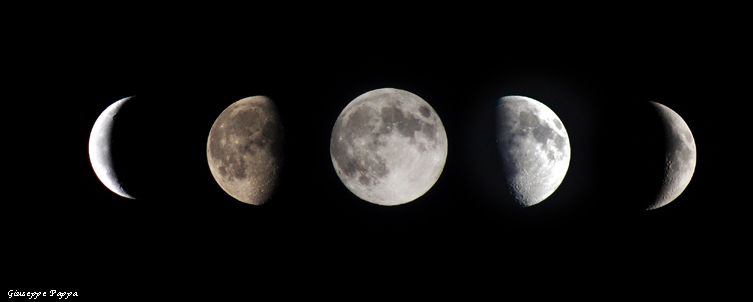
A solar eclipse only occurs during which moon phase?
a)
1st Quarter
b)
New Moon
c)
Full Moon
d)
3rd Quarter
56.

a)
solar eclipse
b)
lunar eclipse
57.
Which type of eclipse occurs when the Moon comes directly between Earth and the Sun?
a)
Lunar eclipse
b)
Solar eclipse
58.

What is the darkest inner part of the shadow cone called, where a total eclipse can be viewed.
a)
Total
b)
Umbra
c)
Penumbra
59.

a)
solar eclipse
b)
lunar eclipse
60.
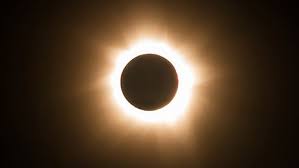
During a solar eclipse...
a)
The sun is blocked by the moon
b)
The Earth is blocked moon
c)
The moon is blocked by the sun
d)
You are blocked
61.
Why do the Sun and Moon appear to be the same size in the sky?
a)
The Sun is 400 times bigger, but the Moon is 100 times closer.
b)
The Sun is 100 times bigger, but the Moon is 400 times closer.
c)
The Sun is 400 times bigger, but the Moon is 400 times closer.
d)
The Moon is 400 times bigger, but the Sun is 400 times closer.
62.
What is the order during a lunar eclipse
a)
sun, moon, earth
b)
sun, earth, moon
63.
To view totality, where do you have to be located?
a)
Within the Moon's umbra
b)
Within the Sun's umbra
c)
Within the Moon's umbra
d)
Within the Earth's penumbra
64.
When Earth moves into the moon’s shadow, a solar eclipse takes place. What is the only moon phase that this can possibly occur in?
a)
full moon
b)
new moon
c)
third quarter
d)
waning gibbous
65.
Why isn't there an eclipse every month?
a)
Because the moon orbits the sun differently than Earth does.
b)
Because the Earth's orbit and the moon's orbit are at the same angle, flat plane.
c)
Because the moon's orbit is offset from Earth's orbit by 1.5°, not in a flat plane.
d)
Because the lunar cycle is longer than a month.
66.
A lunar eclipse occurs when the Moon casts a shadow on Earth.
a)
True
b)
False
67.
You would see a partial solar eclipse if you were within the Moon’s penumbra.
a)
True
b)
False
68.
The order of a lunar eclipse is..
a)
Sun-Earth-Moon
b)
Earth-Sun-Moon
c)
Moon-Sun- Earth
d)
Earth-Moon-Sun
69.
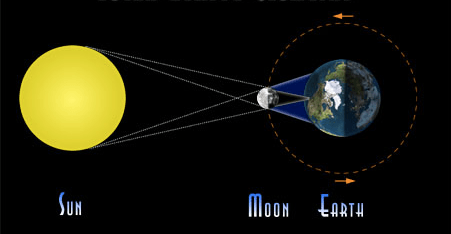
Which type of eclipse is shown in this picture?
a)
Solar Eclipse
b)
Orbit
c)
Lunar Eclipse
d)
Total Eclipse
70.

What is a difference between spring and neap tides?
a)
Spring tides occur when the earth and sun are IN LINE with the new or full moon.
b)
Spring tides occur when moon in 3rd or 1st quarter phases
c)
Spring tides are LOWER than neap tides
d)
Spring tides occur in Spring and neap tides can occur in any season
71.

Which body has the greater effect on Earth's tides?
a)
Sun
b)
Saturn
c)
Moon
d)
Venus
72.
What do we call tides that have a smaller range that happen when the sun and moon are at right angles to each other?
a)
Neap Tide
b)
Spring Tide
c)
Larger Change
d)
Smaller Change
73.

What type of tide would this arrangement of earth-moon-sun create?
a)
full moon tide
b)
new moon tide
c)
neap tide
d)
spring tide
74.
At the same time the sea is drawn to the moon, another tidal bulge takes place on other side of Earth. True or False?
a)
True
b)
False
c)
Maybe
d)
I don't know!
75.
If tides alternate from high to low and there are two of each type of tide a day, about how many hours will generally be between each different tide?
a)
2 hours
b)
6 hours
c)
12 hours
d)
24 hours
76.

What type of tides would this arrangement of earth-moon-sun create?
a)
neap tide
b)
spring tide
c)
new moon tide
d)
full moon tide
77.

Maureen measured the water level of the ocean at high tide and at low tide every day near her home in Florida. The table below shows her results. On which day did a spring tide most likely take place?
a)
June 3
b)
June 6
c)
June 9
d)
June 11
78.

The diagram below shows the alignment of the sun, the moon, and Earth. In which locations are neap tides taking place?
a)
1 and 2
b)
1 and 3
c)
2 and 4
d)
3 and 4
79.
What changes do tides have on the earths surface?
a)
causes floods
b)
breaks building
c)
rise and fall of the ocean water
d)
causes the earth to have more water
80.
How many low tides and high tides happen in a day?
a)
1 low tide, 1 high tide
b)
4 low tides, 4 high tides
c)
3 low tides, 3 high tides
d)
2 low tides, 2 high tides
81.
The moon's __________ pulls the water on the earth towards it causing tides to occur.
a)
gravitational force
b)
light
c)
shadow
d)
orbit
82.

What type of tide will occur at 9:30 a.m.?
a)
low
b)
high
c)
none
d)
high and low
83.
You visited the beach at 12 pm (noon) and it is high tide. If you return 6 hours later what tide will you see?
a)
high
b)
low
c)
none
d)
spring
84.
About how many hours separate low and high tide?
a)
8
b)
24
c)
12
d)
6
85.
What are tides?
a)
More water filling up the ocean
b)
The rising and falling of the water on the earth surface
c)
Jupiter orbiting the moon
d)
Waves in the oceans
86.
Why do tides have patterns?
a)
Because the earth rotates
b)
Because the sun rotates
c)
Because the earth orbits around the sun
d)
Because the moon orbits around the sun
87.
After a high tide occurs, how long will it take for the next high tide?
a)
12 hours
b)
6 hours
c)
12 days
d)
6 days
88.
What do we call the small tides that happen when the sun and moon are at right angles to each other?
a)
Neap Tide
b)
Spring Tide
c)
Larger Change
d)
Smaller Change
89.
How many times per month does a spring tide occur?
a)
Once
b)
twice
c)
three times
d)
it changes every month
90.
A[n] ______________ tide occurs when the sun is at right angles to the line between Earth and the moon.
a)
high
b)
neap
c)
low
d)
spring
100 %

