wayground logo

Free Printable Worksheets

NEW

Font size

S
M
L
XL
Worksheets

S138 Protein Synthesis and Mutations

Total questions: 44

Worksheet time: 33mins
Name
Class
Date
1.
In RNA, Uracil pairs with ______. 
a)
cytosine
b)
adenine
c)
guanine
d)
thymine
2.
The process to go from DNA to mRNA is _______
a)
translation
b)
transcription
c)
replication
3.
The process to go from mRNA to a protein is called ____
a)
transcription
b)
rRNA
c)
replication
d)
translation
4.
Choose the nucleotide sequence of the RNA strand that would be complementary to the following strand: 
GTAGTCA
a)
UATUAGA
b)
ACGACTG
c)
CAUCAGU
d)
CATCAGT
5.
The main function of tRNA is to...
a)
carry a message that, when translated, forms proteins
b)
form a portion of ribosomes
c)
string together complementary RNA and DNA strands
d)
bring amino acids from the cytoplasm to the ribosomes
6.
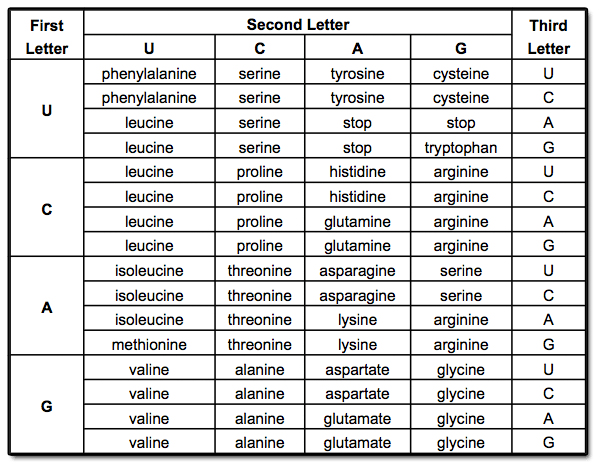
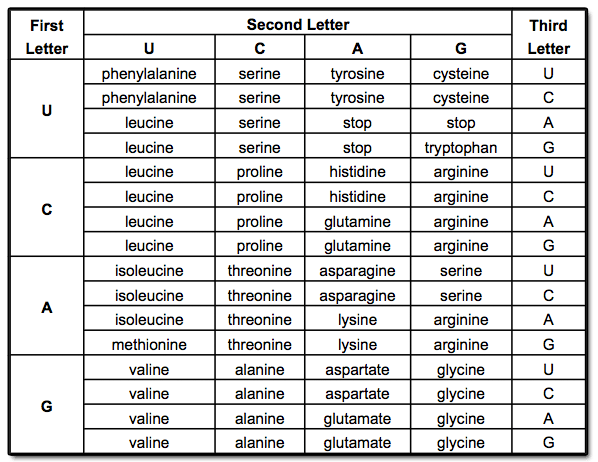
What amino acid is represented by the codon UUA?
a)
Phenylalanine
b)
Tyrosine
c)
Leucine
d)
Stop codon
7.
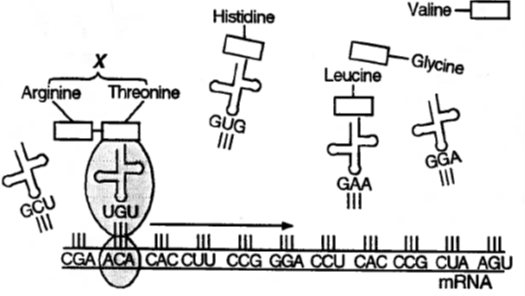
What process is going on in this photo? 
a)
Transcription 
b)
Translation 
c)
Replication 
d)
All the above 
8.
What is the location in the cell for translation?
a)
nucleus
b)
mitochondria
c)
ribosome
d)
chloroplast
9.
What is the three base sequence of mRNA that codes for a single amino acid?
a)
Anticodon
b)
Codon
c)
Protein
10.
What is the location in the cell for transcription?
a)
nucleus
b)
cytoplasm
c)
ribosome
d)
mitochondria
11.
Translation is the process where
a)
mRNA is created in the Nucleus
b)
mRNA is decoded to form a protein 
c)
glucose molecules are made
d)
is where lipids are synthesised
12.
What is the correct amino acid sequence for the mRNA code AUGCCAGUAUGA
a)
Met-Pro-Ala-Val
b)
Met-Pro-Val
c)
Tyr-Gly-His
d)
Tyr-Gly-Arg-His
13.
How many amino acids are coded for by this sequence of nucleotides:
ATG GGA ACT CCA
a)
4
b)
2
c)
6
d)
12
14.
The enzyme that produces RNA in Transcription is called
a)
RNA Polymerase
b)
DNA Polymerase
c)
Transcriptase
d)
RNA Intrase
15.
tRNA molecules match the mRNA codons with a(n):
a)
Codon
b)
Anti-Codon
c)
Intron
d)
Methylated Cap
16.
Translation begins with a(n):
a)
Start Codon
b)
Intron
c)
Promoter
d)
Origin
17.
The amino acid sequence of a polypeptide chain comprises the ____ structure of the protein.
a)
Primary
b)
Secondary
c)
Tertiary
d)
Quaternary
18.
The function of ______ is to combine with proteins to form ribosomes.
a)
rRNA
b)
tRNA
c)
mRNA
d)
DNA
19.
What is one characteristic that is true about both DNA and RNA?
a)
single stranded
b)
contain genes
c)
have the base uracil
d)
used as a template
20.
What type of mutation occurs, when a base is subtracted from the sequence? 
a)
Deletion
b)
Insertion
c)
Substitution 
21.
What mutation has occurred here? 
T-G-A-C-C-A
T-G-A-G-C-A
a)
Substitution
b)
Deletion
c)
Insertion
d)
Frameshift 
22.
Why are insertion and deletion (frameshift) mutations so harmful?
a)
They change all of the codons from the mutation on down the line, which changes the amino acid sequence
b)
They insert things that an organism doesn't need.
c)
They often delete things that organisms need.
d)
Insertion and deletions are not any more harmful than substitution mutations.
23.
 A group of three bases on a tRNA molecule that are complementary to mRNA?
a)
codon
b)
anticodon
c)
mRNA
d)
ribosome
24.
The mRNA leaves the ________ to find the ribosome to make proteins.
a)
cell
b)
nucleotide
c)
nucleus
25.
What type of bonds are forming during translation?
a)
Peptide bonds
b)
Hydrogen bonds
c)
Acid bonds
26.
a change in the nucleotide sequence of DNA 
a)
is a mutation
b)
can be a mutation or an epigenetic change
c)
is an epigenetic change
d)
always leads to a permanent change in DNA
27.
a change in one DNA triplet that may result in a new triplet that codes for a stop codon instead of an amino acid is known as
a)
missense
b)
nonsense
c)
frameshift
d)
silent
28.
which of the following mutations results in the loss or addition of a single nucleotide, changing the DNA triplets
a)
missense
b)
nonsense
c)
frameshift
d)
silent
29.
DNA molecule segment is : TTACGCAAG
The mutated DNA segment is TTCGCAAG. This is an example of ___ mutation.
a)
Substitution
b)
Deletion
c)
Insertion
d)
Inversion
30.
Which of the following would result in a frameshift mutation?
a)
Insertions only
b)
Substitution only
c)
Deletion only
d)
Insertions and Deletions
31.
A type of substitution in which no  amino acids change is called 
a)
Missense
b)
Nonsense
c)
Silent
d)
Deletion
32.

In DNA replication, if the original sequence reads AATTTGCGCCCAAT, the complementary DNA strand would read?

a)

AAUUUCGCGGGUUA

b)

AATTTGCGCCCAAT

c)

TTAAACGCGGGTTA

d)

UUAAACGCGGGUUA

33.

If mRNA reads UUU-AGC-UCG-CGC-GUG-CUC, the complimentary tRNA would read?

a)

AAA-TCG-AGC-GCG-CAC-GAG

b)

TTT-UCG-AGC-GCG-CAC-GTG

c)

UUU-AGC-UCG-CGC-GUG-CUC

d)

AAA-UCG-AGC-GCG-CAC-GAG

34.

If the mRNA codons read ACA-GUA-GAA-UUG-AUC, what amino acids make up the protein sequence?

a)

Cys-Val-Gly-Ser-Stop

b)

Cys-His-Leu-Asn-Stop

c)

Thre-Val-Glu-Leu-Iso

d)

None of the above

35.

What is the role of mRNA in expressing specialized structures?

a)

Making energy available for cellular activities

b)

Creating bonds to from biomolecules

c)

Producing sugars that assist with replication

d)

Providing information to form proteins

36.

Which component of the DNA molecule provides instructions for the production of the protein and determines the traits of the organism?

a)

The phosphate group

b)

The sugar molecule

c)

The sequence of nitrogen bases

d)

The hydrogen bonds that hold the sugars to the bases

37.

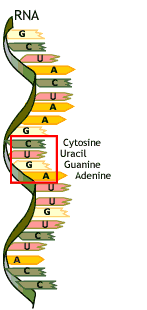
What is the purpose of the cellular process shown in the image?

a)

Preserving genetic information for future generations

b)

Deleting the information in the sequence produced from the DNA template

c)

Transcribing information in the DNA sequence for use by the cell

d)

Producing more nucleotides for the DNA sequence

38.

A sequence of DNA codes for part of a gene and is listed below. How many amino acids are coded for by this segment. 5' ATCAGCGCTGGC 3'

a)

4

b)

8

c)

12

d)

20

39.

Which cellular process is being shown in the image?

a)

Replication

b)

Transcription

c)

Translation

d)

Protein Synthesis

40.

Translation is the process of _____ ?

a)

Converting codons to anticodons

b)

Reading mRNA and finding the tRNA complement

c)

Reading mRNA and building a protein by attaching the coded amino acids

d)

Making the complementary strand of mRNA from the DNA sequence

41.

The final product resulting from the cellular process of transcription is __?

a)

An exact copy of DNA

b)

A complimentary strand of mRNA

c)

A complimentary strand of tRNA

d)

A strand of multiple amino acids held together with peptide bonds

42.

Which mutation will cause translation to stop?

a)

Mutations 1 and 3 only

b)

Mutation 1 only

c)

Mutation 2 only

d)

Muations 1, 2, 3

43.

Genetic mutations can be...

a)

beneficial, harmful, or have no effect at all

b)

beneficial only

c)

harmful only

d)

neutral only

44.

What type of mutation is shown in the diagram?

a)

Point mutation - missense

b)

Frameshift Mutation - deletion

c)

Frameshift Mutation - addition

d)

Point mutation - nonsense