
 Worksheets
Electrostatics and Electric Potential Energy
Total questions: 33
Worksheet time: 33mins
Name
Class
Date
1.
When a glass rod is rubbed with silk and the glass rod becomes positively charged, what happens to the electrons?
a)
they are removed from the rod
b)
they are added to the rod
2.
What do you call the process of charging a conductor by bringing it near another charged object?
a)
induction
b)
polarization
c)
neutralization
d)
conduction
3.
The law of conservation of charge states that...
a)
all atoms have more protons than electrons
b)
only protons can be rubbed off of an atom
c)
charge cannot be created or destroyed
d)
charge cannot be transferred
4.
assume a rubber rod is rubbed against a rabbit fur and gains 5 electrons. which of the following is true?
a)
The fur lost 5 electrons
b)
the fur gained 5 electrons
c)
the fur gained 5 protons
d)
The fur lost 2 electrons
5.
Two like charges
a)
neutralize each other.
b)
repel each other.
c)
must be neutrons.
d)
attract each other.
6.
The charge of an electron is
a)
positive.
b)
negative.
c)
Electrons have no charge
7.
An atom loses an electron. What type of charge does it have now?
a)
positive
b)
negative
8.
An atom gains an electron. What type of charge does it have now?
a)
positive
b)
negative
c)
No charge
9.
Charged objects are not attracted to neutral objects
a)
True
b)
False
10.
When a balloon is rubbed on clothes it acquires a charge by ___________
a)
Induction
b)
reduction
c)
friction
d)
concuction
11.
After you rub a balloon on your hair, what charge does the balloon have?
a)
Positive
b)
Negative
c)
Neutral
12.
What variable do Coulombs represent?
a)
Electrostatic Charge
b)
Force
c)
Distance
d)
Mass
13.
__________ is stored energy.
a)
Potential
b)
Kinetic
c)
None of the above
d)
All of the above
14.

How is the electric force between two charges affected when both of the charges are doubled?
a)
Four times as much.
b)
Two times as much.
c)
Half as much.
d)
One-quarter as much.
15.

How is the electric force between two charges affected when the distance between the charges is halved?
a)
Four times as much.
b)
Two times as much.
c)
Half as much.
d)
One-quarter as much.
16.
Where do electrons go when you rub a balloon on your hair?
a)
Onto the balloon
b)
Into your hair
c)
Nowhere
17.
After you rub a balloon on your hair, what charge does your hair have?
a)
Positive
b)
Negative
c)
Neutral
18.
The reason a charged balloon will stick to a wall is that
a)
the charge is slightly sticky and acts like glue
b)
electrons transfer back and forth between the wall and the balloon
c)
induced opposite charges in the wall are closer than other wall charges
d)
balloon material simply sticks to walls
19.
Gravity:Newton's Law of Gravitation==Electrical Force:_____
a)
Newton's Law of Electrical Forces
b)
Coulomb's Law
c)
The Electric Law
d)
Newton's Law of Atomic Forces
20.
Charging by friction:Rubbing== Charging by contact:_____
a)
rubbing
b)
touching
c)
no contact
21.
Charging by friction: Rubbing==Charging by induction:_____
a)
rubbing
b)
touching
c)
no contact
22.

What is the overall charge on this balloon? (They are the same so look at either one!)
a)
+3
b)
-6
c)
+6
d)
-3
23.

What is the name of this device that is used to detect charges?
a)
beaker
b)
electroscope
c)
van de graff generator
d)
chargometer
24.
If two balloons have the same charge, what will happen if you place them close to each other?
a)
Nothing
b)
They will be attracted
c)
They will pop
d)
They will push each other away.
25.
The accumulation of excess electric charge on an object is called
a)
Static electricity
b)
Electric discharge
c)
Resistance
d)
Circuit
26.
What do you call the process of charging a conductor by bringing it near another charged object?
a)
Induction
b)
Polarization
c)
Neutralization
d)
Conduction
27.
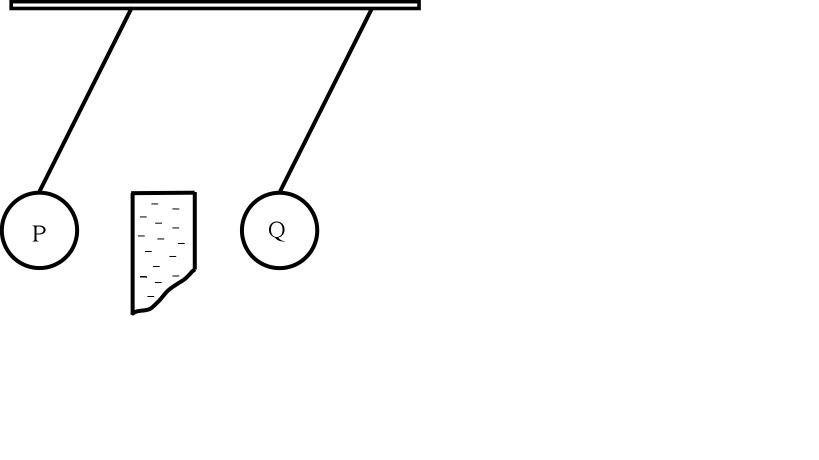
The diagram shows two metal balls, P and Q, hanging from the nylon threads. P is repelled by and Q is attracted to a negatively charged rod.
Which statement is true?
Which statement is true?
a)
P is negatively charged
b)
Q is negatively charged
c)
P is uncharged
d)
P is positively charged
28.
Which part of the atom moves to create electricity?
a)
Proton
b)
Neutron
c)
Electron
29.
Which part of the atom is positively charged?
a)
Proton
b)
Neutron
c)
Electron
30.
An atom that has more protons than electrons would have what charge?
a)
Positive
b)
Negative
c)
Neutral (Zero)
31.
An objective with a negative charge would _______ an object with a neutral charge
a)
Attract
b)
Repel
c)
Do nothing
32.
Electric charge is neither created nor destroyed, but can be rearranged.
a)
true
b)
false
33.
Charging by friction:Rubbing== Charging by contact:_____
a)
rubbing
b)
touching
c)
no contact
100 %

