
 Worksheets
STAAR Spiral Review 8.7ABC
Total questions: 46
Worksheet time: 23mins
Name
Class
Date
1.
What is the Earth's tilt in degrees?
a)
40.5 degrees
b)
32.5 degrees
c)
28.5 degrees
d)
23.5 degrees
2.
The spinning of an object on its axis is called______
a)
orbit
b)
rotation
c)
revolution
d)
tide
3.
Day and night is caused by the _____________ of earth on its axis.
a)
revolution
b)
orbit
c)
rotation
4.
How long does it take the Earth to make one REVOLUTION around the Sun?
a)
12 hours
b)
24 hours
c)
365 days
d)
29.5 days
5.
The Earth's _______ is an imaginary line that goes from the North Pole to the South Pole.
a)
vernal equinox
b)
axis
c)
solar eclipse
d)
solar flare
6.

When the Northern Hemisphere of Earth is Leaning away from the Sun, What season is the Southern Hemisphere experiencing?
a)
Summer
b)
Winter
c)
Spring
d)
Fall
7.
How long does earth's rotation last?
a)
90 hours
b)
about 1 hour
c)
24 hours
d)
48 hours
8.
During an ________, the length of nighttime and daytime are about the same because neither hemisphere is tilted toward the sun.
a)
equinox
b)
solstice
c)
earthquake
d)
solar eclipse
9.

What season is letter A?
a)
Winter
b)
Summer
c)
Spring
d)
Fall
10.

What is letter B's Equinox date?
a)
June 21
b)
December 21
c)
March 21
d)
September 21
11.
When the Northern Hemisphere is pointing towards the sun, what season is the Southern Hemisphere?
a)
Winter
b)
Spring
c)
Fall
d)
Summer
12.
What season is March 21st?
a)
Spring
b)
Fall
c)
Summer
d)
Winter
13.

At position C, which hemisphere would have winter?
a)
Northern hemisphere
b)
Southern hemisphere
14.

At position A, which hemisphere would have summer?
a)
Northern hemisphere
b)
Southern hemisphere
15.

At position D in the Northern hemisphere it would be _____?
a)
Summer
b)
Winter
c)
Spring
d)
Fall
16.

Which letter on the diagram represents the Earth's position on the autumnal equinox?
a)
A
b)
B
c)
C
d)
D
17.

In the summer many people enjoy going to the beach. There is a beautiful beach in Argentina, which is located in the Southern Hemisphere. Which diagram shows the position of Earth when it is summer in Argentina?
a)
A
b)
B
c)
C
d)
D
18.
About how long does it take the moon to revolve around the earth?
a)
1 year
b)
365 days
c)
55 days
d)
29.5 days
19.
December to March are the months of what season?
a)
Summer
b)
Fall
c)
Winter
d)
Spring
20.
Which of the following statements is most accurate about the Movement of Earth and the Sun?
a)
The Sun revolves around the Earth
b)
The Earth rotates around the Sun
c)
The Earth revolves around the Sun
d)
The Earth rotates and revolves around the Sun
21.
Define Waning
a)
Moon appears to be gradually increasing in size
b)
Moon is completely illuminated
c)
Moon appears to be gradually decreasing in size
d)
More than half illuminated
22.
What is the correct order of the moon phases?
a)
new, full, 1st quarter, 3rd quarter
b)
new moon, 1st quarter, full moon, 3rd quarter
c)
1st quarter, 3rd quarter, new moon, full moon
d)
new, 1st quarter, 3rd quarter, full
23.

When only a small part of the moon is visible, it is probably in what phase?
a)
waxing or waning crescent
b)
first quarter
c)
new moon phase
d)
waxing or waning gibbous phase
24.
The 1st Quarter moon is lit on the:
a)
Left Side
b)
Right Side
25.

Name the moon phase
a)
Waning Crescent
b)
Waxing Crescent
c)
Waning Gibbous
d)
Waxing Gibbous
26.

Name the moon phase
a)
Waxing Gibbous
b)
Waxing Crescent
c)
Waning Crescent
d)
Waning Gibbous
27.
Define Full Moon
a)
None of moon is visible
b)
Half moon phase is visible
c)
Complete moon face is visible
d)
Less Than half of moon is visible
28.

The Moon orbits Earth in a ________________ direction
a)
clockwise
b)
counterclockwise
c)
upwards
d)
downwards
29.

How long does it take the moon to complete an orbit around Earth?
a)
23 days
b)
29 days (1 month)
c)
2 weeks (half a month)
d)
365 days (a year)
30.
As the moon moves from a new moon to a full moon, you see:
a)
the moon appearing increasingly lighter
b)
The amount of light the moon is receiving decreasing
c)
the amount of light the moon gets staying constant
d)
more light and then less light
31.

Approximately how much time passes between the new moon and full moon?
a)
one month
b)
two weeks
c)
3 days
d)
24 hours
32.

When the Earth is between the moon and sun, it is most likely a:
a)
new moon
b)
full moon
c)
waxing crescent
d)
waxing gibbous
33.

a)
Crescent
b)
Gibbous
c)
New
d)
Full
34.

a)
Crescent
b)
Gibbous
c)
New
d)
Full
35.

a)
Crescent
b)
Gibbous
c)
New
d)
Full
36.

a)
Crescent
b)
Gibbous
c)
New
d)
Full
37.

a)
Crescent
b)
Gibbous
c)
New
d)
Full
38.

a)
Crescent
b)
Gibbous
c)
New
d)
Full
39.

a)
Crescent
b)
Gibbous
c)
New
d)
Full
40.

Why is the Equator warmest?
a)
Because it is closest to the sun.
b)
Because it receives the most direct sunlight
c)
Because no clouds form here.
d)
Because it is far from the sun
41.
Why do we experience the changing of the season on the earth?
a)
distance from the sun
b)
rotation of the earth
c)
change in solar output
d)
tilt of the earth's axix
42.
What do June 21 and December 21 have in common?
a)
equinox dates
b)
the moon is full
c)
solstice dates
d)
the cold fronts blow in
43.

What happens when the area in which you live tilts away from the sun?
a)
It is summer.
b)
It is spring.
c)
It is winter.
d)
It is fall.
44.
The Earth's axis is tilted _____ degrees.
a)
23.5
b)
25.3
c)
30.2
d)
24
45.

Which season is taking place in the Southern Hemisphere in Position 1?
a)
Winter
b)
Spring
c)
Summer
d)
Fall
46.
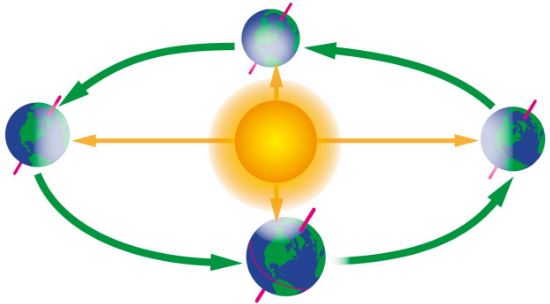
In spring/autumn, the axis of the earth is pointed away or toward the sun?
a)
towards
b)
Neither away or toward
c)
away
100 %

