wayground logo

Free Printable Worksheets

NEW

Font size

S
M
L
XL
Worksheets

Chapter 15 Test Review

Total questions: 46

Worksheet time: 47mins

Name
Class
Date
1.

A pattern of vibration that simulates a wave that is standing still.

a)

A. interference

b)

B. standing wave

c)

C. diffraction

d)

D. reflection

2.
When the crests of one wave overlap the crests of another wave or waves, this occurs.
a)
A. diffraction
b)
B. destructive interference
c)
C. constructive interference
d)
D. resonant frequencies
3.

A section of a longitudinal wave where the particles are crowded together is called a....

a)

A. rarefaction.

b)

B. vibration

c)

C.compression

d)

D. surface wave.

4.
What kind of wave can travel through space?
a)
electromagnetic waves
b)
compressional waves
c)
transverse waves
d)
longitudinal waves
5.
A wave carries...?
a)
energy only
b)
matter only
c)
the matter carries the energy
d)
neither
6.
The units for frequency are measured in _____________.
a)
hertz
b)
seconds
c)
m/s
d)
m
7.
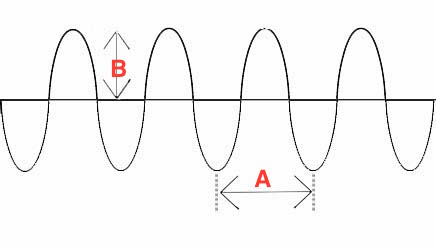
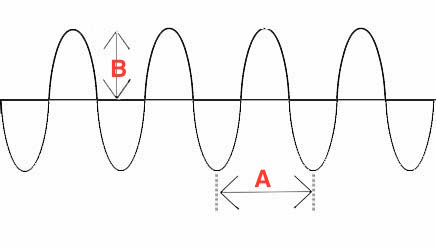
What property of the wave is represented by the letter "B"?
a)
amplitude
b)
crest
c)
trough
d)
wavelength
8.
The highest point on a wave is:
a)
the crest
b)
the trough
c)
the top
d)
the coast 
9.
The lowest point on a wave is the:
a)
Amplitude
b)
Crest
c)
Trough
d)
Wavelength
10.
The number of wavelengths that pass a point each per second is:
a)
frequency
b)
period
c)
longitudinal 
d)
transverse wave 
11.
The type of waves that require medium to pass:
a)
Mechanical Waves
b)
Electromagnetic Waves
12.
When the frequency of a wave increases, what happens to the wavelength?
a)
The wavelength is not directly affected by the frequency of a wave.
b)
The wavelength increases.
c)
The wavelength decreases.
d)
More specific information is needed to form a conclusion about the wavelength.
13.
A mechanical wave cannot travel through...
a)
a vacuum(empty space).
b)
water.
c)
air. 
d)
glass.
14.
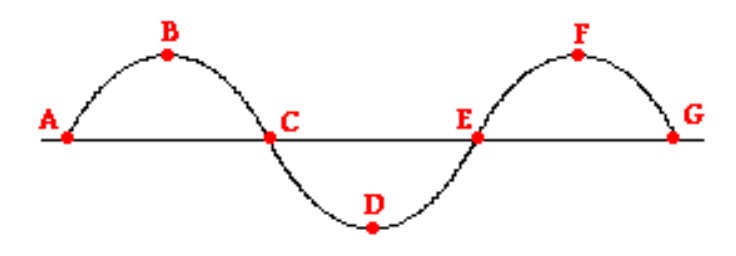
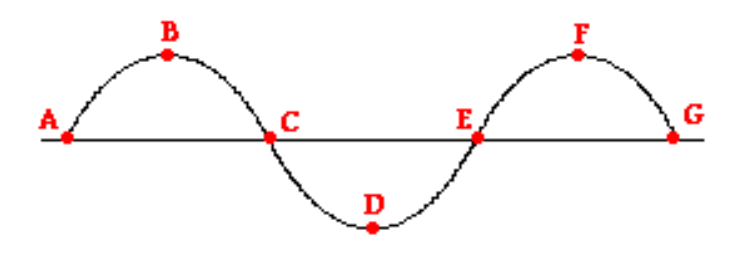
Which letter(s) represent the trough of the wave?
a)
A
b)
B & D
c)
D
d)
C & G
15.
Which letter(s) represent the crest of the wave?
a)
A
b)
B & D
c)
B & F
d)
F
16.
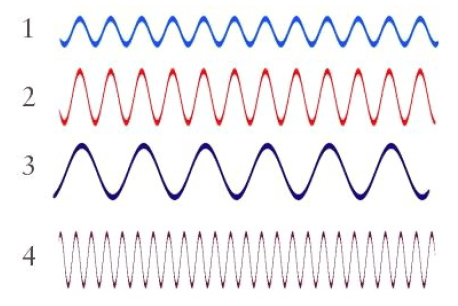
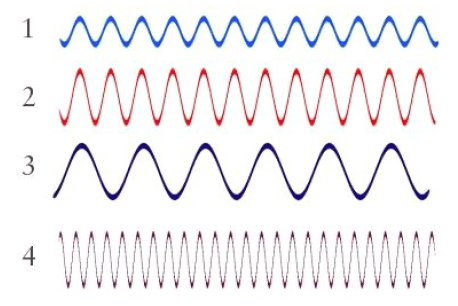
Which wave in the diagram has the greatest frequency?
a)
1
b)
2
c)
3
d)
4
17.

Which wave in the diagram has the longest wavelength?

a)

1

b)

2

c)

3

d)

4

18.
__________ is number of waves in a give time.
a)
Wavelength
b)
Mechanical Waves
c)
Transverse
d)
Frequency
19.
____________occurs when a wave bounces off a surface that it cannot pass through.
a)
Reflection
b)
Refraction
c)
Constructive Interference
d)
Destructive Interference
20.
The fact the two angles are the same is an example of....
a)
Refraction
b)
Angle of Incidence
c)
Law of reflection
d)
Magnification
21.
Which wave behavior do noise cancelling headphones use?
a)
diffraction
b)
refraction
c)
constructive interference
d)
destructive interference
22.
What property of this wave is represented by the letter "A"
a)
amplitude
b)
crest
c)
trough
d)
wavelength
23.
Which material does sound travel the fastest?
a)
solid 
b)
liquid 
c)
gases
24.
When a wave strikes and object and bounces off. (example echo)
a)
medium
b)
refraction
c)
reflection
d)
interference
25.
When a wave bends as it passes through from one medium to another.(example: pencil in a glass of water-)
a)
medium
b)
refraction
c)
reflection
d)
interference
26.
In a transverse wave, particles move...?
a)
back and forth
b)
perpendicular to the origin
c)
side to side
d)
wherever the matter's going
27.
In a longitudinal wave, the particles move...?
a)
back and forth
b)
up and down
c)
vertically
d)
in the direction of the hertz
28.
Which of the following items would work well in space?
a)
A. flashlight
b)
B. megaphone   
c)
C. guitar     
d)
D. drum set       
29.
This image represents what kind of wave behavior?
a)
Diffraction
b)
Reflection
c)
Refraction
d)
Resonance
30.
Light travels fastest in 
a)
empty space
b)
fresh water
c)
solids
d)
salt water
31.

What is diffraction?

a)

Air moving through water.

b)

A beam of light stopping at a wall.

c)

The reflection of light.

d)

The bending of light as it passes around the edge of an object.

32.

Which picture illustrates diffraction?

a)
b)
c)
d)
33.

What happens when light changes the medium it is traveling through.

a)

It changes the type of wave it is.

b)

It disappears.

c)

It changes direction.

d)

No change happens

34.

What type of electromagnetic wave does the human body emit?

a)

microwave

b)

ultraviolet

c)

infrared

d)

radiant

35.

What do we call the electromagnetic waves emitted by the sun?

a)

microwave

b)

radiant energy

c)

ultraviolet

d)

infrared

36.

What type of a electromagnetic wave can lead to sunburns?

a)

infrared

b)

ultraviolet

c)

microwave

d)

radiant

37.

What type of waves do cell phones use?

a)

radiant energy

b)

infrared

c)

radio

d)

microwave

38.
 A wave has frequency of 50 Hz and a wavelength of 10 m. What is the speed of the wave?
a)
500 m/s
b)
50 m/s
c)
5 m/s
d)
0.5 m/s
39.
It is the part of the wave where the particles are spread out.  It is part B in this picture. 
a)
Compression
b)
Rarefaction
c)
Amplitude
d)
Wavelength
40.
It is the part of the wave where the particles are close together.  It is part A on this picture. 
a)
Compression
b)
Amplituide
c)
Rarefaction
d)
Wavelength
41.

What is the formula for wave speed?

a)

wave speed = frequency / wavelength

b)

wave speed = wavelength / frequency

c)

wave speed = frequency x wavelength

d)

frequency = wave speed x wavelength

42.

What type of waves make up water waves?

a)

longitudinal

b)

transverse

c)

longitudinal and transverse

d)

electromagnetic

43.

Which electromagnetic wave is responsible for cell phones?

a)

gamma

b)

xray

c)

microwaves

d)

radio

44.

What type of waves are emitted from humans?

a)

ultraviolet

b)

microwave

c)

infrared

d)

radio

45.

What type of energy comes from the sun?

a)

ultraviolet

b)

radiant

c)

microwave

d)

gamma

46.

What type of waves create sunburns?

a)

microwave

b)

ultraviolet

c)

infrared

d)

radio