
 Worksheets
Properties of Waves
Total questions: 38
Worksheet time: 43mins
Name
Class
Date
1.
Carries energy from one place to another
a)
Waves
b)
Amplitude
c)
Frequency
d)
Crest
2.
Top of the wave
a)
Wavelength
b)
Amplitude
c)
Trough
d)
Crest
3.
Bottom of the wave
a)
Crest
b)
Trough
c)
Frequency
d)
Wavelength
4.
The matter (solid, liquid, or gas) through which waves can travel
a)
Medium
b)
Object
c)
Transverse Wave
d)
Wavelength
5.
A wave that requires a medium through wave which to travel
a)
A. electromagnetic wave
b)
B. longitudinal wave
c)
C. mechanical wave
d)
D. transverse wave
6.
A wave in which the particles of the medium move perpendicularly to the direction the wave is traveling
a)
A. surface wave
b)
B. transverse wave
c)
C. electromagnetic wave
d)
D. longitudinal wave
7.
A wave in which the particles of the medium vibrate parallel to the direction of the wave motion
a)
A. mechanical wave
b)
B. surface wave
c)
C. longitudinal wave
d)
D. wave
8.
A wave can make a leaf bob up and down on the water, but it cannot move the leaf toward the shore. This is because waves only transfer
a)
A. matter.
b)
B. energy.
c)
C. media.
d)
D. crests.
9.

What kind of wave is pictured below?
a)
compressional wave
b)
transverse wave
c)
sound wave
d)
mechanical wave
10.
What is the difference between a longitudinal wave and a transverse wave
a)
Transverse goes side to side
b)
Longitudinal goes up an down
c)
Transverse goes up and down, longitudinal goes side to side
d)
None
11.
How does a sound wave interact with a human ear?
a)
vibrates the ear drum
b)
bounces off the ear canal
c)
rotates the ear drum
d)
vibrates the ear canal
12.
What do we call the part of a compressional wave that is when the waves are squeezed together?
a)
compression
b)
rarefaction
c)
crest
d)
trough
13.
What do we call the part of a compressional wave that is spread a part?
a)
compression
b)
rarefaction
c)
crest
d)
trough
14.

Sound waves are _______________
a)
Transverse waves
b)
Longitudinal waves
c)
Circular waves
d)
Seismic waves
15.
The direction of a transverse waves is ____ to the disturbance/vibration.
a)
equal
b)
less than
c)
at an acute angle
d)
at a right angle
16.

Which of the following is NOT a mechanical wave?
a)
sound
b)
light
c)
ocean
d)
seismic
17.
A compressional wave is another name for a
a)
longitudinal wave
b)
electromagnetic wave
c)
radio wave
d)
hair wave
18.
In a longitudinal wave, the particles move...?
a)
back and forth
b)
up and down
c)
not at all
d)
at a 90 degree angle
19.
_____________________ is the distance between a point on one wave and the identical point of the next wave.
a)
Amplitude
b)
Wavelength
c)
Frequency
d)
Crest
20.

Which vocabulary term is used to identify the distance between points C & G?
a)
Amplitude
b)
Crest
c)
Frequency
d)
Wavelength
21.
All electromagnetic waves have the same...
a)
frequency
b)
speed
c)
wavelength
d)
energy
22.
electromagnetic waves with the longest wavelengths are
a)
gamma rays
b)
x-rays
c)
infrared waves
d)
radio waves
23.
which of the following does NOT belong in the electromagnetic spectrum:
a)
X-ray
b)
sound wave
c)
ultra violet rays
d)
microwaves
24.
Which waves are the type that can give us suntans and sunburns?
a)
Infrared radiation
b)
Ultraviolet radiation
c)
Radio waves
d)
X-rays
25.
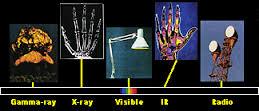
Cancer can be treated with_______________waves.
a)
Penicillin
b)
Radio
c)
Infrared
d)
Gamma
26.

Electromagnetic waves________________travel through space.
a)
Never
b)
Cannot
c)
Can
d)
Wish they could
27.

_____________________light is the only type of EM wave detected by the human eye.
a)
Red
b)
Gamma
c)
Microwave
d)
Visible
28.

The higher the frequency the ______ the energy.
a)
higher
b)
lower
c)
neither, stays the same
29.
Put the visible light colors in order from longest wavelength to shortest wavelength
a)
Violet, Indigo, Blue, Green, Orange, Yellow, Red
b)
Red, Yellow, Green, Orange, Violet, Blue, Indigo
c)
Red, Orange, Yellow, Green, Blue, Indigo, Violet
30.
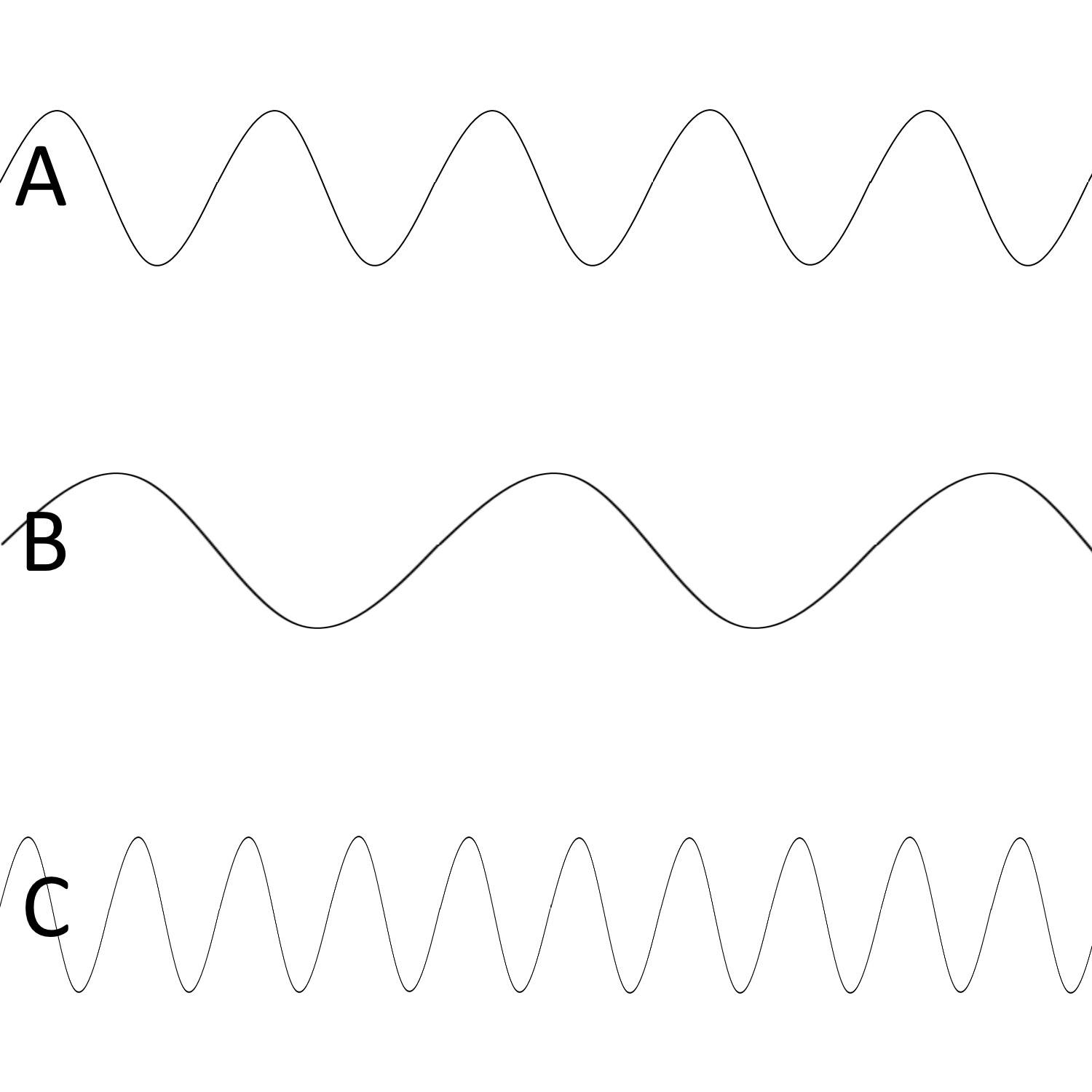
Which wave has the largest wavelength?
a)
A
b)
B
c)
C
d)
None (same wavelength)
31.

Which wave has the largest frequency?
a)
A
b)
B
c)
C
d)
None (same frequency)
32.

The orange line is measuring the _________________________.
a)
wavelength
b)
amplitude
c)
crest
d)
trough
33.
One end of the rope is vibrated to produce a wave with a wavelength of .25 m. The Frequency of the wave is 3.0 Hz. What is the speed of the wave?
a)
3.00 m/s
b)
2.50 m/s
c)
.75 m/s
d)
1.25 m/s
34.
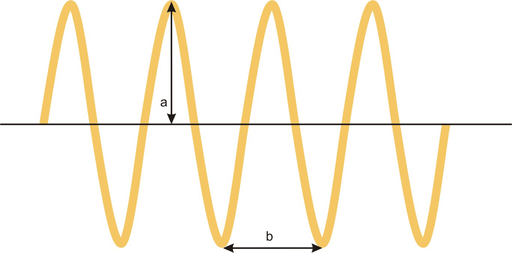
How many waves are in this wave chain?
a)
6
b)
3
c)
4
d)
5
35.
A wave has wavelength of 10 m and a speed of 340 m/s. What is the frequency of the wave?
a)
34 m/s
b)
3400 Hz
c)
3400 m/s
d)
34 Hz
36.
One end of the rope is vibrated to produce a wave with a wavelength of .25 m. The Frequency of the wave is 3.0 Hz. What is the speed of the wave?
a)
3.00 m/s
b)
2.50 m/s
c)
.75 m/s
d)
1.25 m/s
37.

The unit of frequency is ___.
a)
meters
b)
nanometers (nm)
c)
m/s
d)
Hertz
38.
A wave has frequency of 5 Hz and a speed of 25 m/s. What is the wavelength of the wave?
a)
25 m
b)
125 m
c)
5 m
d)
25 m/s
100 %

