
NEW
Font size
S
M
L
XL
 Worksheets
Theory of Evolution & Support
Total questions: 29
Worksheet time: 24mins
Name
Class
Date
1.

When an organism is completely wiped out of existence, we call it?
a)
extinction
b)
adaptation
c)
evolution
d)
inbreeding
2.
The scientific name for an organism is made from the:
a)
class and family name
b)
genus and species name
c)
domain and kingdom name
d)
kingdom and phylum name
3.
Term given to describe the 2 name naming system is:
a)
dichotmous key
b)
binomial nomenclature
c)
2 scientific names
d)
binomial key
4.

Darwin wrote that organisms with traits that are best suited to the environment will ________________
a)
increase in number
b)
become extinct
5.
Which term refers to the process by which individuals that are better suited to the environment survive and reproduce therefore passing down their genes to their offspring?
a)
Evolution
b)
Variation
c)
Adaptation
d)
Natural Selection
6.

Which species’ DNA is most similar to the DNA of the toothed whale?
a)
Hippopotamus
b)
Baleen Whale
c)
Grazing Mammals
d)
Camels
7.
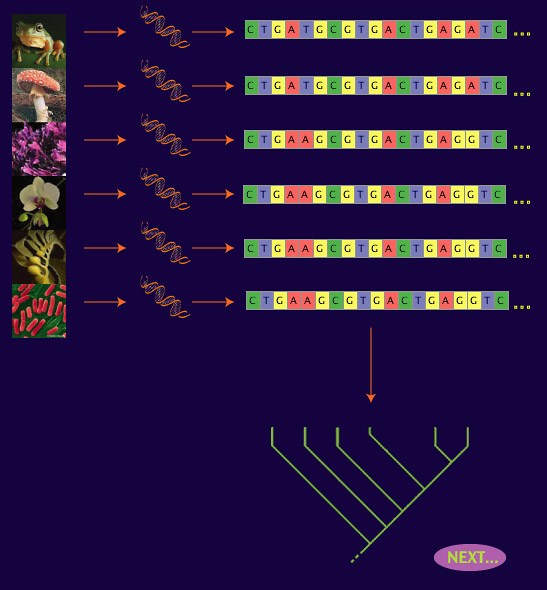
Two organisms that are closely related would have
a)
very similar DNA sequence
b)
exactly the same DNA sequences
c)
no proteins in common
d)
completely different DNA sequence
8.
A remnant or trace of an organism from the past is called a _______.
a)
Ancestor
b)
Skeleton
c)
Fossil
d)
Imprints
9.
Inherited trait that helps an organism survive is a(n) __________.
a)
Fossil
b)
Adaptation
c)
Ancestor
d)
Natural selection
10.

The diagram shows fossils in different rock layers. Which of these statements about the age of these fossils is most likely correct?
a)
Fossil A and C are the same age
b)
Fossil B is older than fossil C
c)
Fossils A is older than fossil B
d)
Fossil D is older than fossil C
11.
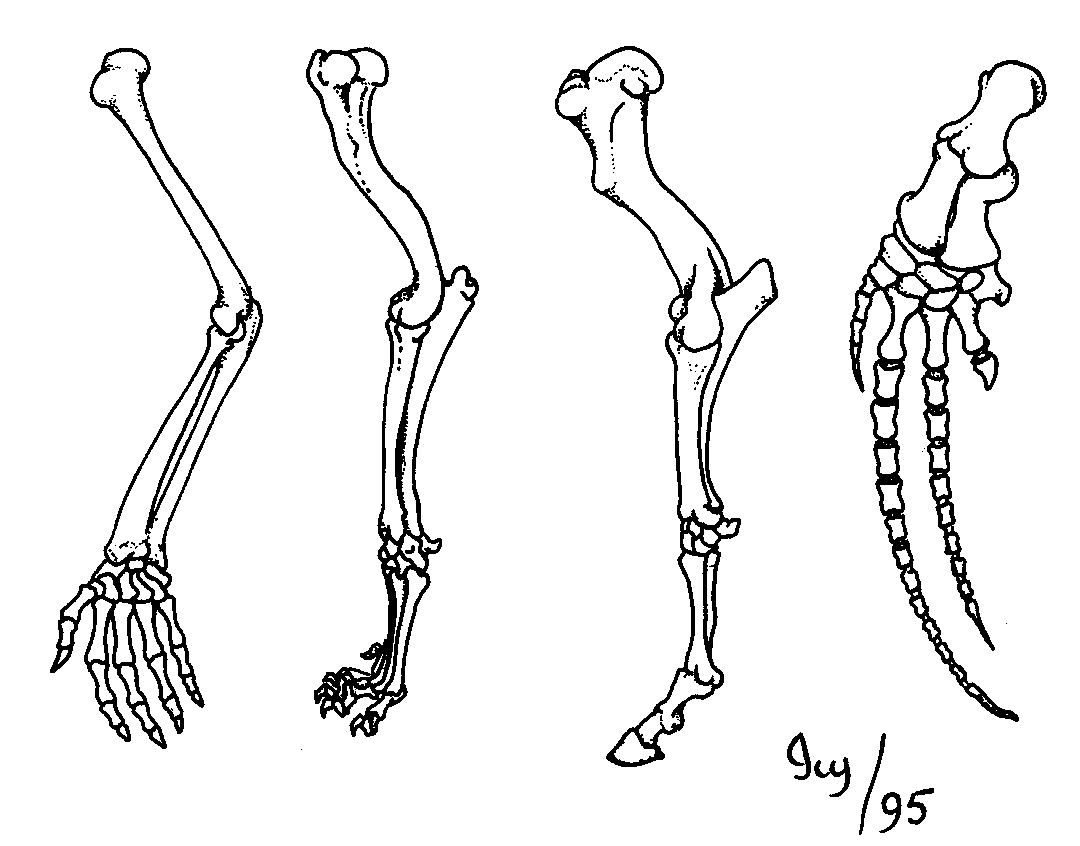
Structures with the same parts have different functions; suggests that organisms share a common ancestry
a)
vestigial structures
b)
homologous structures
c)
adaptive radiation
d)
fossil
12.
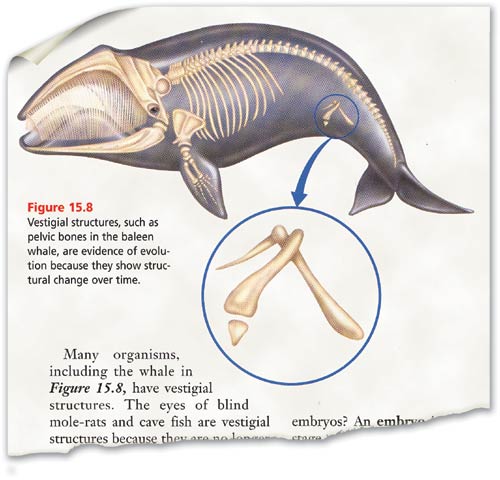
Which of the following is an example of a vestigial structure?
a)
the wings of a red-tailed hawk
b)
the hind limbs of a house cat
c)
the fins of sharks
d)
the tailbone of a human
13.
What is another name for natural selection?
a)
survival of the smartest
b)
survival of the fastest
c)
survival of the biggest
d)
survival of the fittest
14.
What is the study of organisms at the early stages of development?
a)
DNA studies
b)
embryology
c)
extinction
d)
fossil record
15.
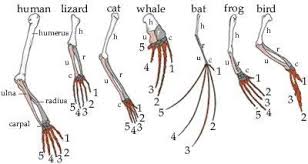
What is this an example of?
a)
vestigial structures
b)
embryology
c)
homologous structures
d)
fossil record
16.

Which layer is the oldest?
a)
1
b)
2
c)
3
d)
4
17.
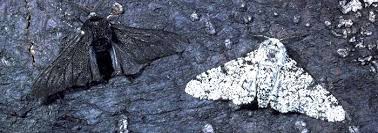
Predict which moth would increase in population
a)
light
b)
dark
18.
Whose theory included "acquired traits" such as a giraffe needing a long neck so they stretch it over time?
a)
Darwin
b)
Lamarck
19.
Which statement best describes the process of evolution?
a)
Populations can survive in different locations on earth
b)
Environmental conditions limit the number of species on Earth
c)
Populations grow when resources are abundant
d)
The traits of a species can change over time
20.
The goal of every species on earth is
a)
to survive and reproduce
b)
divide and conquer
c)
survive and conquer
d)
reproduce and die
21.
During a giraffe’s lifetime, its neck will become longer as it reaches for leaves on taller trees. Which scientist would agree with this idea?
a)
Darwin
b)
Lamarck
22.

In stage one (top row) of these embryos, most of the embryos________
a)
look very similar.
b)
have very different features.
c)
show different stages of development.
d)
have only a tail if they are non-human.
23.
The more similar the stages of embryonic development, the more likely that organisms share ____________
a)
a common ancestor.
b)
embryos.
c)
eggs.
d)
embryology.
24.

Who was the naturalist that traveled the world to study plants and animals?
a)
Albert Einstein
b)
Charles Darwin
c)
Charles Barkley
d)
Isaac Newton
25.

The gradual change in species over time is...
a)
Evolution
b)
Nucleotide
c)
Adaptation
d)
Natural Selection
26.
What is the theory that states life and the universe cannot have arisen by chance and was designed and created by some intelligent entity.
a)
evolutionary theory
b)
intelligent design
c)
natural selection
d)
artificial selection
27.
What is an example of artificial selection?
a)
Letting dogs choose their own mate
b)
Letting plants pollinate on their own
c)
Crossing a labrador and a poodle to create a labradoodle
28.
1. The process of humans choosing parent organisms to breed for desired characteristics is called
a)
natural selection
b)
Artificial selection
c)
random selection
d)
genetic manipulation
29.
1. Artificial selection has been a big factor in the evolution of:
a)
Dogs
b)
Panda bears
c)
Snakes
d)
Jellyfish
Reset

