
NEW
Font size
S
M
L
XL
 Worksheets
SCH 4UI Final Exam Review
Total questions: 36
Worksheet time: 1hrs 10mins
Name
Class
Date
1.
Which relationship is true?
a)
the shorter the bond, the stronger the bond
b)
the shorter the bond, the weaker the bond
c)
the shorter the bond, the fewer electrons it has
d)
the shorter the bond, the lower the bond dissociation energy
2.
How many electrons are shared in a double covalent bond
a)
none
b)
one
c)
two
d)
four
3.
What structure is found in all aromatic compounds?
a)
isomers
b)
methyl group
c)
benzene ring
d)
hydroxyl group
4.

What is the conjugate acid in the following equation?
a)
PO43-
b)
HNO3
c)
NO3-
d)
HPO42-
5.

This chart shows what type of reaction?
a)
exothermic
b)
combustion
c)
endothermic
d)
mesothermic
6.

Give the name of this compound...
C3H8
C3H8
a)
Propene
b)
Butyne
c)
Butene
d)
Propane
7.
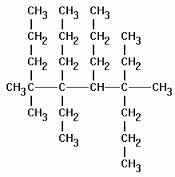
How many carbons are in the longest chain of the following molecule:
a)
11
b)
10
c)
9
d)
8
8.

What type of organic compound is it?
a)
alkane
b)
alkene
c)
alkyne
d)
amino acid
9.
What atom matches this electron configuration?
1s22s22p63s23p64s23d10
1s22s22p63s23p64s23d10
a)
Zinc
b)
Copper
c)
Nickel
d)
Germanium
10.
The electron configuration of an atom is 1s22s22p6. The number of electrons in the atom is
a)
3
b)
6
c)
8
d)
10
11.
What is the electron configuration of Ag?
a)
1s2 2s2 2p6 3s2 3p6 4s2 3d10 4p6 5s1 4d10
b)
[Kr] 5s2 4d9
c)
1s2 2s2 2p6 3s2 3p6 4s2 4p6 5s2 4d9
d)
1s2 2s2 2p6 3s2 3p6 3d10 4s2 4d10 4p6 5d10 5s2 4d9
12.
A ______________ acid can only donate one proton.
a)
Monoprotic
b)
Polyprotic
c)
Diprotic
d)
Triprotic
13.
In the reaction Zn + H2O --> ZnO2 + H2
which element, if any, is oxidized?
which element, if any, is oxidized?
a)
Zinc
b)
Hydrogen
c)
Oxygen
d)
None
14.
What is oxidation number of Cr in Cr2O72-?
a)
-2
b)
+2
c)
+6
d)
+12
15.
For the reaction...
energy + N2(g) + O2(g) <−> 2NO(g)
If O2(g) is removed, the concentration of N2 will _______.
energy + N2(g) + O2(g) <−> 2NO(g)
If O2(g) is removed, the concentration of N2 will _______.
a)
increase
b)
decrease
c)
remain the same
d)
double
16.
What is the proper Keq for the following reaction?
2 NO(g) + O2(g) ⇌ 2 NO2(g)
2 NO(g) + O2(g) ⇌ 2 NO2(g)
a)
Keq = [NO2]2 / [NO]2[O2]
b)
Keq = [NO]2[O2] / [NO2]2
c)
Keq = [NO]2[O2][NO2]2
d)
Keq = 2[NO][O2] / 2[NO2]
17.
What is the reducing agent of this reaction?
3Mg + N2−−−−> Mg3N2
3Mg + N2−−−−> Mg3N2
a)
Mg
b)
N2
c)
Mg3N2
d)
MgN
18.
Which half-reaction correctly represents oxidation reaction?
a)
Mg −−−>Mg2+ + 3e-
b)
Zn −−−>Zn2+ + 2e-
c)
Ag−−−>Ag+ + 2e-
d)
Li −−−>Li+ + 2e-
19.
Thermal energy refers to....
a)
Heat energy
b)
Light energy
c)
Potential Energy
d)
Rotational energy
20.
A molecule of ammonia, NH3, is
a)
polar
b)
nonpolar
c)
ionic
d)
none of these
21.
This theory indicates that valence electrons move into 3-D arrangement in order to put as much distance as possible between them
a)
Electron Theory
b)
VSEPR Theory
c)
Dalton's Atomic Theory
d)
Resonance Theory
22.
The shape of a molecule that has 3 single covalent bonds and one lone pair on the central atom is
a)
tetrahedral
b)
trigonal planar
c)
trigonal pyramidal
d)
linear
23.

Which element has the largest atomic radius?
a)
H
b)
Cl
c)
K
d)
Br
24.

What polymer does this shorthand formula represent?
a)
PVC
b)
Polypropene
c)
DNA
d)
Polyethene
25.
Molecules that have planar configurations include which of the following?
1. BI3 2. C2H4 3. NF3
a)
3 only
b)
1 only
c)
1 and 2 only
d)
1, 2, and 3
26.
"Electrons occupy orbitals of lowest energy first" is part of which electron configuration rule?
a)
Hund’s Rule
b)
Aufbau Principle
c)
Pauli Exclusion Principle
d)
Miller's Rule
27.
Which one is not an organic compound
a)
plastic bottles
b)
noodles
c)
water
d)
wooden tables
28.
The amount of energy that will raise the temperature of 1 g of a
substance 1°C is
a)
a joule
b)
its specific heat capacity
c)
the same for every element
d)
the same for certain metals and water
29.
“In any chemical or physical process, energy is neither created nor destroyed” is a statement of the
a)
law of conservation of energy
b)
law of conservation of mass
c)
law of physical and chemical change
d)
system
30.

On which portion(s) of the graph is only a liquid present?
a)
A
b)
B
c)
C
d)
D
31.
An increase in temperature results in which of the following
a)
Slow collision frequency
b)
Allow less effective collision between the particles
c)
Cause particles to lose speed
d)
Increase collision between the particles thus increasing the rate.
32.
When Keq > 1,
a)
There are more products than reactants when the reaction reached equilibrium.
b)
There are more reactant than products when the reaction reached equilibrium.
c)
The amount of reactants is equal to the amount of products.
d)
Not enough information to relate the amounts of reactants and products at equilibrim
33.
Define chemical equilibrium.
a)
A reaction is reversible.
b)
The concentration of the reactants is equal to the concentration of the products.
c)
The rate of a forward reaction is equal to the rate of the reverse reaction.
d)
The reaction stops and no further change in concentration occurs.
34.
A solution has a [OH-] of 3.42 x 10⁻¹² mol/L what is the [H+]?
a)
2.92 x 10⁻³ mol/L
b)
3.42 x 10² mol/L
c)
2.92 x 10⁻² mol/L
d)
3.42 x 10⁻⁵ mol/L
35.
What is the conjugate base of HCO3-?
a)
HCO3-
b)
H2CO3-
c)
H2CO3
d)
CO32-
36.
What compound is the Reducing Agent?
I2 + H2SO3 + H2O --> I- + HSO4- + H+
a)
I2
b)
H2SO3
c)
H2O
d)
H
Reset

